
Short answer: a USB wall charger that passes a drop test and an output-voltage test on a 5-piece sample can fail the same tests on a 500-piece bulk run. The cause is rarely the factory lying; it is PCB revision drift, capacitor downshift, or housing material change between sample and bulk. Here is how to lock the verification flow before deposit.
Why sample and bulk chargers diverge
Three components drive the divergence. The first is the PCB revision: the flyback controller IC (e.g., Power Integrations, ON Semiconductor, or a Chinese second-source equivalent) determines the no-load power, the output ripple, and the surge tolerance. A factory that sources a cheaper controller IC for the bulk run will see the no-load power rise, the output ripple rise, and the surge tolerance fall. The second component is the bulk capacitor: the brand and value determine the output ripple at peak load. A factory that downshifts from a Rubycon or Nippon Chemi-Con to a no-name Chinese capacitor at the same uF and voltage rating will see the output ripple rise 2 to 3x. The third component is the housing material: a thinner ABS or a recycled ABS will fail a 1 m drop test at a higher rate than the original spec.
The China-side explanation is straightforward. Component spot pricing moves monthly; a factory that quotes aggressively in a slow month will quietly substitute a lower-cost component for the bulk run. The factory is not lying; they are using the same model number, the same housing, the same PCB layout. They are using a different capacitor brand or a different controller IC revision. The buyer’s spec did not name the components, so the substitution is technically compliant.
What to lock on the PO
- PCB revision: the exact flyback controller IC part number, locked in writing.
- Bulk capacitor: brand (e.g., Rubycon, Nippon Chemi-Con, or equivalent) and uF/V rating.
- Housing material: ABS grade (virgin or recycled), wall thickness in mm.
- Output spec: 5V/2.4A or 20V/3A (USB-PD), with output ripple max 50 mV pk-pk.
- Drop test: 1 m onto concrete, 6 sides, no functional failure per ASTM D5276.
- Certification: UL 60950-1 or UL 62368-1 listed, FCC Part 15B verified.
Buyer must verify before deposit
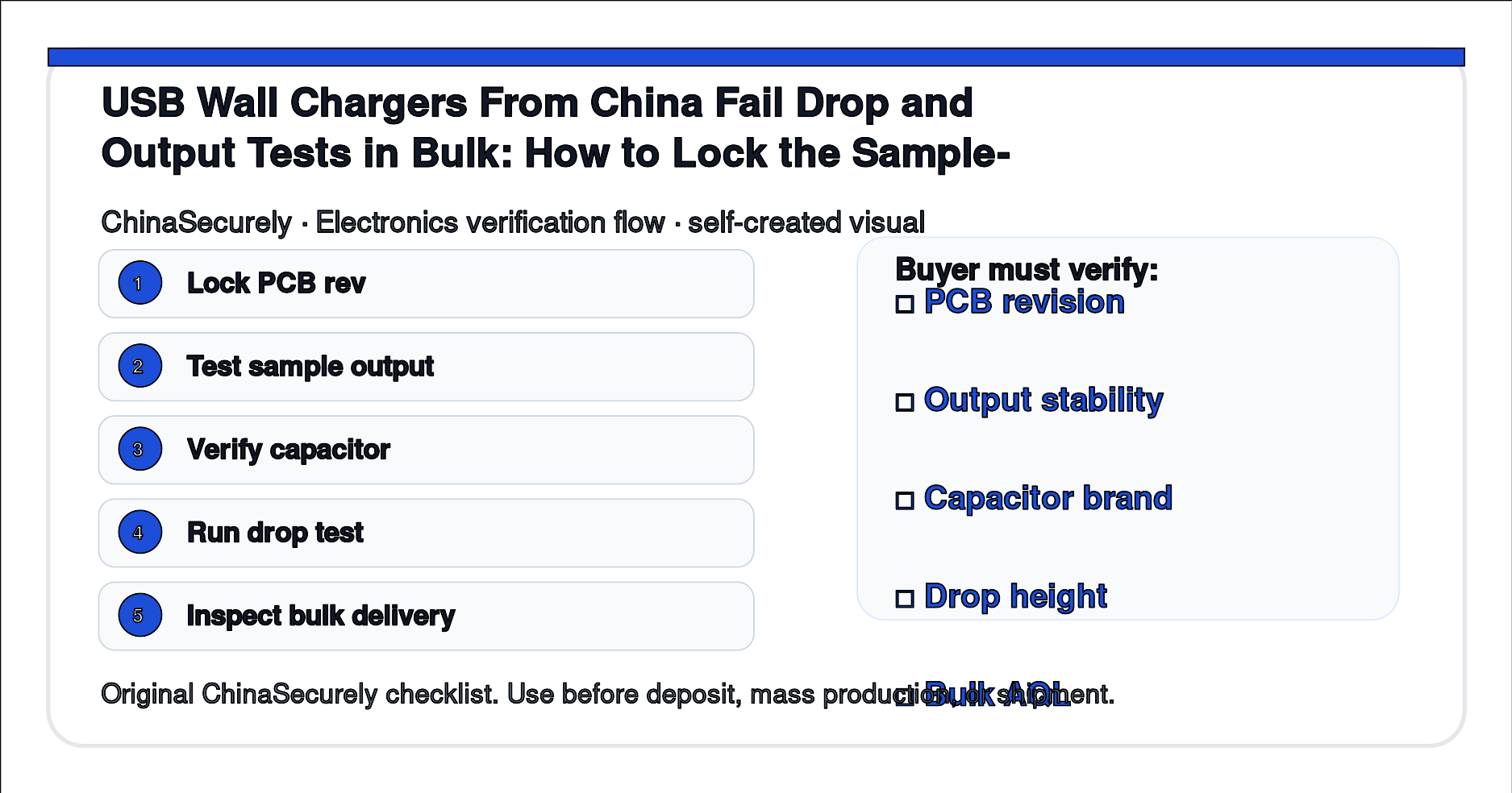
- Ask the supplier for the PCB revision and the controller IC part number.
- Ask the supplier for the bulk capacitor brand and uF/V rating.
- Ask the supplier for the housing material grade and wall thickness.
- Request a 5-piece pre-production sample from the real production line.
- Run an output-ripple test on the 5 samples with an oscilloscope at peak load.
- Run a 6-side drop test on 3 of the 5 samples per ASTM D5276.
China-side explanation
Charger factories in Shenzhen and Dongguan operate on a tight cost-down schedule: every quarter, the purchasing team negotiates a lower price on the same component. A factory that sources the same controller IC, the same capacitor brand, and the same housing material for 12 months in a row is rare; most factories cycle through 2 to 4 component revisions per year. A buyer who inspects the sample in Q1 and approves the bulk in Q2 will see a different component set. The cheapest insurance is to require the supplier to disclose the PCB revision, the capacitor brand, and the housing material grade on the PO, and to add a sample retention clause so the bulk run can be checked against the original sample. The second cheapest insurance is to commission a third-party lab test on a 5-piece pre-production sample, including output ripple and drop test, before approving bulk production.
Step-by-step solution
- Send the supplier a written spec: PCB revision, capacitor brand, housing material grade, output spec, drop test, and certification.
- Order a 5-piece pre-production sample from the real production line, not the showroom sample.
- Test the sample output ripple at peak load with an oscilloscope.
- Run a 6-side drop test on 3 of the 5 samples per ASTM D5276.
- Verify the UL or FCC certification is current and matches the model number.
- Add a sample retention clause and a component-disclosure clause to the PO.
Quick checklist
- PCB revision locked: controller IC part number in writing.
- Bulk capacitor locked: brand and uF/V rating.
- Housing material locked: ABS grade and wall thickness in mm.
- Output spec locked: 5V/2.4A or 20V/3A, ripple max 50 mV.
- Drop test passed: 1 m, 6 sides, no functional failure.
- Certification current: UL 60950-1 or UL 62368-1, FCC Part 15B.
Sources
- IEC 60950-1 — Information technology equipment safety (superseded by IEC 62368-1)
- IEC 62368-1 — Audio/video, information and communication technology equipment safety
- UL 60950-1 — Standard for information technology equipment safety
- ASTM D5276 — Standard test method for drop test of loaded containers by free fall
- ASTM D4169 — Standard practice for performance testing of shipping containers and systems
- QIMA — Pre-shipment inspection for chargers and small electronics
This article is for sourcing verification, not for electrical safety certification. Confirm your final charger certification path with a qualified certification body (UL, TUV, or equivalent) before listing in the US market.