
Short answer
If paper bags from China tear near the handle, do not treat it as only a “bad glue” problem. For small importers, the safer fix is to specify the load, paper GSM, handle structure, reinforcement patch, test method, and carton packing before you approve the next sample.
A sample bag can survive a quick hand pull in an office but fail in real use when the bag carries a heavy jar, a candle set, cosmetics, or several folded garments. The weak point is often where the handle, glue, paper fiber direction, and reinforcement patch meet.
Buyer question: “My kraft paper bags looked fine in the sample, but some tore near the rope handle after customers put products inside. What should I ask the Chinese supplier before reordering?”
Why this problem happens
Paper bag strength is a system, not one material. The same outside size can be made with different paper weight, recycled fiber content, handle type, glue area, and reinforcement method. When a buyer only says “kraft paper bag with rope handle,” the supplier may quote the cheapest workable version.
Common causes include:
- paper GSM too low for the product weight;
- handle holes punched too close to the top edge;
- no reinforcement patch or a patch that is too small;
- glue not fully cured before packing;
- bags packed tightly and bent in the export carton;
- humidity during storage or transport weakening recycled kraft paper.
Shipping also matters. Carrier packing guidance generally stresses that packages should protect contents from normal handling, compression, and movement during transit. That same idea applies inside your retail packaging order: if finished bags are compressed, bent, or shipped in weak cartons, the handles can be stressed before your customer ever uses them.
China-side explanation
Many Chinese packaging suppliers build paper bags from a menu of materials and processes. The salesperson may show a nice photo, but the factory floor still needs a production specification: paper weight, lamination or no lamination, handle material, glue, reinforcement board, hole position, and packing method.
For small runs, the factory may not automatically run a formal load test unless you ask for it. A supplier may also change paper stock between sample and mass production if the quotation does not lock the paper GSM and finish. This is why the approval sample, quotation, and production file must describe the same bag.
Step-by-step solution
- Write down the real loaded weight. Include the product, inserts, tissue paper, and any free gift.
- Ask for the paper GSM and whether the paper is virgin, recycled, coated, laminated, or uncoated.
- Specify the handle type: twisted paper, cotton rope, ribbon, die-cut handle, or flat paper handle.
- Require a reinforcement patch around the handle area for heavier products.
- Ask the supplier to make a loaded sample test using your expected product weight.
- Confirm the handle hole distance from the top edge and side edge.
- Approve the sample only after a practical carry test, not just a photo.
- Add the final specification to the purchase order and carton mark instructions.
- Ask for pre-shipment photos showing packed bags, carton condition, and sample load testing.
What to ask the supplier
Copy and adapt this message:
Please confirm the paper bag specification for mass production: paper GSM, paper type, handle material, handle hole position, reinforcement patch size, glue method, and expected carrying weight. Please test one finished bag with our target loaded weight for at least 30 minutes and send photos or a short video. Please also confirm how many bags will be packed per export carton and whether the handles will be protected from bending.
A serious supplier should be able to answer most of this. If they only reply “quality is good,” slow down and ask again in a more specific way.
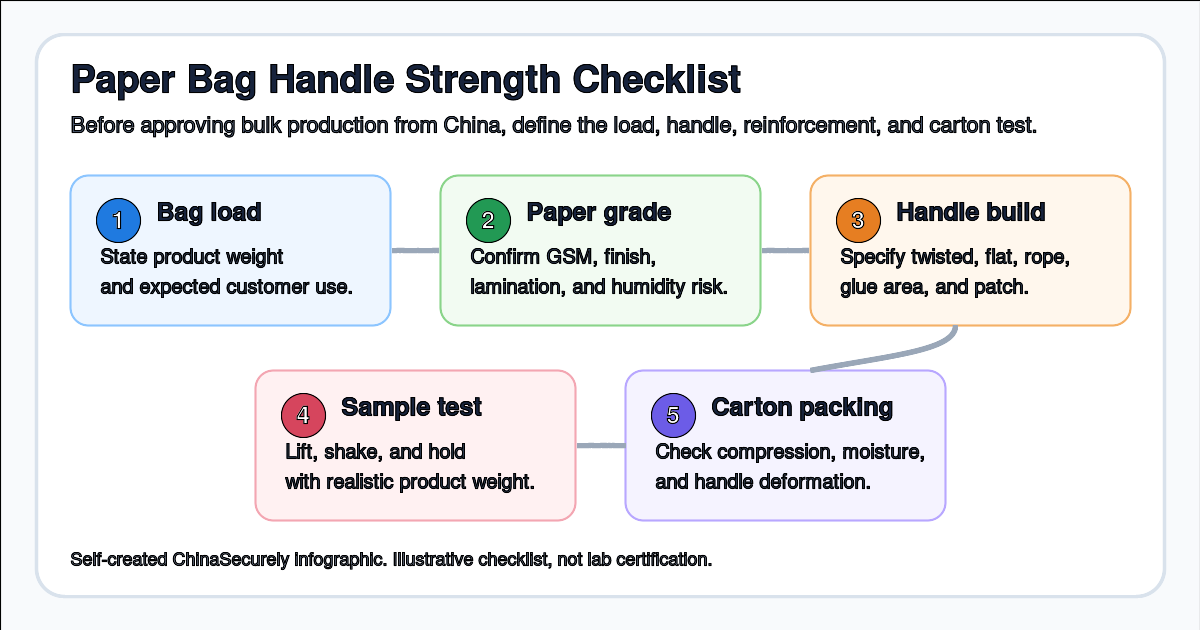
Handle-strength checklist for buyers
| Check point | What to ask | Why it matters |
|---|---|---|
| Loaded weight | Product weight plus inserts | Prevents under-spec paper bags |
| Paper GSM | Exact GSM and paper type | Locks the material used in production |
| Handle area | Patch size and hole distance | Reduces tearing at the stress point |
| Test method | Loaded carry or hang test | Shows practical strength, not just appearance |
| Carton packing | Bags per carton and handle protection | Prevents damage before use |
Cost and trade-off notes
A stronger bag may cost more because of heavier paper, reinforcement patches, better handles, or stronger export cartons. For a low-value giveaway bag, a basic structure may be acceptable. For candles, glass jars, cosmetics sets, or retail products where the bag is part of the customer experience, weak handles can cost more than the savings.
Do not ask the supplier to “make it cheaper” and “make it stronger” without naming which part can change. Ask for two options: a budget version and a stronger version, with the exact specification difference.
Sources and source status
- FedEx packing guidance: https://www.fedex.com/en-us/shipping/packing.html
- UPS packaging support page was checked as a general shipping-packing reference; access may be blocked from this server, so it should be treated as a secondary reference until manually reviewed: https://www.ups.com/us/en/support/shipping-support/packaging-tips.page
Related questions
Is a higher GSM always enough?
No. Higher GSM helps, but the handle structure and reinforcement area can still fail if the holes are too close to the edge or the patch is weak.
Should I request a video test?
For custom bags carrying heavy products, yes. A short, simple loaded test is more useful than a polished factory photo.
Can I use one sample to approve mass production?
Use the sample to approve structure, then make sure the purchase order locks the same materials and test requirements.
Before you approve the reorder
If your packaging supplier’s quote only says “kraft paper bag,” ask for a real specification before paying the deposit. The weak point is usually hidden in the details.
One small editorial rule I would use here: if the bag carries something breakable, oily, or gift-like, test the handle with the actual product weight and a little extra margin. If it only carries a lightweight promo card, do not overbuild it just to feel safer. Match the bag to the job.