Short answer
A Chinese supplier Proforma Invoice (PI) is not just a price list. It is a short legal contract that locks product spec, payment terms, delivery terms, and Incoterms risk. A small importer who reads the PI for the unit price alone usually misses the clauses that decide whether a dispute is winnable. The most common hidden costs show up in the payment block, the shipping mark block, and the certification block.
What a PI is supposed to do
A PI sits between the sales chat and the production order. It is the document the factory uses to open an internal work order. For the buyer, it is the last clean moment to fix product spec, payment schedule, and shipping terms before money moves. If a clause is wrong on the PI, fixing it later requires a written change order that many factories will not sign.
Three PI blocks small importers read too quickly
1. The payment block
The payment block usually looks like a single line: “30% T/T deposit, 70% before shipment.” This line hides several decisions.
- Deposit trigger. Does the 30% trigger on PI signing or on the factory confirming the order? Most factories trigger on PI signing. A safer pattern is to split the trigger: 10% on PI signing, 20% on sample approval or material purchase confirmation.
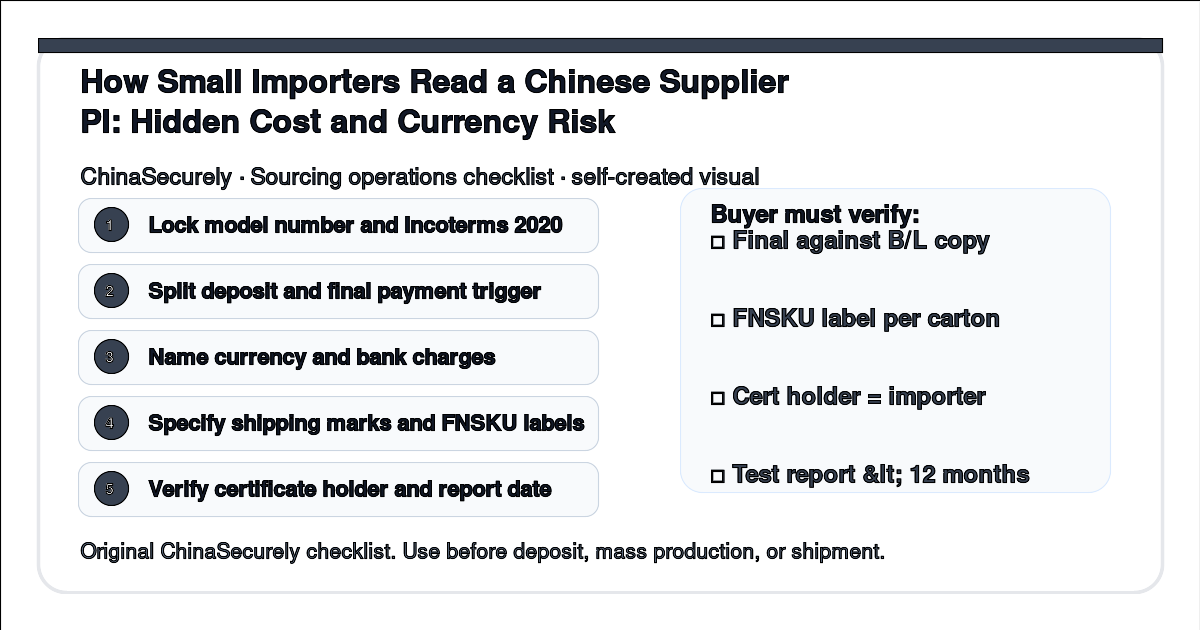
- Final payment trigger. “Before shipment” can mean before goods leave the factory floor, before goods are loaded onto a truck, or before the B/L is released. The safest trigger is “against B/L copy after pre-shipment inspection passed.”
- Payment currency. Most Chinese factory PIs price in USD. A few price in EUR or RMB. Currency swings between PI signing and final payment can move your landed cost by 3 to 5%.
- Bank charges. T/T payments usually split charges “shared” or “OUR.” “Shared” means the buyer pays the local bank fee and the supplier pays the Chinese bank fee. If the clause says “OUR,” the buyer pays both sides, which adds roughly USD 25 to 40 per wire.
2. The shipping mark block
The shipping mark block looks like a code: “Side mark: CS-2026-001, Main mark: as buyer.” It hides several decisions.
- Carton mark ownership. If the main mark is “as buyer,” the buyer has to provide artwork. If it is “as supplier,” the factory uses its own standard. A neutral supplier mark is a common Amazon FBA rejection cause.
- Side mark content. Side marks usually carry the PO number, the SKU, and the carton count (for example, “23/40” for carton 23 of 40). Missing or wrong side marks slow down inbound receiving at Amazon FBA and at 3PL warehouses.
- FBA label requirements. If the goods ship to Amazon FBA, the carton label block must specify the FNSKU label format. “Amazon FBA label” is not enough — the PI should name the FNSKU file and the carton count per label.
3. The certification block
The certification block usually looks like a list of letters: “CE, FCC, RoHS.” It hides several decisions.
- Certificate holder. CE and FCC certificates are issued to a specific company. If the certificate holder is the factory and not the importer, the certificate is useless in some markets and creates customs delays.
- Test report age. Many factories reuse test reports for several production years. The PI should require a test report dated within 12 months of the production batch.
- Test report scope. A CE certificate for a charger and a CE certificate for a USB cable are not interchangeable. The PI should list the model number on the certificate and on the PI must match.
- Restricted substance list. RoHS, REACH, and Prop 65 each have their own scope. The PI should name which restricted substance list applies to which component.
What actually goes wrong on a first order
- The unit price was correct, but the deposit trigger was PI signing, so the factory has 30% cash before the buyer sees a sample or a pre-production photo.
- The final payment trigger was “before shipment,” so the buyer wired 70% before the pre-shipment inspection. When the inspection found defects, the factory had no leverage to fix them.
- The shipping mark block did not name the FNSKU file, so the factory printed its own mark. Amazon FBA rejected the inbound at the warehouse and the buyer paid return shipping and re-labeling.
- The CE certificate holder was the factory, so the importer could not use the certificate as the technical file owner in the EU.
- The RoHS test report was dated 2023 for a 2026 production batch, so customs in California held the shipment for a Prop 65 review.
PI red flags that should slow the deposit
- PI does not name the product model number or refers to it only as “as discussed.”
- Payment currency is not named.
- Bank charges clause is missing or says “OUR.”
- Final payment trigger is “before shipment” instead of “against B/L copy after inspection.”
- Shipping mark block says “as supplier” for an Amazon FBA shipment.
- Carton count and labels per carton are not specified.
- Certificate holder is the factory instead of the importer.
- Test report date is missing or older than 12 months.
- Delivery terms are “FOB” but the buyer has no freight forwarder named.
- Incoterms version is not named (Incoterms 2010 vs 2020 changes who pays terminal fees).
What to ask the supplier before signing the PI
“Please send the PI in PDF with the following items clearly named: product model number matching our approved sample, payment currency, bank charges clause, deposit trigger date, final payment trigger against B/L copy after inspection, shipping marks and side marks, carton labels per carton with FNSKU, certificate holder name, and Incoterms 2020 version. Please also confirm that any CE, FCC, RoHS, or REACH certificates attached have been issued to our company as the certificate holder and are dated within the last 12 months.”
If the supplier refuses to add the certificate holder change or to switch the final payment trigger to “against B/L copy after inspection,” treat the refusal as a signal. It usually means the supplier plans to keep the certificate portable across other buyers and to keep payment leverage on their side.
Buyer checklist before wiring the deposit
- PI names product model number, payment currency, and Incoterms 2020 version.
- Deposit trigger is split between PI signing and sample approval, not a single 30% on signing.
- Final payment trigger is “against B/L copy after inspection,” not “before shipment.”
- Shipping mark block names main mark, side mark, and carton count format.
- Amazon FBA carton labels are specified by FNSKU file and carton count per label.
- Certificate holder is the importer, not the factory, for every attached certificate.
- Test report dates are within 12 months of the production batch.
- Bank charges clause is “shared,” not “OUR.”
- Delivery terms are consistent with the buyer’s freight forwarder arrangement.
- PI is saved as PDF with a file name and date for later reference.
Authoritative references
- ICC — Incoterms 2020 official rules and summary
- FCC Equipment Authorization — search FCC ID and certificate holder
- EU CE marking — NANDO database of notified bodies
- EU REACH Regulation (EC) No 1907/2006 — restricted substances and SVHC
- Amazon FBA — carton label and inbound requirements
- QIMA — pre-shipment inspection process for small importers
A PI is a short contract, not just a price list. The hidden decisions live in the payment block, the shipping mark block, and the certification block. ICC Incoterms, FCC, EU CE and REACH, and Amazon FBA inbound rules are the public technical references for this category. Confirm current payment terms, certificate holder rules, and inbound requirements with the relevant authority and your freight forwarder before wiring any deposit.