
Short answer
A glass pitcher that looks thick and heavy on the sample can crack when hot water is poured in, because the factory quietly shifted from a borosilicate formulation to a soda-lime formulation between sample and bulk. The pitcher that survived the kitchen is not the same glass as the one that broke.
The buyer complaint we keep seeing
A US small importer orders 1,200 glass pitchers for a kitchenware brand. The PI says “clear glass pitcher, 1.5L, heat resistant.” The sample pitcher survives a pour of freshly boiled water, then sits on a wooden trivet without cracking. Two bulk lots later, buyers report the pitcher cracks along the base when they pour hot tea. Some crack on first use. The supplier replies “heat resistant, thick glass,” and sends a generic spec sheet. The glass really does look thick. The formulation is not.
Why “heat resistant” on a sample is not enough
Glass for kitchenware falls into two very different chemistry families:
- Borosilicate glass contains boron trioxide (B2O3) and has a low coefficient of thermal expansion (roughly 3.3 x 10⁻⁶/K). It tolerates a sudden temperature change of about 160°C and is the chemistry used for lab glassware and most premium kettles and French presses.
- Soda-lime glass is the common bottle and window glass. Its coefficient of thermal expansion is roughly three times higher (about 9 x 10⁻⁶/K) and it can crack when hit with a sudden temperature change of 40°C to 50°C.
To survive a typical kitchen use — pouring 95°C water into a room-temperature pitcher — the glass needs to be one of:
- Borosilicate chemistry (best), with a documented B2O3 content.
- Tempered soda-lime (acceptable for some mugs and carafes) with a documented tempering process.
- Thick annealed soda-lime (only acceptable when the product is clearly labeled “not for boiling water”).
The label “heat resistant” tells you the supplier claims heat resistance. It does not tell you whether the formulation is borosilicate, tempered soda-lime, or annealed soda-lime.
China-side explanation
Glass factories in Zibo (Shandong), Cangzhou (Hebei), and Danyang (Jiangsu) typically run two or three chemistry tiers for the same pitcher shape:
- Entry tier: annealed soda-lime, no tempering. Sold as “heat resistant” in marketing copy. Fails a 95°C pour on first use roughly 1% to 5% of the time.
- Middle tier: tempered soda-lime, air-quench tempering line. Sold as “high temperature resistant.” Tolerates a 95°C pour but will fail a 120°C shock.
- High tier: borosilicate glass from a dedicated line (such as the established borosilicate lines in Zibo and Cangzhou). Sold as “borosilicate” or “heat shock resistant” with a B2O3 percentage in the spec.
If the PO does not name the glass chemistry (borosilicate vs soda-lime), the tempering process, and the thermal-shock test method, the factory will quote the middle tier under a high-tier label. The pitcher that cracks is usually the entry tier under a middle-tier quote.
What actually verifies a heat-resistant pitcher
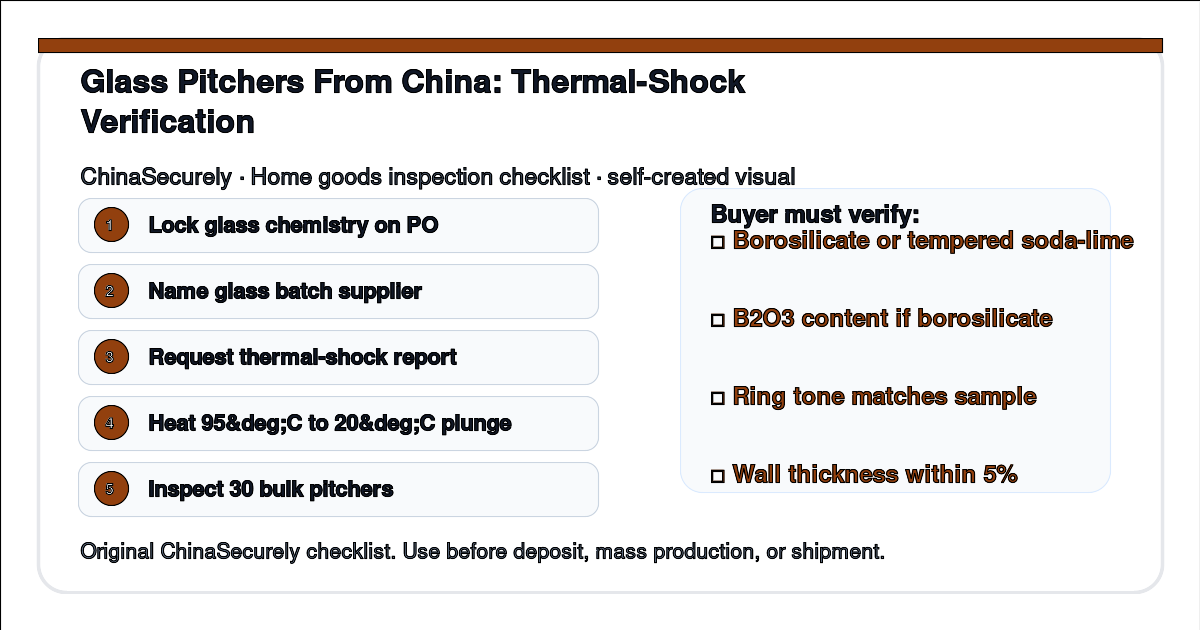
- Lock the glass chemistry on the PI: “borosilicate glass, B2O3 content not less than 12%” or “tempered soda-lime, air-quench tempering line.”
- Ask for a thermal-shock test report. The pitcher is heated to 95°C or 120°C, then plunged into 20°C water. Borosilicate tolerates 160°C shock. Soda-lime typically fails above 50°C.
- Ask for the glass batch supplier name. Borosilicate suppliers in Zibo and Cangzhou can be named; commodity soda-lime suppliers usually cannot.
- Run your own thermal-shock test on 30 bulk pitchers. Heat to 95°C, plunge to 20°C water. Cracking means the chemistry does not match the claim.
- Compare weight and ring tone. Borosilicate has a higher ring tone and a slightly lower density than soda-lime. A significantly duller ring on a bulk pitcher suggests the chemistry shifted.
- For tempered soda-lime, ask for the tempering line documentation. Tempered glass shows a characteristic stress pattern under polarized light.
Sample-to-bulk risk matrix
| Risk | Sample impact | Bulk impact | Buyer check |
|---|---|---|---|
| Soda-lime instead of borosilicate | Low, sample is room-temp filled | High, cracks on first hot pour | Thermal-shock test on 30 bulk units |
| Tempering skipped | Low, pre-production line runs tempering | High, untempered soda-lime cracks | Polarized light inspection on cut section |
| B2O3 content reduced | Low at 95°C | Medium, marginal thermal margin | Lab assay on one bulk pitcher |
| Wall thickness reduced | Low | Medium, lower mechanical strength | Weigh and measure wall thickness |
| Annealing skipped | Low in short term | Medium, latent stress cracks weeks later | Storage at 50°C for 7 days, then thermal test |
What to ask the supplier before the deposit
"Please confirm on the PI: the glass chemistry (borosilicate with B2O3 content, or tempered soda-lime), the glass batch supplier name, the thermal-shock test method and result, and the wall thickness in millimetres. Please share a third-party lab thermal-shock report on a finished pitcher."
If the sales rep answers “high temperature resistant” without naming the chemistry, the batch supplier, or the thermal-shock test, treat the claim as unverified. That answer usually means annealed soda-lime under a heat-resistant label.
Buyer checklist before releasing the balance payment
- Glass chemistry on the PI matches the sample — borosilicate or tempered soda-lime.
- Glass batch supplier name on file.
- Thermal-shock test on 30 bulk pitchers from the lot: zero cracks at 95°C to 20°C.
- Wall thickness on bulk units within 5% of the sample.
- Ring tone of bulk pitchers matches the sample (slight variance OK, dull tone flags a chemistry shift).
- For food contact: confirm LFGB or FDA food-contact compliance per destination market.
Authoritative references
- ISO 3585 — Borosilicate glass 3.3 — Properties
- ASTM E438 — Specification for Glasses in Laboratory Apparatus
- FDA — Food Contact Substances (FCS) inventory
- BfR — LFGB food-contact recommendations
- QIMA — pre-shipment inspection for home goods
Related reads from ChinaSecurely
- Why Glass Food Containers Arrived Broken: Shipping, Packaging, and What to Claim
- Ceramic Mugs from China Arrive Chipped: Defect Limits, Packing Checks, and Claim Evidence
Glass pitcher performance depends on the specific chemistry, the tempering or annealing process, and the destination market food-contact rules. ISO 3585 and ASTM E438 are the standards references for borosilicate glass. Confirm current food-contact requirements with your destination market regulator before shipping.