
A cracked fold on a tuck-end carton is the kind of failure that does not show up in the pre-shipment photo set. It shows up when a buyer opens a 24-pack on Instagram Live, or when a retailer-unboxing audit team cuts one open and finds flakes at the score. Most crease failures are not design failures. They are score-depth failures on the wrong caliper of folding board, made worse by dust in the scored channel. For small importers, the fix is on the PO, not in the artwork.
Short answer
A tuck-end carton that cracks on fold almost always has a score depth set for a different board caliper. Specify the caliper in points or mm, the folding-board grade (FBB, SBS, CCNB), the score depth rule (often two-thirds of caliper), and the relief thickness. Ask the factory to run a 10-panel fold test on the actual production run sample and to share the die-reset photo on the first 200 sheets.
Why this happens in real runs
A buyer in Toronto importing herbal-tea cartons from Anhui ran into this exact failure. The factory quoted “350 gsm white cardboard” and sent a sample that folded cleanly. The bulk production cracked at the tuck on every fourth carton. Inspection of the production board showed the bulk run was on a slightly thinner 320 gsm FBB at the same caliper; the score die had been set for the sample spec, not the bulk spec. The factory had assumed the spec was “the same.” Score depth was a few hundredths of a millimeter too deep for the production board, which is enough to crack the surface.
Why Chinese factories often get this wrong
Folding-carton factories in Wenzhou, Shenzhen, and the Pearl River Delta run multiple calipers on the same die. A die cutter is set up by hand, scored by hand, and the operator usually writes the last-set depth onto the die itself. When the operator reads “350 gsm” on the PO, they assume a specific caliper based on the supplier’s recent experience with that grade. A second source of variation is the creasing matrix: metal or phenolic channels that support the board during the score. A worn matrix changes the effective depth even if the die setting is unchanged. The third variable is the side of the printed sheet that faces up when scored — the wrong side can lead to a hairline crack on the print face.
Step-by-step: how to lock the spec
- Request the caliper in millimeters or points (for example, 0.6 mm FBB or 18 pt SBS) and the brightness / grade on the PO, not just “350 gsm cardboard.”
- Specify the score-depth rule, for example, 0.6 mm FBB scored at 0.4 mm depth with a 0.3 mm relief. Different factories use different conventions; ask which rule they apply.
- Request a creasing matrix check. A worn matrix is a common silent failure; ask for a recent matrix-reset log.
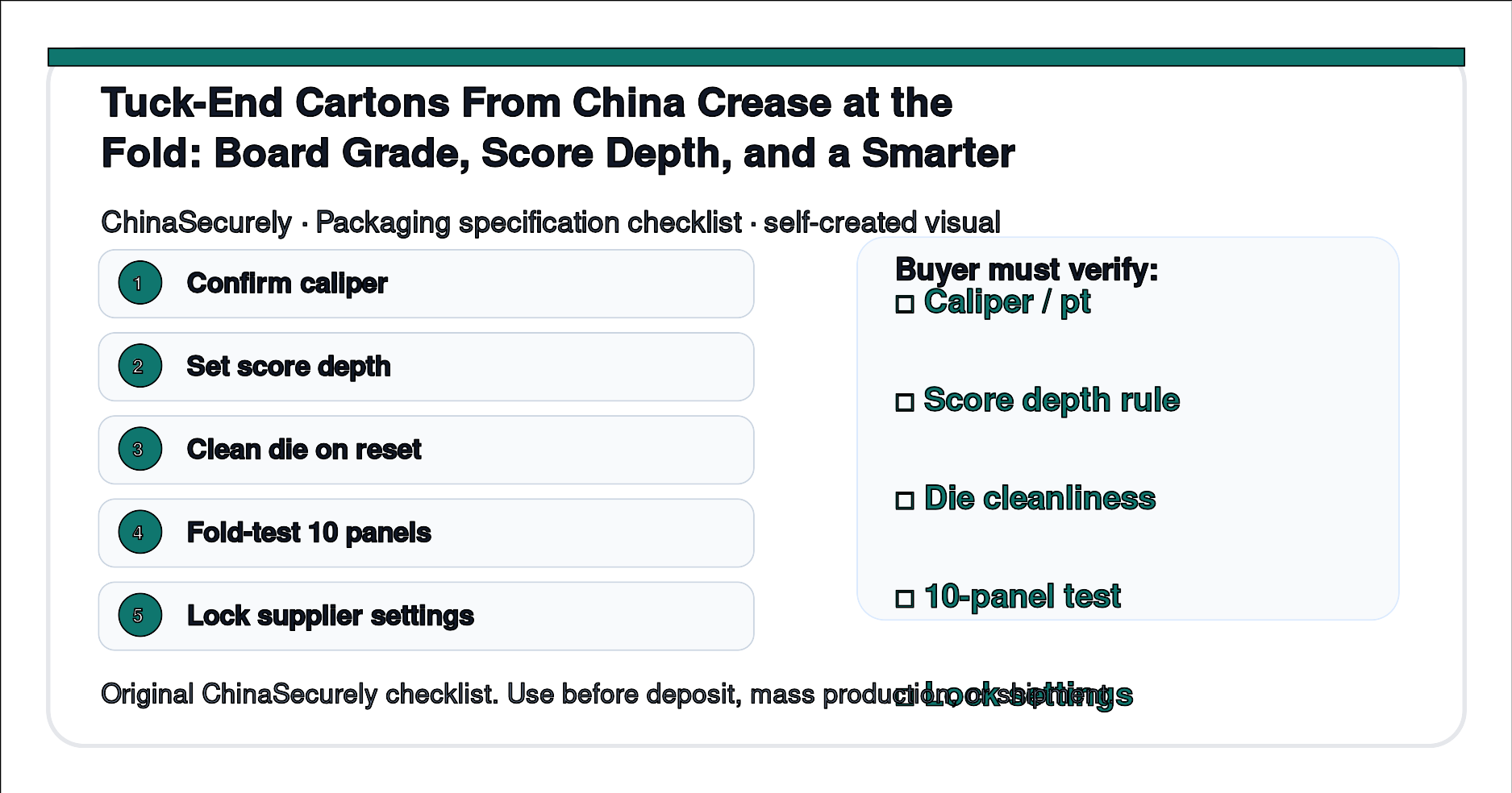
- Run a 10-panel fold test on the first 100 sheets off the production run. Score on the print-face side as a check. Inspect for surface crack and dust in the channel.
- Lock and freeze. Once approved, freeze the grade name, the caliper, the score depth, and the production-line setup into the PO so the next run uses the same settings.
What to ask the supplier
“For 30,000 tuck-end cartons at 0.6 mm FBB, please confirm: caliper in mm, board grade and supplier, score depth in mm, creasing matrix condition, and creasing rule (for example, two-thirds of caliper). Run a 10-panel fold test on the actual production run and send a photo of the score on the first 200 sheets. We accept the production run only if the fold test passes.”
Cost, risk, and trade-off notes
- Tightening the score spec to a fixed mm depth usually adds 0.4 to 1.2 percent to unit cost because the factory checks the die more often; it is rarely rejected on price.
- Tucker-end designs with auto-bottom create more score lines than straight-tuck designs; auto-bottom is more prone to crease failure on the same board grade.
- If the sample folds cleanly but the bulk run cracks, the cause is most often board caliper drift, not score drift. Caliper-gauge the bulk run at the warehouse.
- Do not switch board grade mid-run on price alone; the score-depth rule has to be re-validated for the new caliper.
Buyer checklist
- Caliper in mm or points locked on the PO.
- Board grade and supplier locked on the PO.
- Score depth in mm locked on the PO and verified by a 10-panel fold test.
- Creasing matrix condition verified and reset log filed.
- Production-run photo of score on first 200 sheets on file.
Related questions buyers ask
- Why does my reverse-tuck crack but the straight-tuck doesn’t? Reverse-tuck has two opposed score lines that fold opposite ways; it is more sensitive to score depth than straight-tuck.
- Can an auto-bottom carton be creased the same way? No, auto-bottom adds a 4th and 5th score; creasing rules differ. Confirm with the die supplier.
- What if my retailer specs a particular thickness? Use the retailer’s tolerance, not the supplier’s, when the carton ships into their DC.
Authoritative references
Source status: ready. Authoritative references cover folding-carton creasing and score practice (Fibre Box Association industry reference), TAPPI standard test methods for folding cartons, ISO 12647-2 offset process control for the printed side, and Bobst die-cutter and creasing matrix industry reference. The buyer should still ask the factory to lock the caliper in mm, the score depth, the creasing matrix condition, and the print-face-up rule on the PO, and to run a 10-panel fold test on the first 200 sheets of the production run.
- https://www.fibrebox.org/ — Fibre Box Association (FBA) — Corrugated creasing and folding reference (industry practice for score depth on FBB, SBS, CCNB; recommends the two-thirds-of-caliper score rule and the print-face-up rule)
- https://www.tappi.org/standards/ — TAPPI — Standard test methods for folding cartons (TAPPI T 489, T 494, T 543) referenced in die-maker and carton spec writing
- https://www.iso.org/standard/81719.html — ISO 12647-2:2013 / Amd 1:2015 — Graphic technology — Process control for the production of half-tone colour separations, proofs and production prints — Part 2: Offset lithographic processes (used as colour / print-quality reference for printed folding cartons)
- https://www.bobst.com/ — Bobst — Die-cutting and folding-carton machinery reference (industry source on score depth vs caliper, creasing matrix maintenance, and reverse-tuck vs auto-bottom creasing rules)
What to do next
If you are at sampling, send the questions above and require a 10-panel fold test photo. If you are seeing cracks in the bulk run, request a caliper sample from the suspect lot and ask the factory to re-cut the score matrix. Do not pay the balance until a fresh 10-panel fold test passes.