
Short answer: a cotton towel that arrives at 550 GSM from a Chinese supplier can measure 470 GSM after the first wash. The cause is almost always yarn count downshift, looser loop density, or a missing pre-shrunk finish. The factory did not lie; the towel is technically cotton, and the at-delivery GSM is real. Here is how to lock GSM, yarn count, and loop density before deposit.
Why towels shrink after the first wash
Three factors drive post-wash shrinkage. The first is yarn count: a 32 Ne yarn (finer) and a 21 Ne yarn (thicker) produce towels of similar visual appearance at delivery but different dimensional stability. The thicker yarn has more cotton fiber to relax, which means more shrinkage. The second factor is loop density: a tight loop pile (8 to 10 loops per cm2) is more dimensionally stable than a loose loop pile (5 to 6 loops per cm2). The third factor is the pre-shrunk finish: a hot-washing and drying cycle at 60 to 90 degree C stabilizes the cotton fiber and reduces post-wash shrinkage from 12 to 18 percent to 3 to 5 percent.
The China-side explanation is straightforward. Cotton yarn spot pricing follows the global cotton futures market; a factory that quotes aggressively in a high-cotton-price month will quietly downshift from 32 Ne to 21 Ne and skip the pre-shrunk finish. The visual difference at delivery is hard to detect by eye or by hand-feel alone; the post-wash GSM drop is 12 to 18 percent and shows up in the customer’s first wash. The buyer’s spec did not name the yarn count or the pre-shrunk clause, so the substitution is technically compliant.
What to lock on the PO
- Yarn count: 32 Ne for face cloths and hand towels, 21 Ne for bath towels (or finer for premium lines).
- Loop density: minimum 8 loops per cm2 for bath towels, minimum 10 loops per cm2 for face cloths.
- GSM at delivery: locked at 500 to 600 GSM for bath towels, locked at 350 to 450 GSM for face cloths.
- Post-wash GSM: maximum 8 percent shrinkage from at-delivery GSM after 5 wash cycles.
- Pre-shrunk finish: hot-wash and tumble-dry cycle before shipment.
- OEKO-TEX or equivalent: certified for skin-contact use.
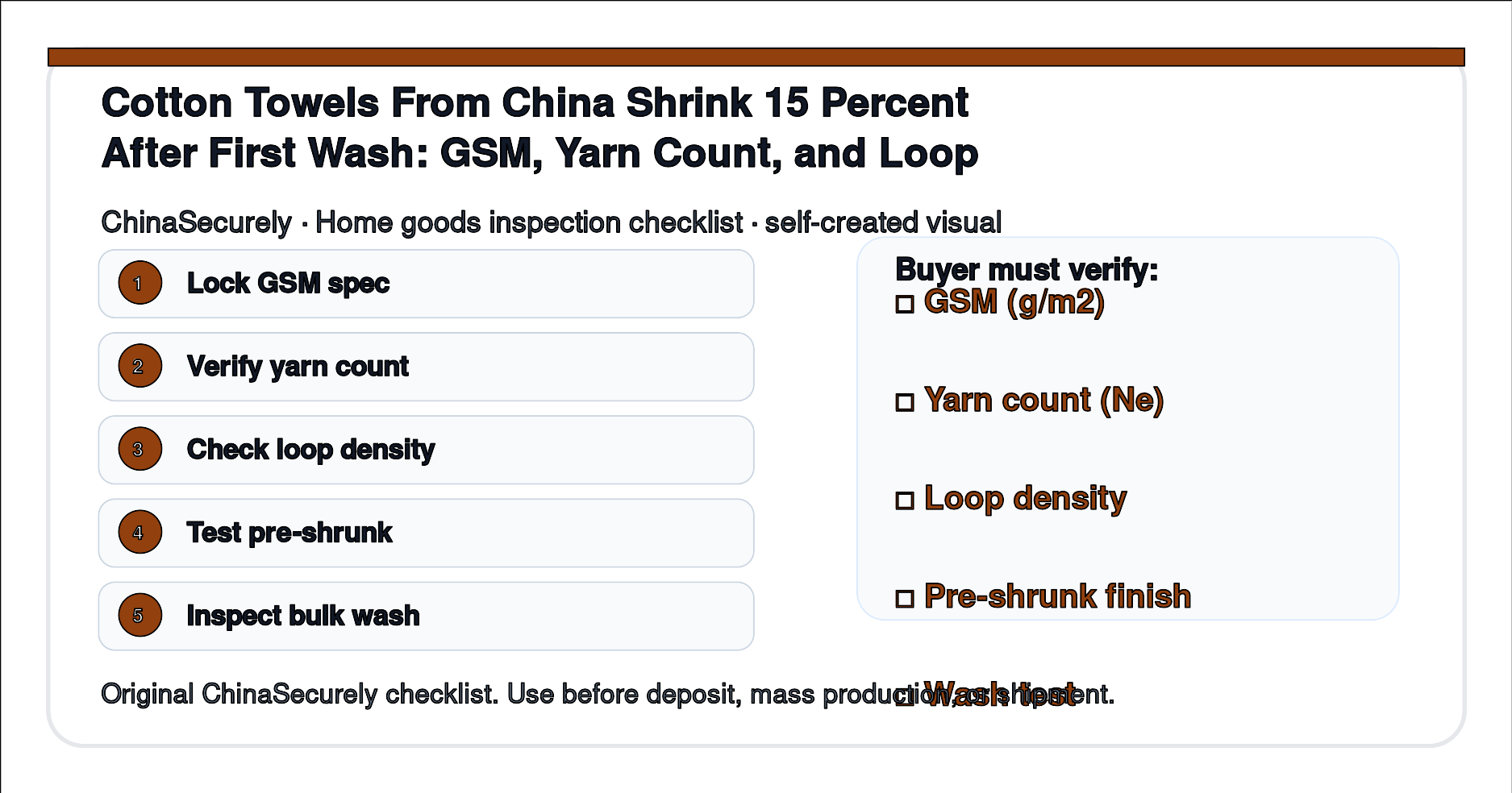
Buyer must verify before deposit
- Ask the supplier for the yarn count (Ne) and the loop density in writing.
- Ask the supplier for the pre-shrunk finish procedure and the wash-cycle count.
- Request a 5-piece pre-production sample from the real production line.
- Measure the sample GSM at delivery per ASTM D3776.
- Wash the sample 5 times and re-measure the GSM per ASTM D3776.
- Inspect the loop density with a magnifier or a loop-counting ruler.
China-side explanation
Cotton towel factories in Nantong, Gaoyang, and Anqing operate on a tight cost-down schedule. A 32 Ne yarn costs 15 to 25 percent more than a 21 Ne yarn of the same cotton grade; a pre-shrunk finish adds 8 to 12 percent to the finishing cost. A factory that sources the cheapest yarn and skips the pre-shrunk finish saves 20 to 35 percent on the BOM. The visual difference at delivery is hard to detect without a magnifier and a wash test; the post-wash GSM drop is 12 to 18 percent and shows up in the customer’s first Amazon review. The cheapest insurance is to require the supplier to disclose the yarn count and the pre-shrunk finish in writing on the PO, and to add a sample retention clause plus a wash-test clause so the bulk run can be checked against the original sample.
Step-by-step solution
- Send the supplier a written spec: yarn count (Ne), loop density, at-delivery GSM, post-wash GSM shrinkage max 8 percent, pre-shrunk finish clause.
- Order a 5-piece pre-production sample from the real production line.
- Measure the sample GSM at delivery per ASTM D3776.
- Wash the sample 5 times per the care label and re-measure the GSM.
- Inspect the loop density with a magnifier or a loop-counting ruler.
- Add a sample retention clause and a wash-test clause to the PO.
Quick checklist
- Yarn count locked: 32 Ne for face cloths, 21 Ne for bath towels.
- Loop density locked: minimum 8 loops per cm2.
- GSM at delivery locked: 500 to 600 GSM bath, 350 to 450 GSM face.
- Post-wash GSM locked: max 8 percent shrinkage.
- Pre-shrunk finish locked: hot-wash and tumble-dry before shipment.
- OEKO-TEX verified for skin-contact use.
Sources
- ASTM D3776 — Standard test methods for mass per unit area (weight) of fabric
- ASTM D5034 — Standard test method for breaking strength and elongation of textile fabrics (grab)
- ASTM D3512 — Standard test method for pilling resistance and other related surface changes of textile fabrics (random tumble)
- ASTM D2262 — Standard test method for tearing strength of woven fabrics by the tongue (single rip) method
- ISO 6330 — Domestic washing and drying procedures for textile testing
- QIMA — Pre-shipment inspection for textile home goods
This article is for sourcing verification, not for textile engineering. Confirm your final yarn count, GSM target, and wash-test procedure with a qualified textile testing lab before bulk production.