
Short answer: a corrugated carton that crushes on the second tier of a pallet is almost always a spec problem, not a quality problem. The factory built the box you ordered; you ordered the wrong box for the load. BCT and ECT are the two ratings that matter, and most small importers specify neither. Here is how to lock the spec before the deposit leaves your account.
Why cartons crush on the second tier
Three forces act on a palletized carton: vertical compression from the tiers above, humidity softening of the kraft paper, and vibration fatigue during transit. A carton rated for the top tier rarely fails; the failure almost always happens at the second or third tier where the bottom carton carries the cumulative load plus the pallet weight. If your BCT rating is below the cumulative load, the bottom carton buckles and the stack collapses. The China-side explanation is straightforward: most small importers order by price-per-carton, not by BCT-per-dollar. A factory will quote the cheapest 3-ply BC-flute carton that meets the dimensional spec, because that is what you asked for. The factory is not cheating; they followed the spec.
What BCT and ECT actually measure
- BCT (Box Compression Test, ASTM D6420): direct measurement of the finished box. Place the box on a compression press, apply load, record the peak force at buckling. The honest rating for the box the buyer will receive.
- ECT (Edge Crush Test, TAPPI T811): a proxy test on the corrugated board itself. Faster and cheaper than BCT, widely used in the US, correlated to BCT but not interchangeable.
- Mullen burst (TAPPI T810): measures puncture resistance, not stacking strength. Common in legacy specs; the wrong test for palletized loads.
- Flat crush (TAPPI T825): measures flute rigidity, useful as a quality check but not a stacking rating.
What to lock on the PO
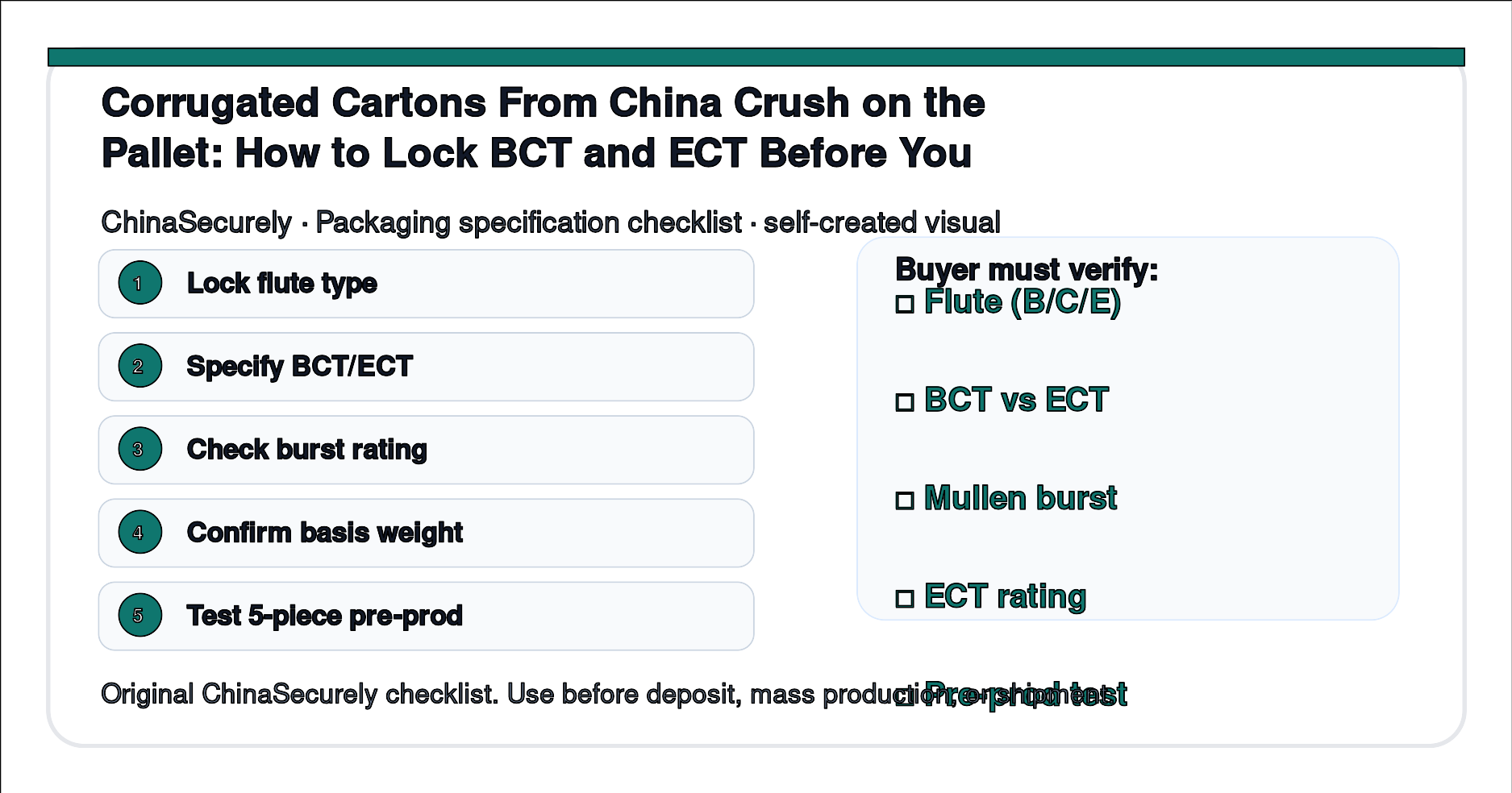
- Flute profile: B-flute (3 mm), C-flute (4 mm), E-flute (1.5 mm), or BC double-wall (7 mm).
- Liner basis weight: 150 to 200 gsm for export-grade cartons.
- Medium basis weight: 100 to 140 gsm for export-grade cartons.
- BCT rating: minimum BCT1500N for single-tier stacking; BCT2000N+ for double-tier.
- ECT rating: minimum ECT44 for export pallet loads.
- Humidity clause: test at 50 percent RH and 90 percent RH to confirm the rating holds.
China-side explanation
Corrugated board pricing follows kraft paper spot prices. When kraft paper prices spike in Q3 and Q4, a Chinese factory will quietly downshift the medium basis weight from 120 gsm to 100 gsm and call it the same grade. The buyer who inspects basis weight by eye cannot tell the difference; the buyer who weighs a 1 m by 1 m sample of the liner and medium will see the 17 percent material reduction. The factory’s price drops by 8 to 12 percent; the BCT rating drops by 15 to 20 percent. The buyer accepts the cheaper quote and pays the cost on the first pallet collapse at the warehouse. Locking the basis weight in writing on the PO, with a sample retention clause, is the cheapest insurance you can buy.
Step-by-step solution
- Calculate the cumulative pallet load: carton weight x tiers above the carton in question.
- Set the BCT target at 1.5x to 2x the cumulative load, not 1x.
- Send the supplier a written spec: flute profile, liner basis weight, medium basis weight, BCT or ECT rating, humidity clause.
- Order a 5-piece pre-production sample from the real production line, not the showroom sample.
- Run a third-party BCT test on 2 of the 5 samples before approving bulk production.
- Add a sample retention clause to the PO so the bulk run can be checked against the original sample.
Quick checklist
- Flute profile locked: B / C / E / BC.
- Liner basis weight locked: 150 to 200 gsm.
- Medium basis weight locked: 100 to 140 gsm.
- BCT rating locked: minimum BCT1500N for export pallets.
- Humidity clause: tested at 50 percent and 90 percent RH.
- Sample retention clause added to the PO.
Sources
- ASTM D6420 — Standard test method for determining compressive resistance of shipping containers, components, and unit loads
- ASTM D4728 — Standard test method for random vibration testing of shipping containers
- TAPPI — Corrugated board test methods (T804, T810, T811, T825)
- ISO 2234 — Packaging: complete, filled transport packages and unit loads: stacking tests using a static load
- FedEx — Packaging guidelines for international shipping
- QIMA — Pre-shipment inspection for cartons and palletized loads
This article is for sourcing verification, not for packaging engineering. Confirm your final BCT/ECT target with a qualified packaging engineer or third-party testing lab before bulk production.
1 thought on “Corrugated Cartons From China Crush on the Pallet: How to Lock BCT and ECT Before You Order”