
Short answer: a WiFi smart plug from China that fails UL or FCC listing, runs hot at the pins, or pops a fuse usually has one of three root causes: the supplier is quoting a UL file number from a different model, the FCC ID belongs to a WiFi module that is no longer authorized, or the enclosure flame rating is below UL 94 V-0. Smart plugs sit in a wall outlet for years under load, so a missed spec turns into a fire risk long before it turns into a return. Here is how to verify before bulk.
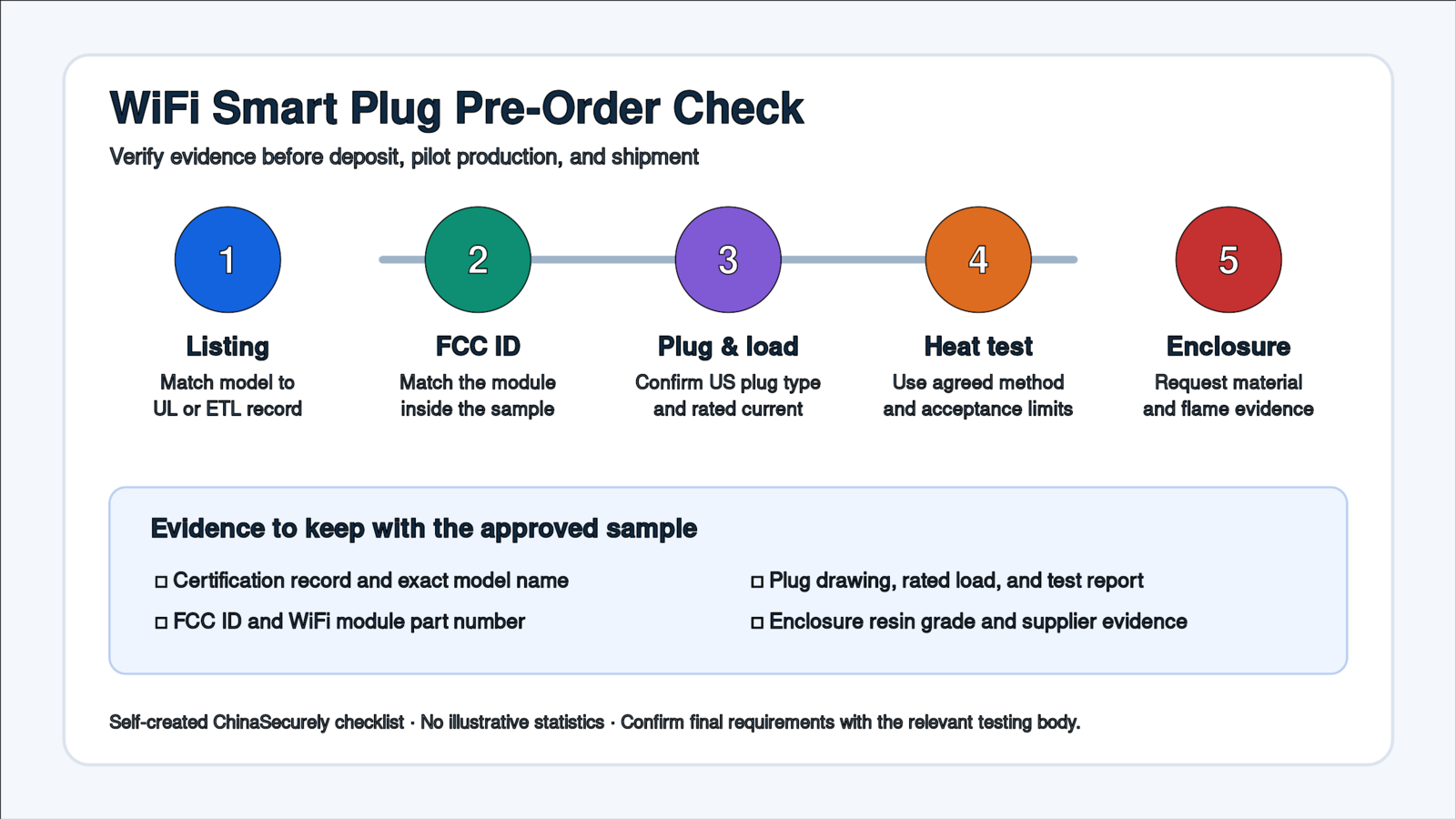
Why WiFi smart plugs fail listing
WiFi smart plugs fail for one of three reasons. The first is UL listing reuse: a factory that has a UL file for a 2-prong plug may quietly use the same file number for a 3-prong grounded plug, which is not authorized. The second is FCC ID drift: a WiFi module that was authorized two years ago may have been withdrawn or modified; the FCC database shows the original grant but the module on the production line may be a different revision. The third is enclosure flame rating: a UL 94 V-2 enclosure will pass a casual inspection but fail UL 94 V-0 testing, and the production line drift is hard to spot without a burn test.
The China-side explanation is straightforward. UL listing is expensive ($5,000 to $15,000 per SKU) and slow (8 to 12 weeks), so a factory that is short on shipping dates will quote an existing file number from a similar model without telling the buyer. The FCC ID is printed on the WiFi module and on the back of the enclosure, so the buyer can verify it directly. Enclosure flame rating is a material property, and a factory that switches from a V-0 PC/ABS blend to a V-2 regular PC saves roughly $0.20 per enclosure.
What to lock on the PO
- UL file number in writing, with the SKU cross-reference from UL’s online database.
- FCC ID in writing, with the FCC grant date and the WiFi module vendor part number.
- Adapter pin spec (NEMA 1-15P or NEMA 5-15P) with pin diameter 6.8 mm and length 17 mm.
- Enclosure flame rating UL 94 V-0 in writing.
- Thermal cutout behavior at 1.5x rated load for 1 hour.
Buyer must verify before deposit
- Look up the UL file number on UL’s online database and confirm the SKU matches.
- Look up the FCC ID on the FCC equipment authorization database.
- Measure pin diameter and length with a caliper on 5 random plugs.
- Run a 1.5x load test for 1 hour and check the thermal cutout trips.
- Cut one enclosure sample and verify the flame rating stamp or run a UL 94 burn test.
China-side explanation
UL listing in China is often held by the trading company rather than the factory. The trading company files one SKU with UL and then quietly reuses the file number across multiple SKUs that share the same enclosure but have different internal electronics. This is technically a UL violation, but it is hard to detect without a UL database lookup. The FCC ID belongs to the WiFi module vendor (e.g. Espressif, Realtek, MediaTek), and the module vendor authorizes the factory to use the ID on finished products. If the factory switches module vendors mid-run without re-authorizing, the FCC ID on the enclosure no longer matches the module inside.
Step-by-step solution
- Send the supplier a written spec with UL file number, FCC ID, pin spec, flame rating, and thermal cutout.
- Look up UL and FCC online before deposit. If the file number or ID does not match, walk away.
- Request a 50-piece pre-production sample and run the pin caliper, flame rating, and thermal cutout tests.
- Inspect 1 percent of bulk at random with a pin caliper before shipment.
- Add a clause: any UL or FCC audit failure triggered by the buyer’s downstream customer is the factory’s liability.
Quick checklist
- UL file number: ______, SKU match on UL database = yes / no.
- FCC ID: ______, grant date = ______, module vendor = ______.
- Pin spec: NEMA 1-15P / 5-15P, diameter 6.8 mm, length 17 mm.
- Flame rating: UL 94 V-0 in writing.
- Thermal cutout trips at 1.5x load within 30 min: yes / no.
Sources
- UL — Underwriters Laboratories product listing database
- Intertek — ETL listed product certification
- FCC — Equipment authorization database
- eCFR Title 47 Part 15 — Radio frequency devices
- NFPA — Home fire safety data on electrical products
- QIMA — Pre-shipment inspection for electronics
This article is for sourcing verification, not for US electrical safety certification. Confirm UL and FCC listings with the issuing body before bulk, and consult a licensed electrician for installation.