
Short answer: a stretch sleeve label from China that warps, tears, or misaligns on the bottling line usually has one of three root causes: the film gauge dropped below the supplier’s quote, the perforation spacing is wrong for the bottle geometry, or the shrink tunnel temperature is set for PVC when the film is PETG. Sleeve labels run at line speed, so a small tear or misalign multiplies fast and forces a stop. Here is how to lock the spec before bulk.
Why stretch sleeve labels fail
Stretch sleeve labels fail for one of three reasons. The first is film gauge: a supplier that quotes 50 mu PETG may run 40 mu or even 35 mu in the bulk run because the visual difference is hard to spot without a micrometer. The second is perforation spacing: a tear line that is too tight snaps during shrink; a tear line that is too loose fails the easy-open claim. The third is shrink tunnel temperature: PETG needs 90 to 110 degrees C with a dwell time of 8 to 12 seconds; PVC shrinks faster and at lower temperatures. A factory set up for PVC cannot run PETG without a tunnel retune.
The China-side explanation is straightforward. PETG and PVC sleeve film prices move with petrochemical feedstock, so a factory that is squeezed on margin will quietly substitute PVC for PETG, or run a thinner gauge, or skip the perforation step. PETG and PVC look identical on the roll. The line operator notices the difference only after the first 1,000 bottles run with 5 percent rejects.
What to lock on the PO
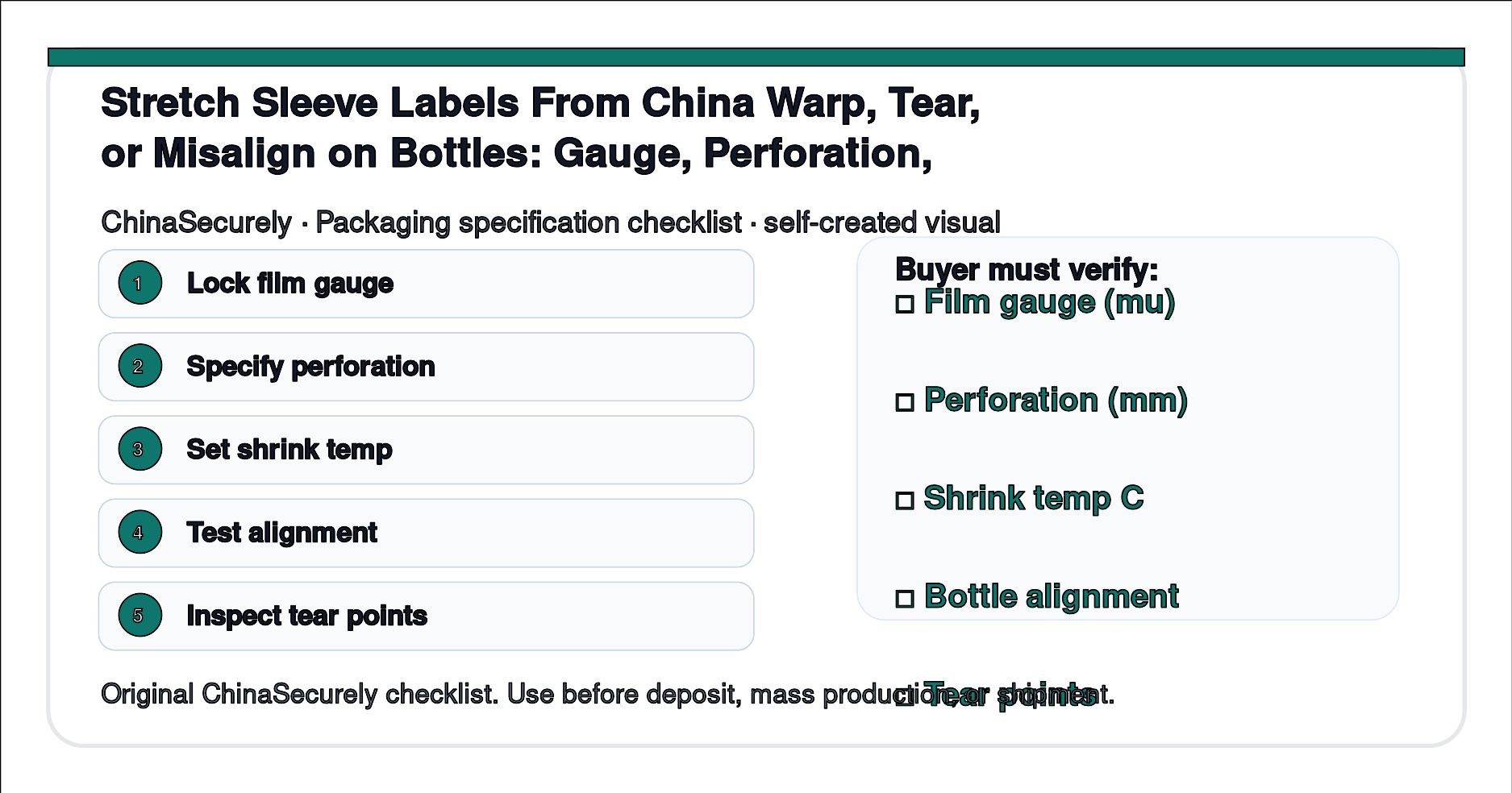
- Film material (PETG or PVC) in writing, with a sample retention clause.
- Film gauge in microns, with a +/- 2 mu tolerance.
- Perforation spacing in millimeters, with a tear-strength test.
- Shrink tunnel temperature profile (preheat, main, post-heat zones) in writing.
- Print registration tolerance in millimeters at the seam.
Buyer must verify before deposit
- Measure film gauge on 5 random sleeves with a micrometer.
- Run a 65 percent shrink test at 90 degrees C in a water bath.
- Tear-test the perforation by hand on a cooled sleeve.
- Run 200 sleeves on the actual shrink tunnel at line speed.
- Inspect print registration at the seam for drift over 1 mm.
China-side explanation
PETG sleeve film is imported into China from a small set of converters in Thailand, Malaysia, and South Korea. PVC sleeve film is fully domestic and cheaper. When PETG imports are delayed at customs, factories quietly substitute PVC and the buyer cannot tell the difference on a flat-printed roll. The tunnel settings are written into the line PLC, and operators rarely retune between shifts. Asking the factory to disclose their film supplier and their shrink tunnel profile is fair and lets you hold the original batch as a retention sample.
Step-by-step solution
- Send the supplier a written spec with film material, gauge, perforation, and shrink profile.
- Request a 200-piece run on the actual shrink tunnel at line speed before bulk approval.
- Add a film-gauge check clause: any roll below 48 mu triggers a refund.
- Inspect 1 percent of bulk at random with a micrometer and a water-bath shrink test.
- Lock the print registration tolerance and inspect the seam on every master carton.
Quick checklist
- Film material: PETG or PVC, supplier disclosed.
- Film gauge: ______ mu, tolerance +/- 2 mu.
- Perforation: ______ mm spacing, tear test passed.
- Shrink profile: preheat ______ C, main ______ C, post-heat ______ C.
- Print registration: seam drift <= 1 mm.
Sources
- ASTM D2732 — Unrestrained linear thermal shrinkage of plastic film
- ASTM D638 — Tensile properties of plastics
- ISO 14616 — Shrink films for packaging
- FDA — Cosmetics packaging and labeling
- QIMA — Pre-shipment inspection for film packaging
This article is for sourcing verification, not for label engineering. Confirm your shrink tunnel profile with your bottling line engineer before bulk.