
Short answer
Stand-up pouches from China often leak at the bottom seal in the warehouse because the laminated film, the bottom-gusset adhesive, or the seal temperature window was not specified in the purchase order. The sample held coffee for six weeks. The bulk run starts leaking through the bottom seam after two.
The buyer complaint we keep seeing
A US small importer sources 50,000 matte-black stand-up pouches with a bottom gusset for a single-origin coffee brand. The PI says “matte black front, kraft back, 250g, zip lock, valve.” Sample: round-bottom, valve works, zip locks, holds 250g of beans without leaking. Two bulk lots later, the warehouse reports roughly 4% of pouches leaking through the bottom seam — sometimes a few drops, sometimes a slow drip. The supplier replies “same material, same machine,” and sends photos of the production line. The film really does look the same. The seal did not.
Why “same material” on a sample is not enough
A stand-up pouch is not one material. It is three to five films laminated together, plus a bottom-gusset adhesive, plus a heat-seal layer with a defined seal window. To pass a one-meter drop test and a 30-day warehouse humidity cycle, the supplier needs:
- A defined laminate structure such as PET / ALU / PE or PET / VMPET / PE with each layer named.
- A heat-seal layer with a stated seal-initiation temperature and a seal-strength window (N/15 mm).
- A bottom-gusset adhesive that survives the same temperature and humidity range as the body film.
- A specified seal-bar temperature, dwell time, and pressure on the packaging line, not just “OK” on a setting.
- A drop test pass at 1.0 m or 1.2 m with 250 g of product, on a concrete floor, sealed side down.
The supplier can change the inner PE supplier, lower the ALU thickness from 7µ to 6µ, or shift the seal-bar temperature by 5°C and the sample still looks the same on the outside. The bottom seam does not.
China-side explanation
Stand-up pouch factories in Shanghai, Shenzhen, and Cangzhou usually run three cost tiers for the same SKU:
- Entry tier: thinner ALU (6µ instead of 7µ), commodity CPP or LLDPE seal layer, no documented seal-strength test. Sold for non-food, non-liquid dry goods.
- Middle tier: named ALU thickness, PE seal layer from a known supplier, seal-strength spec on the COA. Sold for coffee, snacks, and pet food.
- High tier: full laminate structure documented to the micron, validated seal window, drop test report, optional oxygen or moisture transmission rate (OTR / MVTR) report. Sold for coffee, liquid, and export food.
If the PO does not lock the laminate structure, the seal layer, the bottom-gusset adhesive spec, and the drop-test result, the factory can quote the entry tier or middle tier under the high-tier label. The pouch that leaks is usually the entry tier under a middle-tier quote.
What actually verifies a stand-up pouch
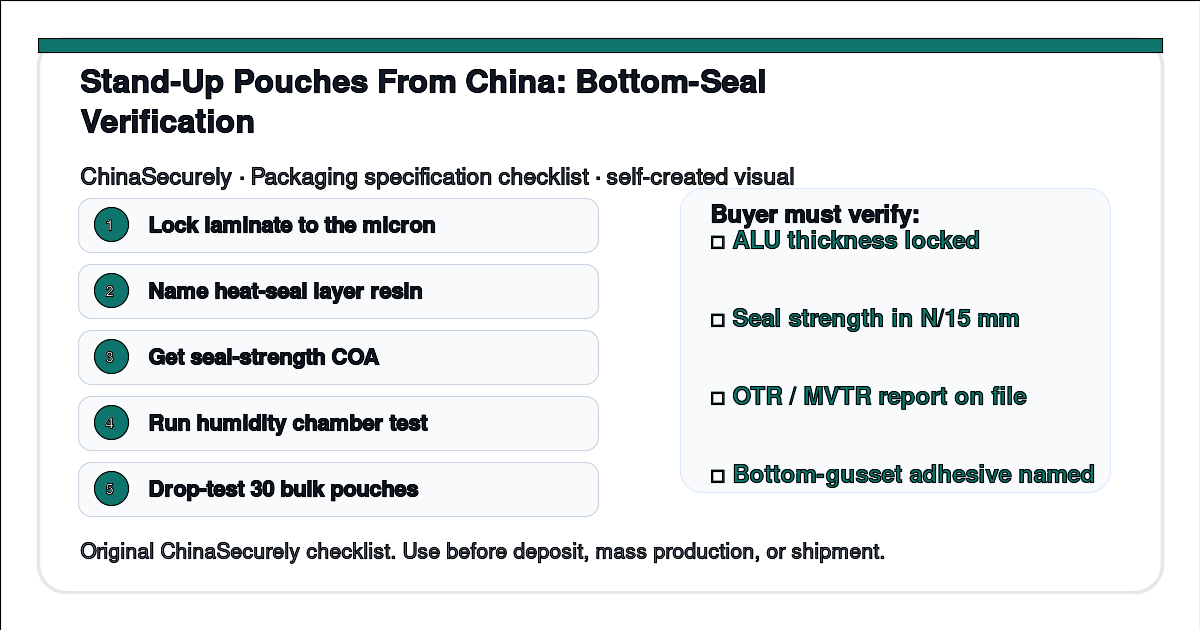
- Lock the laminate structure on the PO to the micron: example “PET 12µ / ALU 7µ / PE 80µ.”
- Ask for the seal-initiation temperature, seal-strength window in N/15 mm, and a COA sample from the bulk lot, not just the pre-production sample.
- Ask for the bottom-gusset adhesive name and supplier. EVA-based and PUR-based adhesives behave differently in heat and humidity.
- Request a drop-test report from the supplier on a finished pouch filled with 250 g of product, sealed side down, 1.0 m onto concrete. Five of five must pass.
- Run your own drop test on 30 finished pouches from the bulk lot before signing the B/L.
- For coffee or moisture-sensitive products, ask for an OTR report (ASTM F1927 or equivalent) and an MVTR report (ASTM F1249 or equivalent).
Sample-to-bulk risk matrix
| Risk | Sample impact | Bulk impact | Buyer check |
|---|---|---|---|
| ALU thickness reduced | Low, still rigid | Medium, pinholes, slow leak, coffee stale | Cross-section one bulk pouch, compare to sample |
| PE seal layer supplier swapped | Low at room temp | High, weak seal window, leaks in warm warehouse | Heat-seal sample at three temperatures, measure peel |
| Bottom-gusset adhesive downgraded | Low if humidity low | High, seam opens in humid warehouse | Humidity chamber test 38°C / 90% RH for 7 days |
| Valve membrane thickness reduced | Low | Medium, valve leaks CO2, coffee goes stale | Pressurise valve with air, watch for slow leak |
| Seal-bar settings drifted | Low in pre-production | High, inconsistent seal across the run | Seal-strength test on 10 bulk pouches |
What to ask the supplier before the deposit
"Please confirm on the PI: the full laminate structure to the micron, the heat-seal layer resin name and supplier, the bottom-gusset adhesive name, the seal-bar temperature and dwell time on the production line, the seal-strength spec in N/15 mm, and a drop-test report on a filled pouch at 1.0 m onto concrete. Please attach a COA from the bulk lot, not just the pre-production sample."
If the sales rep answers “food grade” without naming the laminate, the seal layer, or the drop-test result, treat the claim as unverified. That answer usually means the entry tier under a middle-tier quote.
Buyer checklist before releasing the balance payment
- Full laminate structure on the PI matches the sample cross-section to the micron.
- COA from the bulk lot lists seal-strength value within the agreed window.
- Bottom-gusset adhesive name and supplier on file.
- Drop test of 30 bulk pouches at 1.0 m shows zero leaks.
- Humidity chamber test at 38°C / 90% RH for 7 days shows zero seam failures on a 10-pouch sample.
- OTR and MVTR reports match the SKU’s product sensitivity (coffee, tea, snacks).
Authoritative references
- ASTM F1927 — Oxygen Transmission Rate (OTR)
- ASTM F1249 — Moisture Vapor Transmission Rate (MVTR)
- ASTM F88 — Seal Strength of Flexible Barrier Materials
- ISTA — transport test procedures
- Amazon FBA packaging and prep requirements
Stand-up pouch performance depends on the specific laminate, the heat-seal settings on the production line, and the warehouse conditions in the destination market. ASTM F88 seal-strength tests and ISTA drop tests are the industry references for verification. Confirm current food-contact and packaging rules with your destination market regulator and your retailer before shipping.