
1|
Consider a small US importer whose 65W USB-C PD wall-charger sample works as expected, while random units from the bulk lot reach only about 45W under load. The housing and SKU are unchanged, but customer complaints begin after launch. This sample-to-bulk gap is usually not solved by collecting more certificate PDFs; the buyer needs to verify the actual controller, power-stage components, transformer, and production test record before releasing the balance.
2|
3|
4|
5|
What overseas small importers actually ask
6|
7|
-
8|
- My supplier stamped “PD 3.0 65W” on the housing but my customers say fast-charge does not trigger. Is the label lying?
- The pilot 100 units worked. Bulk 3,000 units run hot and cap around 45W. Same SKU. Why?
- The factory sent a UL certificate PDF. It looks fine. Can I ship?
- Which document actually proves the charger can deliver 20V/3.25A safely, not just theoretically?
9|
10|
11|
12|
13|
14|
Why this problem happens on the China side
15|
16|
A USB-C PD charger is a system: PD controller IC, primary-side switching, transformer, secondary rectifier, GaN or silicon MOSFET, output filter, and the USB-C receptacle. Chinese small-batch factories in Shenzhen, Dongguan, and Zhongshan often buy each of these on the spot market. Between the sample lot and the bulk lot, the purchasing engineer can:
17|
18|
-
19|
- Substitute a different PD controller that supports fewer profiles or has different protection behavior.
- Change the switching device, transformer, rectifier, or thermal design in a way that reduces sustained output.
- Use a smaller or lower-cost transformer that reduces thermal headroom.
- Send a safety or regulatory document issued to a similar—but not identical—model.
20|
21|
22|
23|
24|
25|
The sample worked because it was hand-built with the reference bill of materials. Bulk did not, because purchasing followed the “cost-down” BOM.
26|
27|
Step-by-step verification plan before bulk sign-off
28|
29|
-
30|
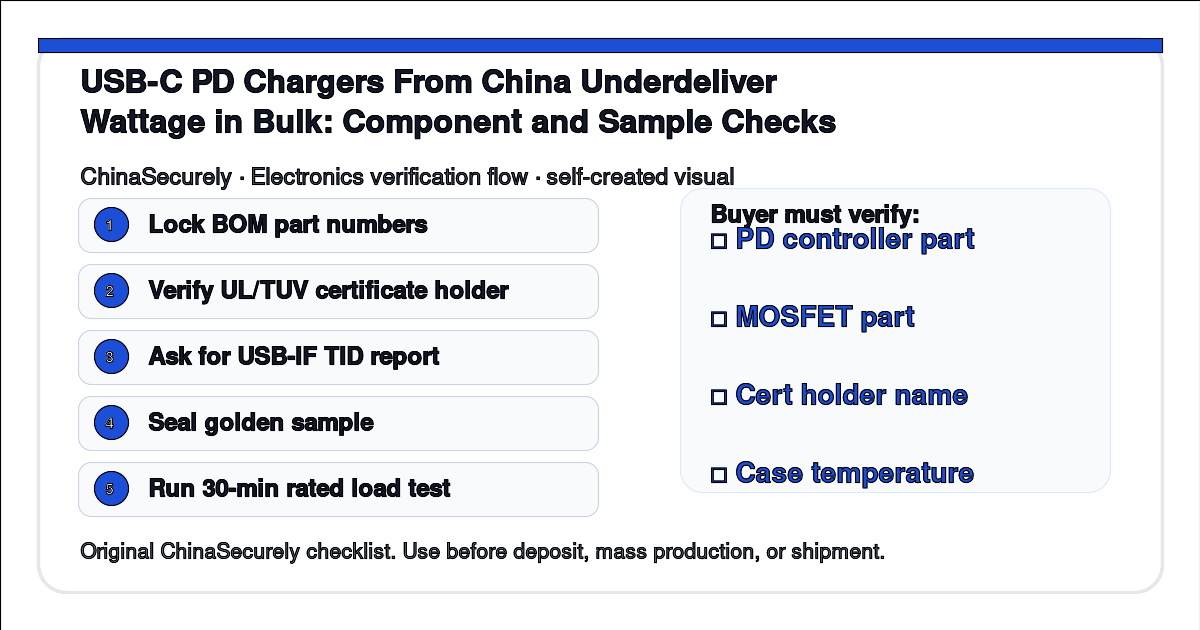
- Lock the bill of materials in writing. Ask for the PD controller part number, MOSFET part number, transformer supplier, and USB-C receptacle brand. Put them in the PO as a “no substitution without written approval” clause.
- Request the safety certificate holder name. UL, TÜV, Intertek, and SGS publish online certificate lookup. Confirm the certificate belongs to this factory legal name and this exact model number.
- Ask for a PDN Analyzer or USB-IF compliance test report. A screenshot of one PD handshake is not proof. A USB-IF Integrator’s List (TID) entry or a lab report with voltage/current curves at 5V, 9V, 15V, and 20V is the evidence you want.
- Golden-sample and seal it. Keep one sample from the pilot lot in a tamper-evident bag with a signed label. Compare bulk teardown to this sample.
- Run a real 30-minute load test. Use a suitable electronic load and test the supplier-declared rated output for 30 minutes under a documented ambient condition. Record output voltage, current, negotiated PD profile, case temperature, and any drop-outs. Set acceptance limits with the applicable safety standard, laboratory, and approved golden sample; do not invent a universal housing-temperature threshold.
- Define a statistically defensible pre-shipment sample plan. Choose the lot size, inspection level, and acceptance limits with your inspector before production; do not treat one AQL number as universal.
31|
32|
33|
34|
35|
36|
37|
38|
Documents to demand before payment balance
39|
40|
| Document | Why you need it | How to check |
|---|---|---|
| Signed BOM with part numbers | Blocks silent component swap | Match to teardown photos of pilot sample |
| UL/TÜV/Intertek certificate holder lookup | Confirms certificate is not borrowed | Search the certifier’s public database by file number |
| USB-IF TID or lab PD test report | Proves real PD contract at each voltage | Look for voltage/current curves and rise/fall times, not screenshots |
| Adapter class and input marking | Confirms mains input rating and safety class | Compare rating plate to certificate scope |
| DGR/hazmat classification if bundled with cells | Air freight compliance | Ask forwarder for section II or IB decision |
52|
53|
What ChinaSecurely recommends putting in the PO
54|
55|
-
56|
- PD controller and MOSFET part numbers, exact.
- Certification file numbers with certifier name, model, and issue date.
- A written substitution clause: any BOM change requires written buyer approval and re-certification.
- An inspection AQL clause naming rated-load 30-minute test.
- Payment terms that reserve at least 30% until pre-shipment inspection passes.
57|
58|
59|
60|
61|
62|
63|
Inspection checklist for the pre-shipment lot
64|
65|
-
66|
- □ Rating plate model, wattage, and certificate numbers match PO exactly.
- □ Teardown of 2 random units matches golden-sample BOM.
- □ PD contract holds at 5V, 9V, 15V, and 20V under load.
- □ Temperature result stays within the product-specific, lab-approved acceptance limit after the agreed rated-load test.
- □ Connector durability requirement and supporting test evidence match the approved specification.
- □ AC input cable and plug match destination-market safety standard (US NEMA 1-15P, EU CEE 7/16, UK BS 1363).
67|
68|
69|
70|
71|
72|
73|
74|
Sources and status
75|
76|
-
77|
- USB-IF Documents Library – USB-C and PD specifications.
- UL Certificate Directory – safety certificate lookup by file number.
- Intertek Directory of Certified Products – certificate holder lookup.
- FCC ID Search – FCC equipment authorization lookup.
- Directory availability and update timing vary; verify each record against the exact legal manufacturer, model, and file number.
78|
79|
80|
81|
82|
83|
84|
ChinaSecurely Electronics Desk note: PD chargers are not a legal or certification service. This article is a sourcing verification checklist. For destination-market compliance always confirm scope and rating with the certifier and, if bundled with lithium cells, review 49 CFR 173.185 and IATA DGR with your forwarder.
85|
86|