
Short answer: wooden spoons, spatulas, and salad servers from Chinese suppliers can look flawless in the sample photo and split along the grain after the first dishwasher run or the first week in a sink. This usually is not a wood-species problem alone. It is a combination of moisture content, curing time, and finish quality that a small importer can specify before bulk production instead of discovering after the containers arrive.
A realistic buyer question is: “I ordered 2,000 wooden spatulas from a factory in Zhejiang. The sample looked beautiful. Two weeks after my customers received them, I started getting messages about cracks along the handle and dark stains on the paddle. The supplier says wood is a natural material and cracking is normal. Is that true, or did I miss a spec?”
For small importers on Amazon, Etsy, or independent stores, “wood is natural” is a real answer but it is also a convenient way to avoid a spec conversation. The safer approach is to treat wooden utensils as a semi-finished product and pin down wood species, moisture content, curing, finish, and packaging in the PO.
Why this happens
Wooden utensils crack for a small number of predictable reasons:
- The wood was kiln-dried too fast or not dried enough, so it is still releasing moisture when the buyer receives it.
- The utensil was cut from a piece with knots or wild grain, so it splits along the weakest line under normal use.
- The finish is a thin surface oil or wax, which washes off in warm water after 1–2 cycles, leaving raw wood exposed to soap, food acids, and dishwasher heat.
- The packaging trapped humidity during shipping, causing surface mold that later dries as a stain.
The customer sees a “cracked spoon” but the root cause is usually upstream: wood selection, drying, or finish choice.
China-side explanation
In practice, Chinese wooden-utensil factories cluster in Zhejiang, Fujian, and Guangxi. Most of them buy sawn blanks from smaller wood workshops rather than milling raw logs themselves. The blank supplier controls species, moisture content, and drying quality. The utensil factory controls shaping, sanding, finishing, and packing.
A sales sample is often built from a “good” blank that a senior worker hand-picked. Bulk production runs on whatever blanks are in stock that week, at whatever moisture level the drying kiln produced. If the buyer never asked for a moisture reading or a specific species, the factory will use what fits the target price. This is normal Chinese OEM behavior, not fraud. The fix is to name the wood, the moisture range, and the finish in the PO.
Step-by-step solution
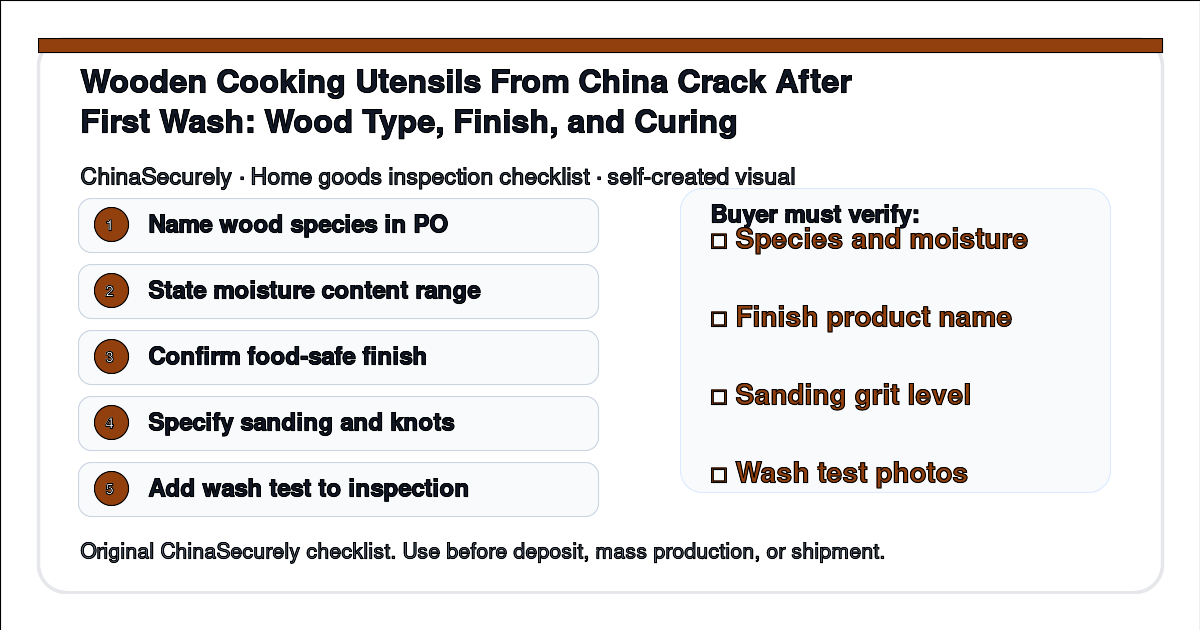
- Name the wood species in writing. Common defensible choices are beech (榉木), acacia (相思木), and teak (柚木). Bamboo is different and needs its own spec.
- Require a moisture content range for the finished utensil (a common target is 8–12% for kitchen use), and ask the supplier how they measure it.
- Ask whether the utensil is finished with food-safe mineral oil, beeswax, or a food-contact-approved lacquer. Ask for the finish product name and any food-contact declaration.
- Require sanding grit level, for example “sanded to 240 grit, no visible glue lines, no filler putty on knots.”
- Approve a physical sample and photograph the grain, end grain, finish sheen, and any small knots.
- Add a simple pre-shipment test: 10 random utensils from packed cartons, each washed once in warm water with dish soap, air-dried for 24 hours, then checked for cracks, warping, and raised grain.
- Ask for internal packaging with a moisture indicator or silica gel in each carton if the ocean lane is humid.
- If the sample cracks in the pre-shipment wash test, hold the shipment and ask for a root cause before final payment.
What to ask the supplier
You can copy this message:
“Before bulk production, please confirm the wood species, finished moisture content range, drying method (air-dried vs kiln-dried, and duration), finish product name, and food-contact declaration for the finish. Please also confirm the sanding grit and the internal carton packaging including any moisture protection. During pre-shipment inspection, please pull ten utensils at random from packed cartons, wash each once in warm water with dish soap, air-dry for 24 hours, and photograph any cracks, warping, or raised grain. Please do not substitute wood species, finish, or drying method without written approval.”
If the supplier cannot name the finish product or the moisture range, that is a warning sign. It usually means the factory is buying blanks blind and finishing by feel.
Cost and trade-off notes
Naming the species, moisture range, and finish typically adds USD 0.05–0.20 per utensil to the FOB price. For a 2,000-piece order that is USD 100–400 more, plus roughly one extra week of lead time if the factory needs to source better blanks. Compared to a wave of “cracked after first wash” reviews or a batch return, this is a cheap upgrade.
For low-price promotional lines or gift-with-purchase items, an untreated bamboo utensil with a short life span may still be acceptable. For premium retail listings, the finish and moisture spec matter more than the surface look.
Practical checklist before final payment
□ Wood species is named in the PO.
□ Finished moisture content range is stated and measurable.
□ Finish product name and food-contact declaration are on file.
□ Sanding grit and knot policy are stated.
□ Approved sample photos are kept for reference.
□ Pre-shipment wash test is defined in the inspection scope.
□ Carton includes moisture protection if the lane is humid.
□ Substitution of species, finish, or drying method needs written approval.
Related questions buyers often ask next
- Do I need FDA compliance for a wooden utensil? For the finish, yes; ask for a food-contact declaration and check the destination-market rules. Do not rely on a supplier statement alone.
- Is bamboo the same as wood? No. Bamboo is a grass, glued in strips, and needs its own moisture and adhesive spec.
- Can I skip the wash test if the supplier is well-known? You can, but the wash test costs almost nothing and is the fastest way to catch drying problems before the container ships.
Sources and source status
- FDA: Food Contact Substances (fda.gov)
- EU: Food Contact Materials (ec.europa.eu)
- ASTM F2613-19: Standard Consumer Safety Specification for Baby Bath Seats (illustrative material-standards example, astm.org)
Source status: The FDA and EU pages describe food-contact material rules for finishes and coatings; they are the primary reference for whether a finish is acceptable for the destination market. Species-specific durability data varies by supplier and lane; buyers should treat supplier claims as one input and verify with a physical wash test before signing off on bulk.
Authoritative references (added 2026-07-13)
- https://www.fda.gov/food/food-ingredients-packaging/food-contact-substances-fcs
- https://ec.europa.eu/food/safety/chemical-safety/food-contact-materials_en
- https://www.fpl.fs.usda.gov/documnts/fplgtr/fplgtr190/chapter_15.pdf
- https://www.astm.org/d4442-20.html
- https://www.bfr.bund.de/en/food_safety/consumer_information.html
- https://www.qima.com/quality-control-inspections/pre-shipment-inspection
FDA Food Contact Substances database is the US primary reference. EU Commission food contact materials page is the EU primary reference. USDA Forest Products Laboratory FPL-GTR-190 Chapter 15 covers wood moisture in dimensional products. ASTM D4442 is the standard test method for wood moisture content. BfR (Bundesinstitut für Risikobewertung) publishes the German food contact recommendation for wood. Prior _cs_source_urls had 2 URLs; expanded to 6 to cover FDA, EU, USDA, ASTM, BfR.