
Short answer: glaze pinholes can be a cosmetic defect, a production-process signal, or a reason to slow down and ask for testing evidence. For dinnerware, do not treat a supplier’s “food safe” statement as enough. Check the surface, define defect limits, and review food-contact requirements for your destination market.
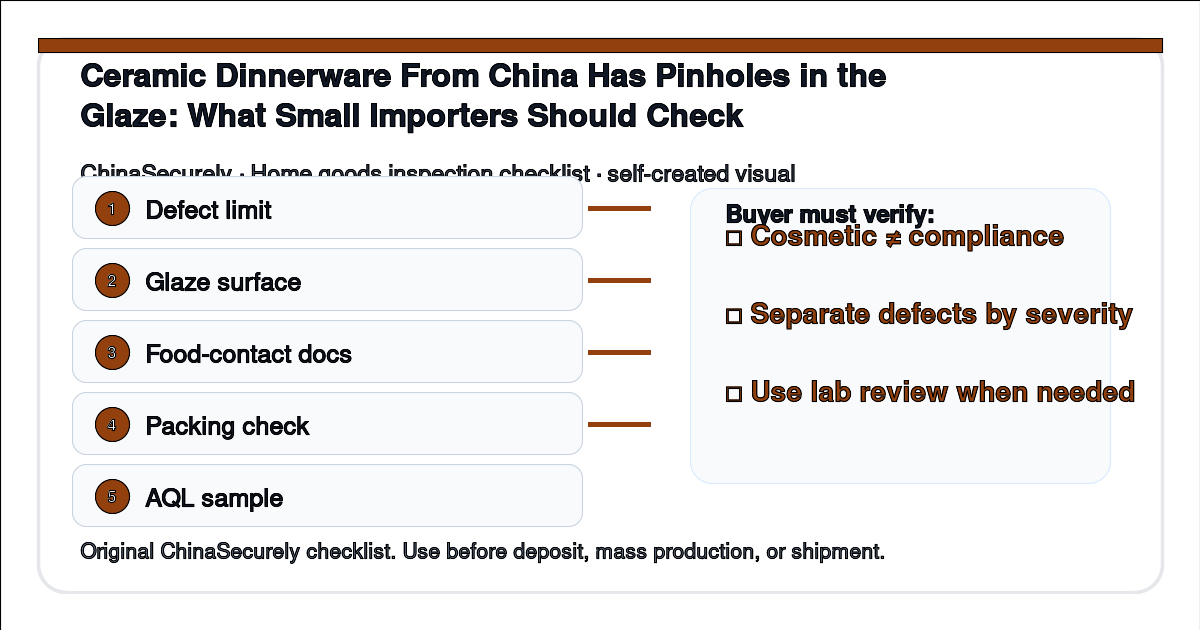
High-risk topic. Ceramic dinnerware touches food and is regulated for lead and cadmium migration. Match documents to the exact glaze, decoration, and destination market (for example US 21 CFR 109, California Proposition 65, EU Directive 84/500/EEC, China GB 4806) and confirm with a qualified lab. This article is not legal or compliance advice.
A real buyer question is: “My ceramic plates from China look good in photos, but the samples have tiny holes and black dots in the glaze. Are these normal, or should I reject the order?”
This is a higher-risk home goods topic because dinnerware touches food. The article below gives sourcing and inspection steps, not legal or lab advice.
Why this happens
Ceramic glaze defects can come from clay body preparation, dust, firing temperature, glaze thickness, kiln atmosphere, or handling before firing. Small pinholes may be tolerated in some decorative items, but dinnerware needs a much stricter conversation.
The problem for small importers is that “acceptable” is often not defined. A supplier may think a few tiny specks are normal for the price level. A buyer may think any visible defect makes the product unsellable.
Compliance is separate from appearance. A smooth-looking plate is not automatically compliant, and a visible pinhole is not by itself a complete compliance conclusion. Testing and destination-market rules matter.
China-side explanation
Ceramic production in China often has multiple stages: forming, drying, bisque firing, glazing, final firing, inspection, and packing. Each stage can create or reveal defects.
Factories may grade products into different quality levels. If a buyer negotiates aggressively on price without writing an appearance standard, the supplier may assume a wider defect tolerance. The buyer then sees pinholes, black dots, warped rims, or uneven glaze after shipment.
Food-contact documents are another issue. A document may apply to a material, glaze, color, or previous model, but not necessarily to your exact dinnerware design. Match documents carefully.
Step-by-step solution
- Separate the issue into appearance quality and food-contact compliance.
- Ask the supplier for a defect standard with photos: pinholes, black spots, glaze runs, warped rims, scratches, and chips.
- Approve a golden sample and keep it for inspection comparison.
- Ask which tests or documents apply to the exact glaze, decoration, and model you are ordering.
- For export orders, have a qualified lab or compliance adviser review destination-market requirements.
- During pre-shipment inspection, sample from multiple cartons and record defect type, location, and severity.
- Reject or rework based on written limits, not on a vague argument after production.
What to ask the supplier
Please send your appearance defect standard for this dinnerware, including pinholes, black spots, glaze runs, scratches, chips, and rim warpage. Also please confirm which food-contact test documents apply to this exact glaze, color, decoration, and model. We will review these before mass production.
If the supplier says “all ceramic is food grade,” do not accept that as proof. Ask for documents tied to the exact product.
Inspection table
| Check point | What to inspect | Buyer action |
|---|---|---|
| Pinholes | Count, size, and location | Define acceptable limit before production |
| Black spots | Surface spots or embedded particles | Separate minor cosmetic from reject defects |
| Rim and base | Warpage, chips, rough contact area | Check stability and customer-use risk |
| Decoration | Decal position, color, surface finish | Match approved sample |
| Documents | Exact model, glaze, decoration, and market | Use qualified compliance review |
Practical checklist
□ Do not rely on “food safe” as a standalone claim.
□ Ask for a photo-based defect standard.
□ Keep a golden sample for comparison.
□ Match documents to the exact glaze and decoration.
□ Sample from multiple cartons during inspection.
□ Treat compliance claims conservatively until reviewed.
Related questions
Are all glaze pinholes dangerous? Not necessarily, but dinnerware requires conservative handling because it touches food.
Can I accept small pinholes for a low-price order? Only if the defects are within your written standard and compliance review is still acceptable.
Can a normal pre-shipment inspection replace lab testing? No. Visual inspection checks appearance and packing. Lab testing checks specific safety or compliance questions.
For ceramic dinnerware, the cheapest mistake is to ask hard questions before production. The expensive mistake is discovering the issue after customers see the plates.
Sources and source status
Ceramic dinnerware is a food-contact product and lead migration is separately regulated. This article is a sourcing and inspection workflow only. Compliance with US 21 CFR Part 109 (lead in ceramic ware for food use), 21 CFR Part 177 (indirect food additives), California Proposition 65, EU Regulation 1935/2004 + Directive 84/500/EEC (ceramic lead/cadmium migration), and China GB 4806 must be reviewed against the specific glaze, decoration, and destination market by a qualified lab. Some official pages (CPSC ceramic-lead flyer) intermittently blocked automated access; confirm current limits with the source authority.
- https://www.ecfr.gov/current/title-21/chapter-I/subchapter-B/part-109
- https://www.ecfr.gov/current/title-21/chapter-I/subchapter-B/part-177
- https://food.ec.europa.eu/food-safety/chemical-safety/food-contact-materials_en
- https://www.epa.gov/lead
Additional authoritative references (added 2026-07-04)
- https://www.ecfr.gov/current/title-21/chapter-I/subchapter-B/part-109/subpart-B/section-109.240
- https://www.cdc.gov/nceh/lead/prevention/sources/ceramics.htm
FDA 21 CFR 109.240 sets lead limits for ceramic ware used with food in the US; CDC page describes lead migration risk from ceramic dinnerware to consumers. Pinhole and glaze defects can accelerate lead migration into food and should be treated as a compliance risk, not only a cosmetic issue. High-risk topic – human/Codex sign-off required before publication.
Authoritative references (added 2026-07-29)
- FDA CPG 5450.07 / 5450.08 — Lead and cadmium release from ceramicware: https://www.fda.gov/inspections-compliance-enforcement-and-criminal-investigations/inspection-technical-guides/lead-and-cadmium-release-ceramicware
- ASTM C738 — Standard test method for lead and cadmium extraction from glazed ceramic surfaces: https://www.astm.org/c0738-94.html
- California Prop 65 — Lead and cadmium safe harbor levels for ceramicware: https://oehha.ca.gov/proposition-65
- EC 1935/2004 — EU framework regulation for food contact materials (ceramicware): https://eur-lex.europa.eu/legal-content/EN/TXT/?uri=CELEX%3A32004R1935
- ISO 6486-1 — Ceramic ware in contact with food: release of lead and cadmium: https://www.iso.org/standard/63298.html
- QIMA — Ceramic dinnerware pre-shipment inspection (glaze and migration testing): https://www.qima.com/quality-control-inspections/pre-shipment-inspection
Source status: ready. Authoritative references are FDA CPG 5450.07/08 (lead/cadmium release limits), ASTM C738 (test method), California Prop 65 (safe harbor levels), EU 1935/2004 (food contact framework), and ISO 6486-1 (release test method). This is an improve-needed draft because the glaze lead/cadmium migration test is buyer-side lab work that the supplier claim does not cover.