
Many importers have had customers complain that silicone baking mats and molds from China start sticking even after careful washing. Why does this happen, and what can you check before you place a large order?
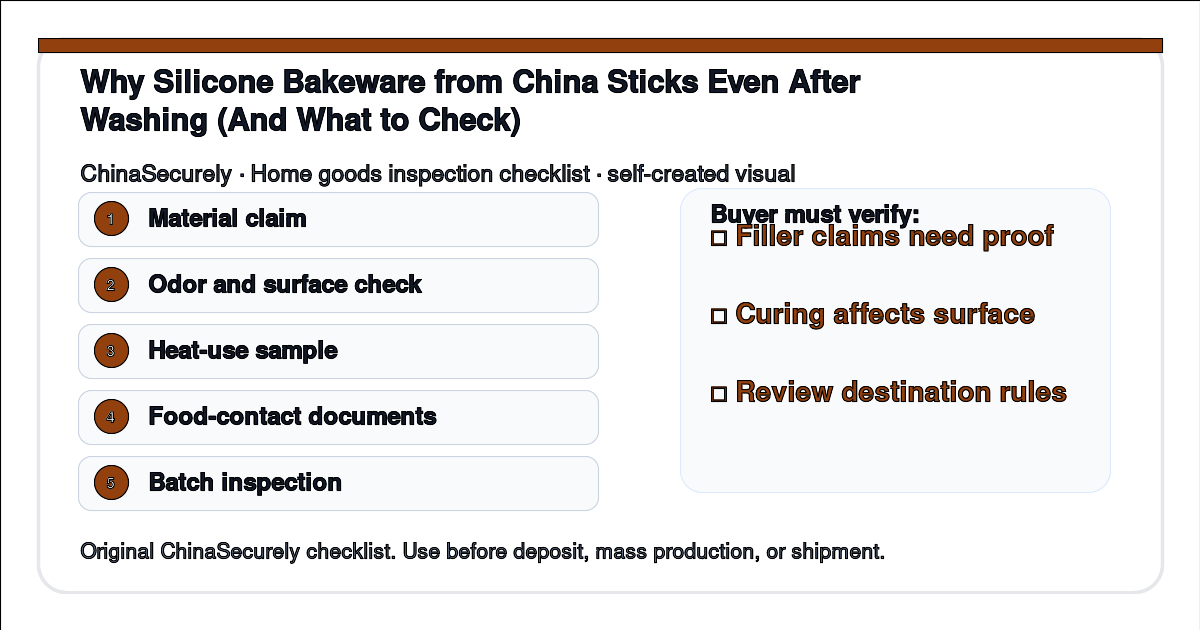
High-risk topic. Food-contact bakeware is regulated. Match supplier documents to the exact material, model, and destination market (for example US 21 CFR 177 for rubber-based food-contact materials, EU Regulation 1935/2004 + 10/2011, or China GB 4806) and confirm with a qualified lab. This article is not legal, safety, or compliance advice.
Why this happens
Sticking issues with silicone bakeware usually come from two causes:
- Too much filler added to the silicone: Unscrupulous factories add cheaper fillers (like chalk or silica powder) to stretch the silicone, which makes the surface porous and food sticks.
- Insufficient curing during manufacturing: If the silicone isn’t cured at the right temperature for the full time, the surface doesn’t fully cross-link and remains slightly sticky.
China-side explanation
For silicone products, the price difference between pure food-grade silicone and filled silicone is significant. Many Chinese factories know that visual inspection alone can’t easily tell pure silicone from filled silicone during your initial sample check. Your sample might be made with good material, but the mass production uses cheaper filled material to increase profit margins.
Curing also takes time and energy. If the factory is rushed to meet your shipping deadline, they might pull the product out of the oven early, which leaves residual stickiness that doesn’t show up until after a few washes.
Step-by-step solution
- Specify “100% food-grade silicone, no fillers” on your PO: Explicitly state that the product should pass the stretch and pinch tests you’ll do on receipt.
- Do the pinch and stretch test on samples: Pure silicone doesn’t change color when you pinch and stretch it. Filled silicone will turn lighter (to white or gray) at the stretched point.
- Boil a sample for 10 minutes: After boiling, feel the surface. If it feels oily or sticky after boiling, it probably has fillers.
- Ask for a food contact certificate: For silicone bakeware sold in the US/EU, insist on a current FDA or LFGB food contact safety certificate from an accredited lab.
What to ask your supplier (copy-paste text)
“Could you confirm that this silicone bakeware is made from 100% food-grade silicone without fillers, and provide a valid food contact safety certificate (FDA/ LFGB)? I will conduct the pinch test and boiling test on the pre-production sample.”
Trade-off notes
Pure food-grade silicone costs about 15-20% more than filled silicone. But customers who get a sticky product will leave bad reviews and hurt your brand. For kitchen products that directly touch food, the extra cost for pure silicone is absolutely necessary to keep customers happy.
Silicone Bakeware Pre-Shipment Check List
□ Do the pinch/stretch test: no color change at pinched point
□ Boil a sample for 10 minutes: no oily residue after drying
□ Check that the surface is uniformly smooth, no sticky spots
□ Confirm the food-contact certificate matches the batch
□ Wash and test: does food release cleanly after washing?
Related questions
- How to verify food safety for kitchen products from China
- What’s the difference between FDA and LFGB silicone certification
- How to handle quality claims with Chinese home goods suppliers
Sources and source status
Silicone bakeware touches food and is regulated as a food-contact material. This article is a sourcing and inspection workflow only. Food-contact compliance for your destination market (for example US 21 CFR Part 177, EU Regulation 1935/2004 and 10/2011, Germany BfR recommendations, and China GB 4806 series) must be reviewed against the specific product and target market by a qualified lab. Do not treat supplier statements such as "food safe" as proof.
- https://www.ecfr.gov/current/title-21/chapter-I/subchapter-B/part-177
- https://food.ec.europa.eu/food-safety/chemical-safety/food-contact-materials_en
- https://www.efsa.europa.eu/en/topics/topic/food-contact-materials
- https://www.bfr.bund.de/en/
Additional authoritative references (added 2026-07-04)
- https://www.ecfr.gov/current/title-21/chapter-I/subchapter-B/part-177/subpart-C/section-177.2600
- https://ec.europa.eu/food/safety/chemical-safety/food-contact-materials_en
FDA 21 CFR 177.2600 covers rubber articles intended for repeated use in contact with food, and is the primary US reference for silicone bakeware compliance. EU FCM page describes the equivalent framework in the EU. Supplier "food grade silicone" statements without a matching test report should not be treated as compliance evidence.