
When you receive a batch of custom corrugated boxes from China, you might notice the edges feel soft or crush easily even though the supplier quoted the same “3-layer E-flute” you asked for. This is one of the most common packaging quality issues small importers face.
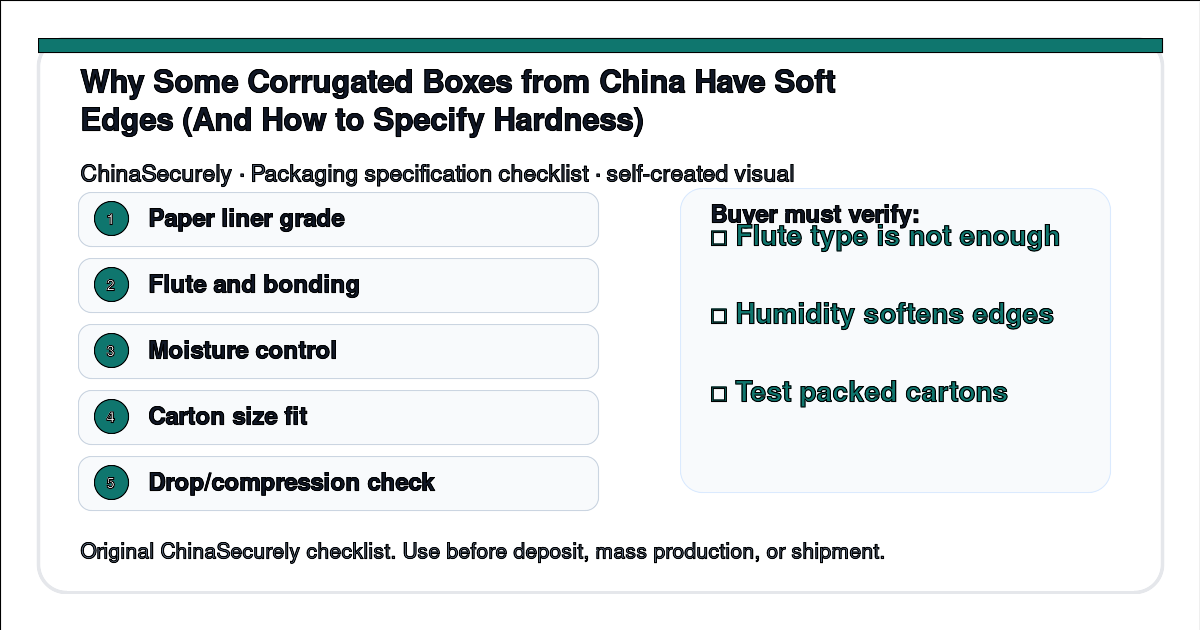
Why this happens
Corrugated box stiffness depends on two main factors most buyers don’t specify clearly:
- Paper grade for the liners: Suppliers often use lower-grade recycled paper for the outer and inner liners to cut costs. The flute might be correct, but the liners can’t hold their shape.
- Flute bonding quality: If the adhesive between the liner and flute isn’t applied evenly or fully, the layers separate easily, especially at edges where the board is cut.
China-side explanation
In Chinese packaging factories, material grading is more flexible than in North America or Europe. When you just say “E-flute corrugated”, the sales team will quote based on the cheapest available material that technically matches the flute size. They assume you won’t check edge hardness unless you explicitly require it. Factories also run large rolls of paper through multiple jobs, and a small drop in adhesive pressure at the end of a run can create soft edge sections that get passed to smaller orders.
Step-by-step solution
- Specify liner material grades explicitly: Don’t just say 3-layer E-flute. State “175 gsm kraft outer liner + 150 gsm kraft inner liner + E-flute corrugated medium”.
- Request a sample edge crush test (ECT) rating: Common ratings are 32 ECT, 44 ECT, or 65 ECT depending on your box size and weight. Match the ECT rating to your product weight.
- Check the sample before approval: Press the edge of the sample box against a hard surface. If it bends more than 10 degrees under light pressure, ask for a stiffer option.
- Add a line to your purchase order: “All edges must be fully bonded and show no softness when pressed by hand. 10% of boxes in random check must meet ECT rating.”
What to ask your supplier (copy-paste text)
“Could you please confirm the exact paper grammage for the outer and inner liners for this order? Please also provide the Edge Crush Test (ECT) rating and include one sample piece for our hardness check before full production.”
Trade-off notes
Higher grade liners and better bonding usually add 5-10% to the total box cost. But soft edges lead to more damaged goods in transit, which often costs 10-20% of your order value in returns and lost customers. For heavier products (>5kg per box), the extra stiffness is almost always worth the cost.
Pre-shipment Soft Edge Check List
□ Check 5 random boxes from different parts of the shipment
□ Press each corner and edge firmly between your thumb and forefinger
□ Reject the batch if more than 1 box in 5 has visibly soft edges
□ Ask the factory to re-glue loose edges or replace affected boxes
□ Confirm ECT rating with a simple manual test if no lab test is available
Related questions
- How to specify correct corrugated board for shipping heavy products
- What is the difference between recycled kraft and virgin kraft paper for packaging
- How to check for bad bonding in corrugated boxes before shipment
Sources and source status
Sources support corrugated packaging and compression/drop-test context. The exact test method and pass level must be agreed with the supplier or inspection provider for each product.