
Buyer Question: Microfiber cleaning cloths I imported start smelling musty after a few washes. Supplier says it’s my water quality. Is that true?
Sources: Reddit r/ecommerce, Reddit r/FulfillmentByAmazon, microfiber textile industry public guides, Zhejiang microfiber factory public catalog pages
The Buyer Question
“I imported microfiber cleaning cloths from China for a commercial cleaning supply business. After 3–4 washes in a commercial washing machine, the cloths develop a persistent musty smell. The microfiber supplier says this is my water quality or detergent problem, not theirs. Is that accurate?”
The supplier is partially right about water quality, but they are deflecting from a real product quality issue. The musty smell in microfiber cloths after washing is a combination of factors — and the product’s fiber quality and density play a significant role.
Short Answer
The musty smell is caused by bacteria and mold growing in the microfiber structure between uses. This happens because: (1) low-quality microfiber has a more open fiber structure that traps moisture and organic matter, (2) the cloths were not properly dried after use, and (3) detergent residue in low-quality microfiber creates a breeding ground for bacteria. You can reduce or eliminate the smell with proper washing technique, but the root cause is often product quality. Request a higher GSM microfiber with a tighter weave specification for future orders.
Why This Happens
1. Fiber split quality determines absorbency and odor. High-quality microfiber (typically 80/20 polyester/polyamide blend) is manufactured by splitting the polyester fibers to create microscopic hook-like structures that trap dirt and moisture. Low-quality microfiber may not be fully split, reducing its ability to release water and organic matter during washing.
2. Low GSM means faster bacterial growth. GSM (grams per square meter) measures microfiber density. A higher GSM cloth (300–400 GSM) is denser, dries faster, and has less internal space for bacterial growth. Low GSM cloths (200–250 GSM) dry more slowly and retain more moisture between uses.
3. Detergent residue feeds bacteria. Low-quality microfiber has more surface area and more fiber gaps where detergent residue accumulates. This residue feeds bacteria and creates biofilm that produces the musty smell.
4. Improper drying. If microfiber cloths are stored in a damp pile or in a non-breathable bag after use, they retain moisture. Even “dry” looking cloths can harbor moisture in the fiber core.
5. Fabric softener destroys microfiber. Using fabric softener on microfiber coats the fibers and reduces their split structure, eliminating the cleaning performance and creating a residue that feeds bacteria.
China Supply Chain Perspective
Microfiber production is concentrated in:
- Zhejiang (Hangzhou, Shaoxing) — largest microfiber textile production in China
- Jiangsu (Suzhou, Wujiang) — high-quality microfiber for export
- Shandong — industrial microfiber production
- Guangdong — consumer-grade microfiber goods
The 80/20 polyester/polyamide ratio is the standard for quality cleaning microfiber. Lower ratios (70/30) are cheaper but less effective. Some very cheap microfiber uses 100% polyester with no polyamide — this is effectively just cheap polyester fabric, not true split microfiber.
Raw material price for quality 80/20 microfiber is approximately $2.50–$4.00/kg for the fabric. Very low-priced microfiber cloths may use recycled polyester or low-grade materials.
The key quality indicator for microfiber is split quality — whether the fibers were properly split during manufacturing. This is visible under a microscope (100x magnification): split fibers look like an asterisk; unsplit fibers look like a smooth circle.
Step-by-Step: Solving the Smell Problem
Step 1: Test Current Cloths with Proper Washing
Wash the cloths using only hot water (60°C/140°F) and no detergent — just hot water. This removes detergent residue that may be feeding bacteria.
If the smell persists after a hot water-only wash, the problem is deeper (fiber quality). If it resolves, the detergent residue was the issue.
Step 2: Strip the Cloths
Perform a “strip” wash:
- Hot water (60°C) + washing soda (not detergent) — 2 tablespoons
- Run a full wash cycle
- Rinse thoroughly with clean water
- Dry completely in a dryer on high heat or in direct sunlight
This removes embedded residue that regular washing cannot clean.
Step 3: Check Fiber Quality Under Magnification
Using a 100x magnifying glass or USB microscope:
- Good split microfiber: Fibers appear as multiple fine strands, irregular cross-section
- Unslit or poorly split microfiber: Fibers appear as smooth, round individual strands
Poorly split microfiber cannot be fixed — it is a product quality issue.
Step 4: Adjust Washing Routine
For future use:
- Wash in hot water (60°C+) at least weekly
- Use minimal detergent — microfiber needs very little
- Never use fabric softener
- Never use bleach on colored microfiber (bleach damages the polyester)
- Dry completely before storing — do not leave in a damp pile
Step 5: Specify Higher Quality for Future Orders
For next order, specify:
- 80/20 polyester/polyamide blend (state this explicitly)
- Minimum 300 GSM for cleaning cloths
- Split fiber confirmed — supplier to provide fiber cross-section photo
- Bleaching agent-free production — some manufacturers use optical brighteners that leave residue
Costs, Risks, and Trade-offs
| Action | Cost | Risk if Skipped |
|---|---|---|
| Strip wash of existing cloths | $5–10 in detergent | Smell persists |
| Fiber quality test (magnification) | $20–50 for microscope | Cannot identify root cause |
| Upgrading to 300+ GSM microfiber | +20–30% cost per cloth | Smell continues |
| Specifying 80/20 blend | Free in contract | Supplier uses cheaper ratio |
| Adjusting washing routine | Free | Same smell recurs |
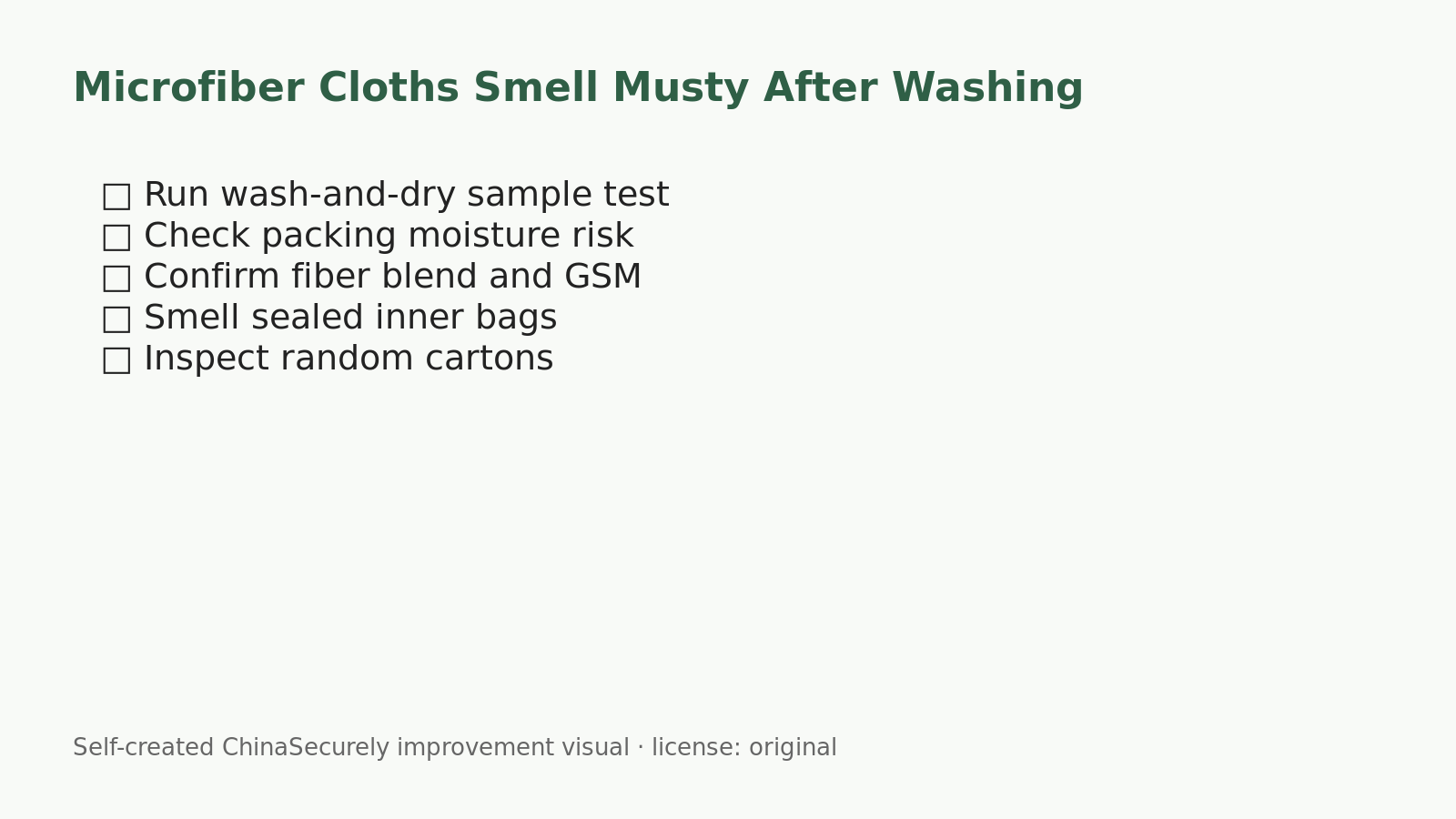
Practical Checklist for Importers
- □ Hot water only wash test completed
- □ Strip wash completed
- □ Fiber quality checked under 100x magnification
- □ Washing routine adjusted (no fabric softener, minimal detergent)
- □ Cloths completely dried before storage
- □ Next order specifies 80/20 ratio in writing
- □ Next order specifies minimum 300 GSM
- □ Split fiber quality confirmed via supplier photo
- □ Supplier provides fiber cross-section documentation
- □ Washing instructions label included with product packaging
Related Questions
Is the supplier right that it’s my water quality?
Water quality can contribute to microfiber odor, but it is not the primary cause. Hard water can leave mineral deposits in microfiber, but these do not typically cause a musty smell. The musty smell is bacterial, not mineral. If the supplier blames water quality without addressing fiber quality and washing method, they are deflecting.
Can I sell microfiber cloths that smell musty after washing?
No. Musty-smelling microfiber indicates bacterial contamination, which is a hygiene issue. If buyers receive cloths that smell bad even after proper washing, returns and negative reviews will follow. Address the quality issue with the supplier or source better-quality microfiber.
Does vinegar work to remove microfiber smell?
White vinegar (1/2 cup in the rinse cycle) can help kill bacteria and remove detergent residue. It is a useful maintenance step. But it is not a fix for low-quality microfiber — the smell will return if the underlying fiber quality is poor.
Need Help Checking a China Sourcing Route or Supplier?
Send the product, target country, order size, and current quote. ChinaSecurely can help you understand the risks before you pay.
Article Metadata
Featured Image: Comparison table — “High-Quality vs. Low-Quality Microfiber: Fiber Structure Under Magnification”
Tags: microfiber, cleaning cloths, odor, material quality, mold, amazon seller, GSM, split fiber
Author: Nora Lin, Home Goods Desk
Sources: Reddit r/ecommerce, Reddit r/FulfillmentByAmazon, microfiber textile industry public guides, Zhejiang microfiber factory public catalog pages
Source notes added during draft-bank optimization
These links are used as public background for inspection, packaging, material, or standards context. They do not certify this specific supplier or product. The checklist image is self-created by ChinaSecurely.