
Buyer Question: Wire bathroom baskets started showing rust spots after 2 months. Sample looked perfect. What type of coating should I request to prevent this?
Sources: Reddit r/smallbusiness, Amazon Seller Forums, 1688 wire product factory pages, ASTM B117 public information
The Buyer Question
“I imported 400 wire bathroom organizer baskets from China. After 2 months of use in a humid bathroom, 30% show orange rust spots. The sample I approved looked perfect for 6 months before I ordered. What went wrong, and how do I prevent this on my next order?”
This is a coating and material specification problem, not a usage problem. Bathrooms are high-humidity environments, and the wrong wire coating will fail every time.
Short Answer
Wire baskets that develop rust in a bathroom after 2 months were either uncoated or under-coated steel wire, or they used an inferior coating type. For humid environments, you need to specify electroplated zinc coating (zinc plating), powder coating, or chrome plating — and you need to state the minimum coating thickness in your order, not just “anti-rust coating.” A sample that lasts 6 months but a bulk order failing at 2 months suggests the supplier sent a different quality sample than what was mass produced.
Why This Happens
1. “Anti-rust coating” is not a specification. Any supplier can write “anti-rust coating” on their product page. Real anti-rust treatments have specific names, standards, and minimum thickness requirements. Without these, the supplier will use the cheapest option.
2. Electroplating thickness varies widely. Quality zinc electroplating for bathroom use should be 8–12 microns minimum. Many cheap suppliers use 3–5 micron electroplating, which fails quickly in humid conditions.
3. Powder coating alone is insufficient for raw steel wire. Some suppliers claim their baskets are “powder-coated” without first applying a zinc undercoat. On raw steel, powder coating chips at wire bending points and moisture gets underneath, causing rust from the inside out.
4. Sample mass production mismatch. This is a deliberate tactic used by some suppliers: send a high-quality sample (perhaps hand-finished or from a different production batch), then mass produce with cheaper materials. The sample you approved may have had a different coating specification than what was actually shipped.
5. Chrome plating confusion. “Chrome finish” can mean decorative chrome (very thin, for aesthetics only) or hard chrome (functional, 20–50 microns thick). Decorative chrome over bare steel in a bathroom will fail within weeks.
China Supply Chain Perspective
Wire basket production is concentrated in several Chinese manufacturing clusters:
- Hebei (Anping, Hengshui) — largest wire mesh and wire product cluster, primarily industrial grade
- Zhejiang (Yiwu, Jinhua) — consumer-grade wire home goods
- Guangdong (Foshan, Jiangmen) — higher-finish consumer wire goods
Hebei products are generally cheaper and aimed at industrial use. Zhejiang and Guangdong producers tend to have better surface finishing for consumer products, but quality still varies significantly.
Common coating types and their bathroom suitability:
| Coating Type | Bathroom Suitable | Min Thickness | Relative Cost |
|---|---|---|---|
| No coating (bare steel) | No | N/A | Base |
| Clear lacquer/ varnish | No | N/A | Base + small |
| Electroplated zinc (trivalent) | Yes (with adequate thickness) | 8+ microns | Moderate |
| Powder coating over zinc | Yes | 8+ micron Zn + 60+ micron PC | Moderate-High |
| Chrome (hard chrome) | Yes | 20+ microns | High |
| Stainless steel wire | Yes | N/A | Highest |
The cost jump from bare steel to zinc-plated wire is approximately 15–25%. From zinc-plated to stainless steel is 40–80%.
Step-by-Step Prevention Process
Step 1: Specify the Exact Coating Type in Writing
Do not write “anti-rust coating.” Instead, specify:
- “Electrozinc plating, minimum 10 microns, trivalent chromium finish”
- “Electrozinc undercoat (8 micron minimum) + polyester powder coat (60 micron minimum)”
- “Hard chrome plating, minimum 20 microns”
Step 2: Request a Coating Thickness Test on the Sample
Ask the supplier to provide a coating thickness test report for the sample. This uses an instrument called a magnetic thickness gauge and is inexpensive ($20–$50 per sample point).
Minimum requirements to state:
- Each basket sample tested at minimum 5 points
- Average coating thickness meets your spec
- No reading below your minimum threshold
Step 3: Add a Salt Spray Test Requirement
Request a salt spray test report (per ASTM B117 or ISO 9227) showing the product passes:
- 48 hours for standard zinc plating
- 96 hours for zinc + powder coat
- 200 hours for hard chrome
This accelerates what happens in a humid bathroom over 6–12 months.
Step 4: Inspect Before Shipping
Before your shipment leaves the factory, request:
- Visual inspection of each basket under good lighting — no exposed steel, no chips in coating
- Random sampling: 5% of shipment, check coating adhesion (tape test)
- Coating thickness spot-check with magnetic gauge
Step 5: Store Products Properly Upon Arrival
Even with correct coating, store wire goods in a dry environment before selling. Moisture in a container during sea freight, followed by warm storage, can accelerate early-stage corrosion.
Costs, Risks, and Trade-offs
| Action | Cost | Risk if Skipped |
|---|---|---|
| Specify coating in writing | Free | Supplier uses cheapest option |
| Coating thickness test | $20–$50/sample | Bulk order fails quickly |
| Salt spray test report | $50–$100 | No acceleration data |
| Pre-ship inspection | $50–$100 | Defective goods shipped |
| Upgrading to stainless steel wire | +40–80% cost | Zero rust risk, high price |
Practical Checklist for Importers
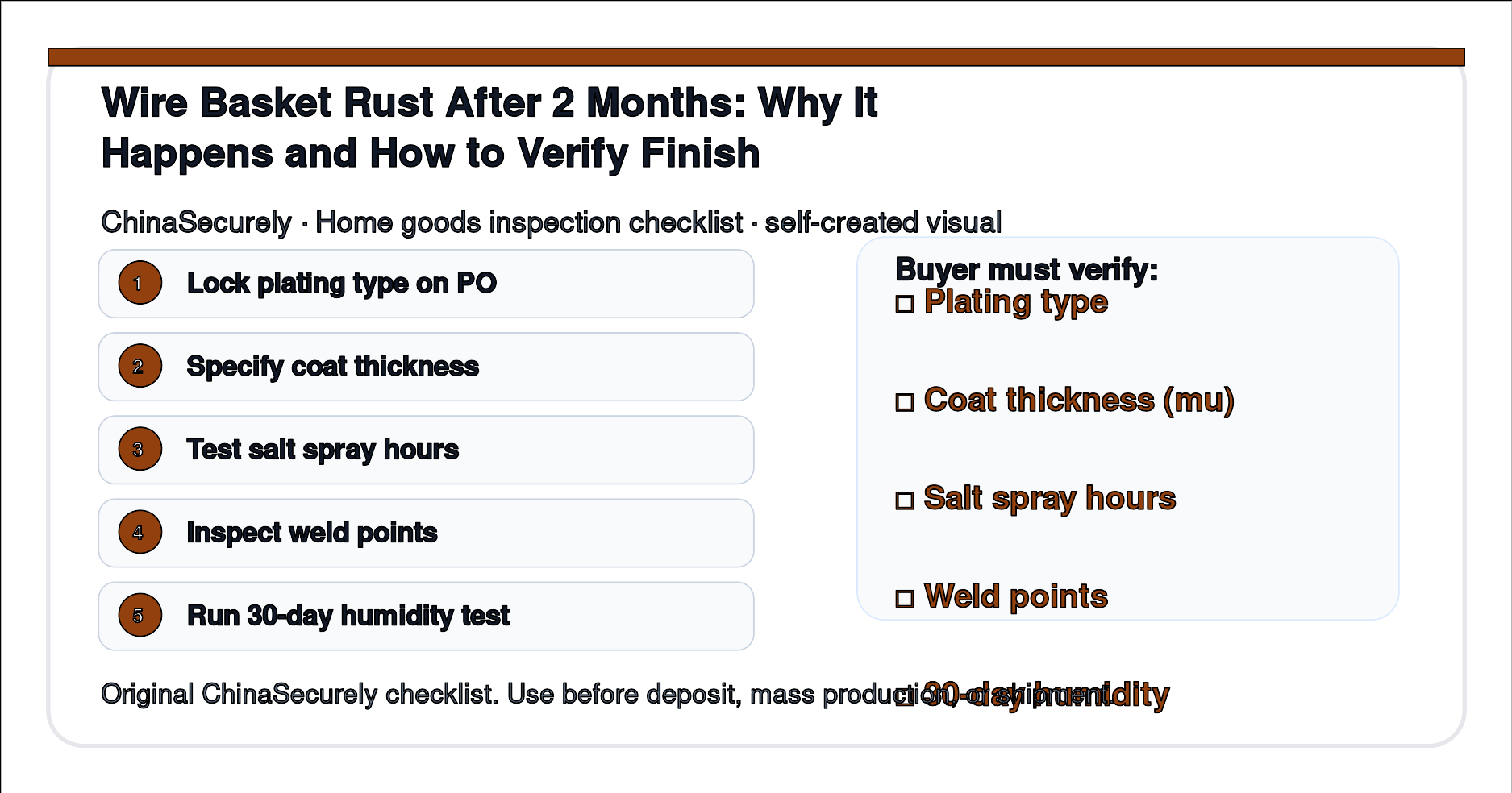
- □ Written coating specification in purchase order (not just “anti-rust”)
- □ Coating type and minimum thickness explicitly stated
- □ Salt spray test result required (48hr minimum for bathroom use)
- □ Sample tested for coating thickness before approval
- □ Pre-ship inspection includes coating condition check
- □ Each basket visually inspected for coating chips before packing
- □ Storage area is dry — no damp warehouse
- □ If using stainless steel, specify grade (304 vs. 201) in writing
- □ Packaging includes silica gel desiccants
- □ “Bathroom use” environment stated explicitly to supplier
Related Questions
Is stainless steel wire worth the cost for bathroom baskets?
For bathroom use, yes. 304-grade stainless steel wire will not rust in any bathroom environment. The cost premium is 40–80% over zinc-plated steel, but it eliminates the entire rust claim category. For premium-priced bathroom organizers, this is the right choice.
The sample had no rust for 6 months. Why did the bulk order rust in 2 months?
This is a red flag for sample mass production mismatch. The sample may have been from a different production batch or even hand-finished. Never approve a sample without requesting a coating thickness test, and always specify the coating requirement in the purchase order.
Can I claim a refund for rusty baskets?
If you have a written coating specification and the product failed within a reasonable timeframe (2 months in bathroom use is reasonable), you have grounds for a claim. Document the rust with photos showing the date, and compare it to your original sample.
Need Help Checking a China Sourcing Route or Supplier?
Send the product, target country, order size, and current quote. ChinaSecurely can help you understand the risks before you pay.
Article Metadata
Featured Image: Infographic — “Wire Basket Coating Types Compared: Which Lasts in Bathrooms”
Tags: wire basket, rust, coating, bathroom, storage, anti-rust, supplier specification
Author: Nora Lin, Home Goods Desk
Sources: Reddit r/smallbusiness, Amazon Seller Forums, 1688 wire product factory pages, ASTM B117 public information
Authoritative references (added 2026-07-21)
- https://www.astm.org/b117-19.html
- https://www.iso.org/standard/62577.html
- https://www.astm.org/d7091-21.html
- https://www.astm.org/d610-08.html
- https://www.galvanizeit.org/
- https://www.qima.com/quality-control-inspections/pre-shipment-inspection
ASTM B117 is the salt spray (fog) test standard for metallic coatings. ISO 9227 covers corrosive atmospheres salt spray tests. ASTM D7091 covers dry coating thickness measurement. ASTM D610 covers evaluating rust on coated steel surfaces. AGA (American Galvanizers Association) is the authoritative reference for galvanized coatings. Prior source set was missing; expanded with category-specific salt spray and coating thickness references.