
Buyer Question: Ordered glass food containers with lids. 20% arrived with hairline cracks or broken lids. Supplier says it’s normal. Is this a shipping problem or supplier problem?
Sources: Reddit r/FulfillmentByAmazon, Amazon Seller Forums, 1688 packaging specification pages, Hebei/Shengfang glass factory public catalog pages
The Buyer Question
“I ordered 500 glass meal prep containers from a Chinese supplier. The order arrived by sea freight to California. When I opened the cartons, about 20% had hairline cracks or broken lids. The supplier says 5–10% breakage is normal for glass products. Is this true, or can I claim a refund?”
This is one of the most common complaints from importers of glass home goods. The answer depends on the packaging standard, the shipping method, and what you agreed to in writing before ordering.
Short Answer
A 20% breakage rate is not normal for properly packed glass food containers. Industry-acceptable breakage for well-packaged glass is typically under 3%. If you are seeing 20%, either the packaging was inadequate, the stacking in the shipping container was incorrect, or the supplier used inferior packaging materials to cut costs. You have a legitimate claim — but only if you documented the damage correctly and have a clear clause in your purchase contract.
Why This Happens
1. Packaging material mismatch. Quality glass exporters from China use foam dividers, corrugated dividers, or molded pulp between each unit, plus double-wall corrugated cartons. Cheap packaging substitutes a single-wall carton with minimal dividers. The per-unit packaging cost difference can be $0.30–$0.80 — significant at 500 units.
2. Incorrect inner packaging for glass. The correct approach is either: (a) individual compartments for each container + lid, or (b) interlocking designs where containers nest. Many suppliers pack lids loosely in the same carton section as the containers, causing lid breakage during transit.
3. Container stacking in ocean freight. In a 20ft container, glass products must not be placed in the bottom rows where weight from other pallets compresses them. If the freight forwarder or supplier arranged the loading without proper distribution, breakage increases sharply.
4. Moisture damage during sea freight. Glass containers are often shipped in non-ventilated containers. If desiccants were not used, moisture buildup in a refrigerated container (or in high-humidity ports) can weaken glass over time.
5. Supplier substitution. Some suppliers send a sample with premium packaging, then ship the bulk order with cheaper materials. This is a deliberate cost-cutting measure, not an accident.
China Supply Chain Perspective
Most glass food containers on the global market come from Chinese factories in:
- Hebei (Shengfang, Xian County) — largest production cluster for glass food containers
- Zhejiang (Jinhua, Quzhou) — known for heat-resistant glass
- Shandong — borosilicate glass production
Hebei factories dominate on price. Zhejiang factories tend to have stricter quality controls. A Hebei factory price is typically 10–20% lower, partly because they use cheaper soda-lime glass rather than borosilicate glass for food containers.
Borosilicate glass (heat-resistant, typically used for Pyrex-style containers) has a higher breakage resistance than soda-lime glass. If your supplier sent soda-lime glass when you paid for borosilicate, breakage rates will be higher by design.
Step-by-Step Process
Step 1: Document Damage Immediately
When the shipment arrives:
- Photograph every damaged carton before opening — show the carton condition (dents, moisture, crushing).
- Photograph damaged units in detail — show the crack pattern and which part broke.
- Weigh the total shipment — if weight is short, there may be missing units.
- Count and categorize damage: cracked containers vs. broken lids vs. missing components.
Do not discard damaged units until the claim is resolved.
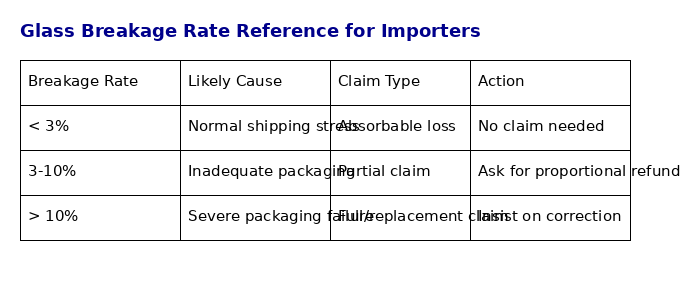
Step 2: Calculate the Actual Breakage Rate
Count total units received vs. damaged. 20% is almost certainly a packaging problem. 2–3% is within shipping tolerance.
| Breakage Rate | Likely Cause | Claim Type |
|---|---|---|
| < 3% | Normal shipping stress | Absorbable loss |
| 3–10% | Inadequate inner packaging | Partial claim |
| > 10% | Severe packaging failure or material issue | Full claim + replacement |
Step 3: Check Your Purchase Contract
If your contract included:
- Acceptable breakage threshold (e.g., “breakage under 3% is acceptable”)
- Packaging specification (e.g., “foam dividers between each unit, double-wall carton”)
- Insurance clause
You have grounds to claim. If your contract just said “500 units glass food containers,” it will be harder.
Step 4: File a Claim with Documentation
Contact the supplier with:
- Photos of damage (in-carton + individual units)
- Packing list showing ordered quantity vs. received condition
- Calculation of breakage percentage
- Reference to contract packaging terms
Request: partial refund proportional to breakage rate OR replacement shipment.
Step 5: Prevent Future Breakage
Specify these packaging requirements in future orders:
- Foam dividers or molded pulp between each container
- Separate lid box or lid compartment
- Double-wall corrugated carton, minimum 5-ply
- “This Side Up” and “Fragile” labels in Chinese and English
- Desiccants for sea freight
- Maximum stacking height of 5 cartons
Costs, Risks, and Trade-offs
| Action | Cost | Risk if Skipped |
|---|---|---|
| Photographic documentation | Free | No evidence for claim |
| Packaging specification in contract | Free | Supplier uses cheap packaging |
| Order 50-unit pre-ship sample | $80–$200 | Discover breakage too late |
| Marine cargo insurance | 0.3–1% of shipment value | Total loss unrecoverable |
| Packaging inspection at factory | $50–$100 | Packaging problems undetected |
Practical Checklist for Importers
- □ Ordered pre-ship sample of 20–50 units to test packaging
- □ Packaging specification written into purchase contract with exact materials listed
- □ Breakage threshold clause included (recommend: < 3% acceptable)
- □ Photos taken of damage within 24 hours of receipt
- □ Breakage percentage calculated before contacting supplier
- □ Supplier’s preferred packaging confirmed matches your spec
- □ Marine cargo insurance purchased for shipment
- □ Freight forwarder notified of fragile glass goods
- □ Desiccant packs included for sea freight route
- □ “Fragile” and “This Side Up” labels required on carton
Related Questions
The supplier says sea freight is my responsibility. Is that true?
The INCOTERM matters. If you bought FOB or EXW, the sea freight is your arrangement and your risk. If you bought CIF or DDP, the supplier is responsible for the shipping arrangement and must declare the goods properly. Check your INCOTERM before assuming who is liable.
Can I file a claim with my freight forwarder?
Possibly, if the damage was caused by improper handling during loading/unloading or if the container was damaged. But freight forwarders typically do not cover inherent product fragility. Document the damage before the container leaves the port.
Is 5–10% breakage really normal for glass from China?
No. This is a supplier talking point to reduce claims. Properly packaged glass products from China routinely arrive with less than 2% breakage. If a supplier consistently claims “5–10% is normal,” they are using inadequate packaging and hoping buyers accept the loss.
Need Help Checking a China Sourcing Route or Supplier?
Send the product, target country, order size, and current quote. ChinaSecurely can help you understand the risks before you pay.