
Short answer: spot UV is a high-gloss varnish printed on top of matte lamination to make logos and patterns pop. Matte lamination is a thin film glued to the entire surface that gives a soft, fingerprint-resistant feel. Both finishes look premium when fresh, but they age differently. Spot UV scratches when stacked in cartons without tissue; matte lamination scuffs at the corners during shipping.
A real buyer question is: “I approved a sample for a 5,000-piece matte lamination cosmetic box with spot UV logo. The cartons arrived with the spot UV scratched off the logo on the top 30 percent of the stack. The supplier says the cartons passed their QC. How do I prevent this on my next order?”
Why this problem happens
Cosmetic buyers who specify “matte lamination with spot UV” on a Chinese packaging PO usually get one of three outcomes: the spot UV bleeds into the matte, the matte scratches during die-cutting, or the spot UV layer peels off during shipping. The reason is that the supplier is choosing the varnish chemistry, the lamination film thickness, and the press sequence without telling the buyer.
- Matte lamination film is usually 23 to 30 microns. Below 23 microns the surface scuffs at the corners during shipment.
- Spot UV varnish coverage under 30 percent of the box face is hard to control on a small press; over 60 percent it competes visually with the matte.
- Press sequence matters: matte lamination is applied first, then spot UV is printed on top. Reverse the order and the spot UV disappears into the matte film.
- The proof cycle is the silent cost driver. Most suppliers send one digital proof and one physical proof; cosmetic buyers usually need three.
China-side explanation
Most Chinese cosmetic-box suppliers run two-pass lamination on a single automatic line. The matte film is glued to the printed sheet, then spot UV is jetted on top through a screen or digital head. The press operator sets the UV lamp intensity and the line speed; both are dialed for the cheapest run, not for the best cosmetic feel. A buyer who does not pin the UV lamp intensity and the line speed gets whatever the supplier chooses that day.
Spot UV chemistry also differs. Water-based UV is cheaper but takes longer to cure; solvent-based UV gives a deeper gloss but yellows slightly on white card. The supplier will not name the chemistry unless asked. For a white-on-white cosmetic box, water-based UV usually wins. For a dark color, solvent-based UV gives a sharper edge.
Step-by-step solution
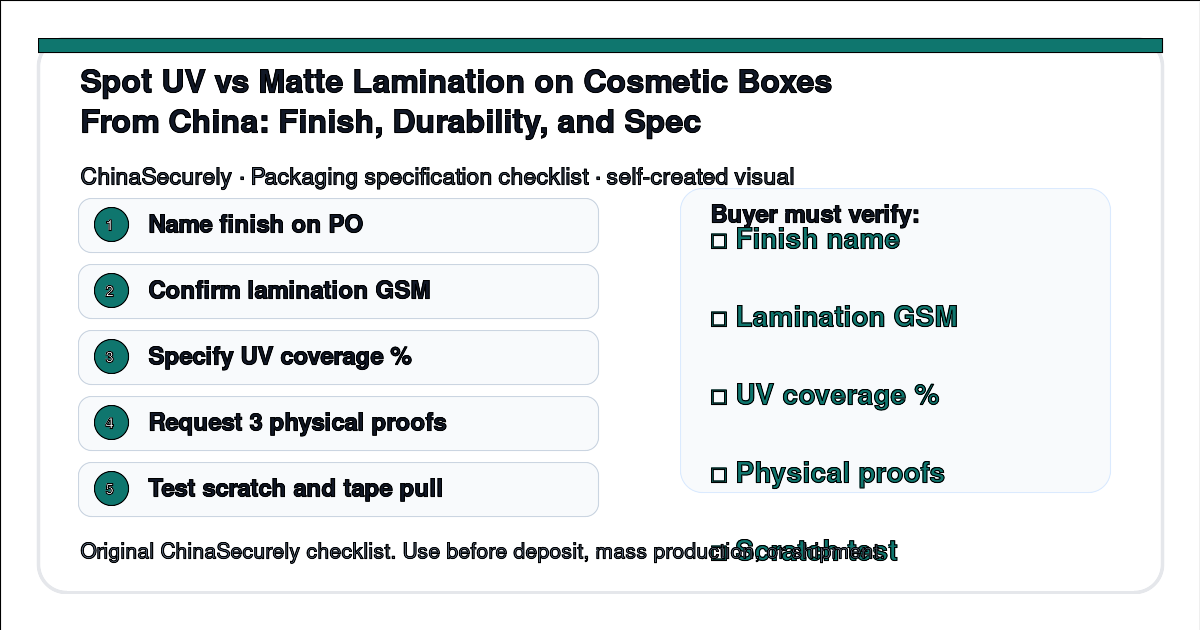
- Name both finishes on the PO: matte lamination film 25 microns minimum, spot UV coverage expressed as a percentage of the box face.
- Ask the supplier to name the spot UV chemistry (water-based or solvent-based) and the press sequence in writing.
- Request three physical proofs: full matte no UV, full UV no matte, partial UV on matte. Approve one before bulk.
- Run a scratch test on each proof: 10 firm rubs with a cotton pad and a 3M tape pull. If matte scuffs at the corners or UV peels, reject.
- Specify tissue paper between each box in the master carton for stacks above 12 boxes. Without tissue, spot UV transfers from one box to the next.
- Lock the lamination GSM, the UV coverage percentage, and the press sequence on the PO with a side-by-side photo.
Side-by-side comparison
| Factor | Spot UV on matte | Matte lamination only |
|---|---|---|
| Visual feel | Gloss accent on soft matte | Soft, uniform matte |
| Per-box cost adder | USD 0.04 to 0.12 | USD 0.01 to 0.03 |
| Scratch risk during shipment | High at UV edges | Medium at corners |
| Fingerprint resistance | High on matte, low on UV | High |
| Press complexity | Two passes | One pass |
| Best for dark colors | Yes | No (looks flat) |
| Best for white-on-white | Yes (sharp edge) | Yes (uniform feel) |
| Failure mode | UV peel during shipment | Corner scuff |
Trade-offs and uncertainty
- Spot UV vs matte lamination is a finishing decision, not a quality decision; both can be done well or badly. The finish choice should match the carton use, the storage conditions, and the shipping method.
- Spot UV scratch resistance depends on the underlying ink chemistry; some metallic and fluorescent inks accept spot UV poorly. Ask the supplier for a printed sample with the actual production ink stack.
- Matte lamination fingerprint visibility depends on the film thickness; 18 to 25 micron film is more fingerprint-resistant than 12 to 15 micron film.
- A US warehouse that runs 60 to 70 percent relative humidity in summer may cause matte lamination to lift at corners; specify edge sealing or use a water-based lamination.
Buyer checklist before signing the PO
- Both finishes are named: matte lamination + spot UV coverage %.
- Lamination film thickness is on the PO (25 microns minimum).
- UV chemistry is named (water-based or solvent-based).
- Press sequence is named (matte first, UV second).
- Three physical proofs are approved before bulk.
- Scratch and tape pull tests pass on the approved proof.
- Tissue paper between boxes is specified for stacks above 12.
Authoritative references
- ISO 15378 — primary packaging inks reference
- TAPPI — paper, printing, and lamination test methods
- GS1 — barcode standards for retail packaging
- FedEx — packing guidelines for retail shipments
- Flexographic Technical Association — print process reference
- QIMA — pre-shipment inspection and supplier verification
Finish choice is a specification decision, not a design preference. ISO 15378, TAPPI test methods, GS1 barcode standards, and FedEx packing guidelines are the public references for this category. Always approve a physical proof before bulk and run a scratch test on the proof. This article is a sourcing verification checklist, not a printing engineering specification.
Source and verification notes (updated 2026-07-30)
- ASTM D3359 — Measuring adhesion by tape test: https://www.astm.org/d3359-23.html
- ASTM D4060 — Abrasion resistance using the Taber Abraser: https://www.astm.org/d4060-19.html
- ISO 2409 — Paints and varnishes cross-cut test: https://www.iso.org/standard/76041.html
- FINAT test methods for labels and related materials: https://www.finat.com/knowledge/finat-test-methods
Finish durability depends on ink system, coating chemistry, curing energy, substrate surface treatment, storage, and handling. Test the real printed and laminated production sample; a finish name such as “matte lamination” is not a complete specification.