
Short answer
Cotton bath towels from a Chinese supplier that shed lint heavily on the first three or four washes usually have low-twist yarn, insufficient singeing, and a weak dye and finishing sequence. Some shedding on the first wash is normal; heavy shedding beyond wash three is a manufacturing problem. You can prevent complaint waves by naming yarn count, twist, GSM, and finish in the PO, requiring a supplier wash-test video, and adding a pilling and shedding test to pre-shipment inspection.
A real buyer scenario
A homeware Amazon seller in Canada imported 2,400 cotton bath towels from a Gaoyang mill. The sample felt soft and fluffy. First customer reviews complained that dryer lint traps filled with towel fibers after every wash for the first month. Returns and one-star reviews arrived within two weeks. The seller asked whether the supplier had substituted materials. The materials were probably correct on paper; the finish process was the actual problem.
Why this happens
Three factors control how much a cotton bath towel sheds during the first month of use:
- Yarn twist: low-twist yarn feels softer but sheds more fiber, especially in shorter cotton staple lengths.
- Singeing: a controlled flame or singeing process burns off surface fuzz before dyeing. Skipped or shallow singeing leaves loose fiber in the loop pile.
- Finishing sequence: soft-hand chemical finishes and mechanical softening can mask a poor pre-treatment. Once the finish washes out, shedding gets worse.
Some initial shedding is normal on any cotton towel. Excess shedding past the third wash cycle indicates a process issue, not a normal break-in.
China-side explanation
Bath towel mills in Hebei, Zhejiang, and Shandong typically compete on three specification levers: yarn count, twist multiplier, and GSM (grams per square meter). Different combinations produce very different feel and durability at the same nominal price:
- Low twist, high GSM: feels plush, sheds more, less durable.
- Higher twist, moderate GSM: feels less plush initially, sheds less, more durable.
- Cheap short-staple cotton with heavy softener: feels great in the box, sheds heavily, softener washes out quickly.
A small importer who buys on “look and feel” alone is likely to receive the third option. Without written yarn count, twist, and staple length in the PO, the mill will quote and produce the cheapest combination that meets the visual sample.
Step-by-step solution
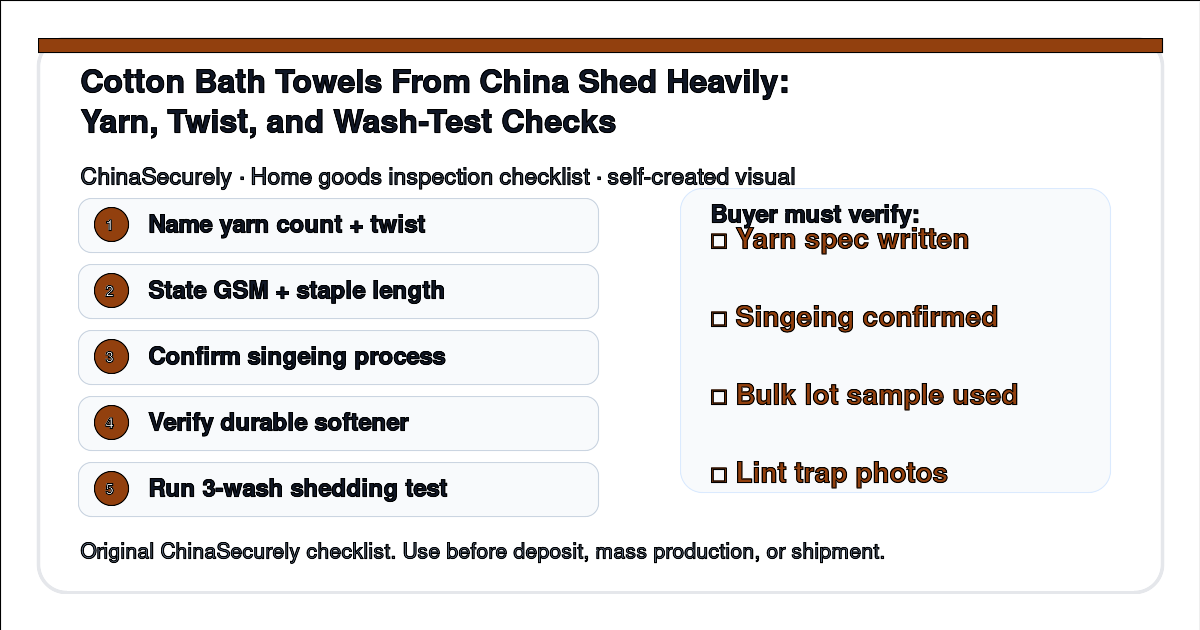
- Write yarn count, twist multiplier, staple length, GSM, and finish process into the PO.
- Require a supplier wash-test video showing three consecutive machine washes with lint-trap photos after each cycle.
- Ask for a written singeing process description or singeing machine name.
- Confirm the softener type used and whether it is durable or wash-out.
- Order a small pre-production sample from the actual bulk yarn lot, not from a demo shelf sample.
- Run the same three-wash test on the pre-production sample and photograph lint traps.
- Add a pilling and shedding test to pre-shipment inspection.
- Reject bulk if lint output on wash three exceeds the wash-one baseline by more than a supplier-agreed threshold.
What to ask the supplier
Please confirm the yarn count, twist multiplier, cotton staple length, GSM, and singeing process for these towels. Also confirm the softener chemistry and whether it is durable or wash-out. We plan to run a three-wash shedding test on the pre-production sample and require the same yarn lot for bulk.
Cost and trade-off notes
- Higher twist and longer staple cotton raise unit cost. The exact bump varies by mill and cotton source; treat any specific percentage as illustrative and confirm with your supplier.
- A durable softener finish holds soft hand for more wash cycles but costs more than a wash-out softener.
- Skipping a wash test on the pre-production sample is the most common reason imported towels arrive with wash-out softener and heavy shedding.
Pre-shipment checklist
- □ Yarn count, twist multiplier, staple length, and GSM confirmed in the PO.
- □ Singeing process documented and confirmed.
- □ Softener type stated as durable or wash-out.
- □ Three-wash test video from bulk yarn lot received and reviewed.
- □ Pilling and shedding test added to inspection scope.
- □ Photos of lint traps after each wash cycle attached to the inspection report.
- □ AQL rejection threshold for shedding stated in the PO.
Related buyer questions
- Why does my towel smell like fish or sour milk after storage?
- Is bamboo towel yarn really more absorbent than cotton?
- How do I test towel colorfastness before signing off bulk?
Sources and uncertainty
- AATCC Test Method 179 for skewness change in fabric after home laundering at https://members.aatcc.org.
- AATCC Test Method 61 for colorfastness to laundering at https://members.aatcc.org.
- ASTM D3512 tumble pilling test at https://www.astm.org/d3512_d3512m-16.html.
- Cotton Council International grading and staple length references at https://cottonusa.org.
Shedding tolerance and softness perception vary by market and customer. Treat cost percentages and softener durability claims as illustrative and verify with a physical three-wash test on the bulk lot before you approve shipment. This article covers textile quality only and is not a legal, safety, or certification opinion.
Need help checking a China sourcing route or supplier? Send the product, target country, order size, and current quote. ChinaSecurely can help you understand the risks before you pay.
Authoritative references (added 2026-07-13)
- https://members.aatcc.org
- https://www.astm.org/d3512_d3512m-16.html
- https://cottonusa.org
- https://www.astm.org/d4772-14.html
- https://www.ftc.gov/news-events/topics/truth-advertising/threading-your-way-through-labeling-requirements-under-textile
- https://www.qima.com/quality-control-inspections/pre-shipment-inspection
AATCC is the American Association of Textile Chemists and Colorists; test methods 135 (wash) and 150 (dimensional change) are the US industry standards. ASTM D3512 covers fabric pilling and shedding via random tumble. Cotton USA publishes cotton fiber quality and yarn twist references. FTC Textile Care Labeling Rule is the US federal reference for care labels on textile products. Prior _cs_source_urls had only fiber/yarn references; added wash-test, dimensional change, and FTC care-labeling references.