
Short answer: LED strip lights can look slightly different even when the listing says the same Kelvin number. The usual reasons are LED bin mixing, unclear tolerance, driver or voltage differences, and weak batch control.
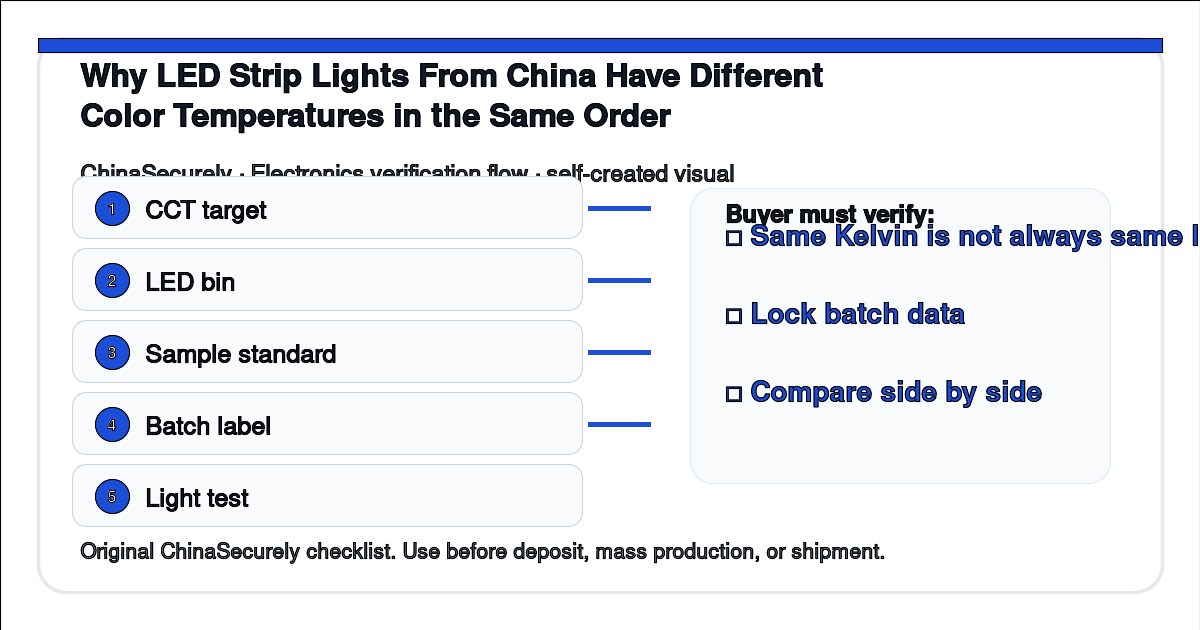
A real buyer question is: “I ordered 300 rolls of 3000K LED strip lights from China, but some rolls look warmer and some look cooler when installed together. How do I prevent this next time?”
For small importers, the risk is highest when strips from different cartons will be used in the same room, shelf display, sign, or installation. A small visual difference that looks acceptable on one sample can become obvious when many strips are installed side by side.
Why this happens
LED color is commonly described with correlated color temperature, often shown as Kelvin. But a printed 3000K or 4000K label is not the whole story. Manufacturers sort LEDs into bins, and those bins can have visible differences.
Voltage drop, power supply choice, strip length, diffuser material, and installation surface can also affect how the light appears. A supplier photo taken with automatic white balance is not useful evidence.
If the purchase order only says “warm white” or “3000K,” the supplier may choose available LED stock that is close enough for general use but not tight enough for a project where strips are placed together.
China-side explanation
LED strip factories often buy LED chips or beads from upstream suppliers, then mount them onto flexible PCB and assemble reels. If the factory is filling a small order quickly, it may use available stock across similar bins unless the buyer asks for tighter control.
Some suppliers can offer tighter bin control, but it may affect price, lead time, or MOQ. That trade-off should be discussed before deposit, not after the first mismatch complaint.
This is not always “bad quality.” Sometimes it is a missing specification. If color consistency matters, say that clearly and define how it will be checked.
Step-by-step solution
- Decide where the strips will be used. Side-by-side installations need tighter color control than separate rooms.
- Ask for the target CCT and acceptable tolerance, not only “warm white.”
- Request LED bin or batch information if the supplier can provide it.
- Approve a physical sample and keep it as the comparison standard.
- Ask the supplier not to mix LED bins or production batches without written approval.
- During inspection, test several rolls from different cartons with the same power supply and compare them side by side.
- Photograph the test setup with fixed camera settings if possible, but do not rely only on photos for final judgment.
What to ask the supplier
Please confirm the target CCT, acceptable tolerance, LED bin or batch control method, and whether all rolls in this order will use the same LED batch. During QC, please test rolls from different cartons with the same power supply and compare them against the approved sample.
A practical reminder: if the supplier cannot explain bin control, do not promise your customer perfect color matching.
QC table
| Risk | What to request | Inspection action |
|---|---|---|
| Mixed LED bins | Same bin or controlled tolerance | Compare rolls from different cartons |
| Wrong color label | Exact CCT on carton and reel label | Match label to approved order spec |
| Voltage effect | Same power supply during testing | Test under one controlled setup |
| Sample drift | Keep approved sample | Compare mass goods to sample |
| Installation surprise | Explain use case to supplier | Tighten spec for side-by-side installs |
Practical checklist
□ Avoid vague words like “warm white” without a target.
□ Ask for CCT target and tolerance.
□ Keep a physical approved sample.
□ Do not allow mixed batches without approval.
□ Test rolls from several cartons under the same power supply.
□ For high-value projects, use qualified light testing instead of phone photos.
Related questions
Is 3000K from every supplier the same? No. The number is useful, but binning, tolerance, and measurement conditions still matter.
Can I reject an order for small color difference? Only if your purchase order defined the tolerance and inspection method clearly enough.
Should I pay more for tighter bin control? If multiple strips will be seen together, usually yes. If rolls are sold for separate household use, a wider tolerance may be acceptable.
Color mismatch is easier to prevent than to argue about. Define the standard before production starts.