
Short answer: soft corners usually come from a weak paperboard structure, a loose insert, or an export carton that protects the box face but not the box edges. The supplier may show a beautiful sample, but the sample does not prove that the same box will survive stacking, ocean freight, courier handling, or Amazon-style receiving.
A real buyer question is: “My cosmetic gift boxes looked fine in the supplier’s photos, but the corners arrived rounded and the lids do not sit cleanly. Is this a printing problem or a box material problem?”
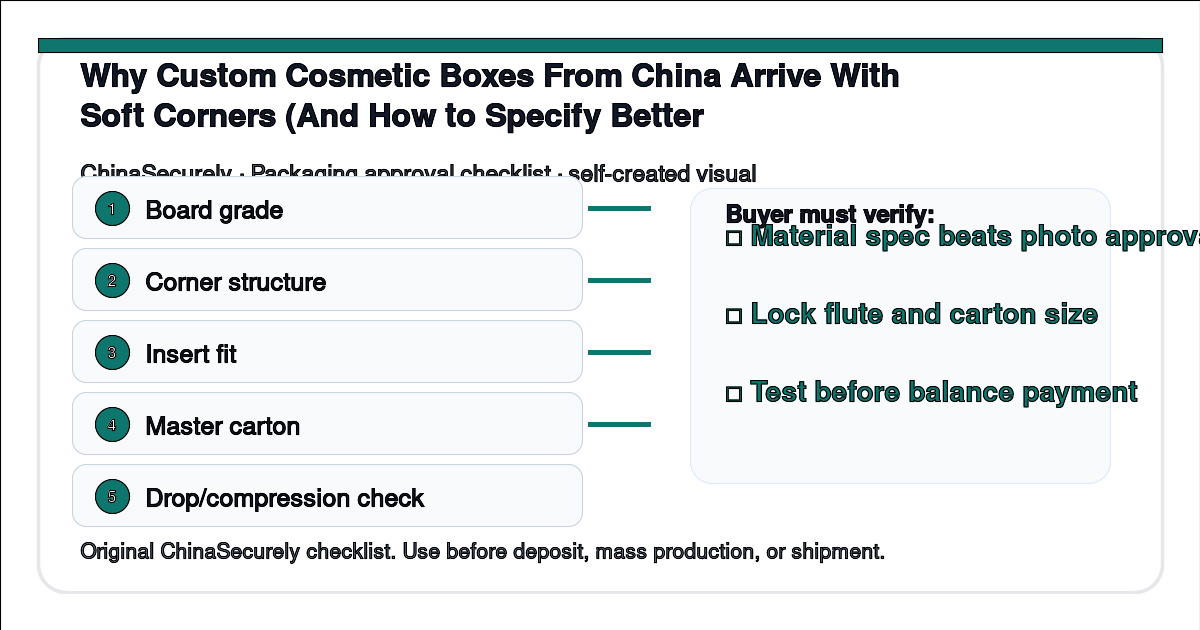
For a small importer, this is not just cosmetic. A crushed corner makes a skincare or beauty product look returned, cheap, or unsafe even when the product inside is fine. The safer move is to approve the structure, insert, and master carton together, not only the artwork.
Why this happens
Cosmetic boxes often use paperboard, greyboard, specialty paper, film lamination, foil stamping, or magnetic rigid-box parts. Each material behaves differently under pressure. A thick-looking sample can still have weak edge support if the board density is low or if the insert lets the product move inside.
The second problem is carton stacking. A supplier may pack boxes tightly enough for a local courier but not for export. If the outer carton is too large, too thin, or underfilled, the corners of the retail boxes take the pressure.
The third problem is approval language. Buyers often approve “same as sample,” while the factory thinks the approved items are size, color, logo position, and surface finish. Edge crush resistance, insert tolerance, and master carton strength may never be written down.
China-side explanation
In China packaging production, printing, lamination, die-cutting, gluing, insert assembly, and final packing may involve different teams or even different workshops. A sales sample can be made carefully by hand. Mass production has more speed pressure and more variation.
MOQ also matters. If the order is small, the supplier may use a common board or shared carton size instead of a fully optimized structure. That does not automatically mean bad faith. It means the buyer must decide where strength matters and pay for that specification before production starts.
A useful internal question is: who owns the damage risk, the paper box factory, the product factory, or the forwarder? If this is not clear before shipment, everyone may blame someone else after the goods arrive.
Step-by-step solution
- Ask for the exact paperboard or rigid-board specification, not only the box dimensions.
- Approve a physical sample with the real product or a weight dummy inside.
- Check whether the insert prevents movement at the corners, not only whether it looks neat from above.
- Request a master carton packing plan: pieces per carton, carton dimensions, carton material, gross weight, and whether there is empty space.
- Ask the supplier to photograph a simple pressure or stacking check. For serious orders, use a third-party pre-shipment inspection with a carton drop or compression-related check.
- Keep one approved sample in your own office and ask the inspector to compare mass production against it.
What to ask the supplier
Please confirm the paperboard or rigid-board specification, the insert material, and the master carton specification for this cosmetic box. Before mass production, please send one assembled sample with the product weight inside, plus photos of how the retail boxes are packed inside the export carton. We need the corners to remain sharp after normal export handling.
A safer follow-up is:
If you plan to change board grade, insert material, carton size, or pieces per carton after sample approval, please ask for written approval before production.
What to check before paying the balance
| Check point | What to verify | Warning sign |
|---|---|---|
| Board structure | Board grade, thickness, and density are written in the spec | Supplier only says “good quality paper” |
| Insert | Product does not move toward corners when shaken lightly | Insert looks nice but leaves empty space |
| Gluing and folding | Corners close cleanly without bulging | Glue gap, warped lid, or uneven fold line |
| Master carton | Carton size and pieces per carton match the packing plan | Carton is reused, oversized, or underfilled |
| Inspection evidence | Sample, mass goods, and packing photos match | Only close-up beauty photos are provided |
Practical checklist
□ Do not approve cosmetic packaging from renderings only.
□ Ask for paperboard or rigid-board details in writing.
□ Test the box with product weight inside, not empty.
□ Include master carton requirements in the purchase order.
□ Keep one approved sample for comparison during inspection.
□ If the packaging is for premium skincare or gift retail, treat corner condition as a sellable-quality requirement.
Related questions
Can I fix soft corners after the boxes arrive? Usually no. You may sort out the worst boxes, but the structure problem cannot be repaired cleanly.
Should I always choose thicker board? Not always. Better board density, insert fit, and carton packing may matter more than a small thickness increase.
Is this a supplier quality problem or a shipping problem? It can be either. That is why the packing plan and pre-shipment evidence matter.
If you are sourcing custom cosmetic packaging from China, make the packaging specification part of the order, not a loose conversation after artwork approval.