
Short answer: paper bag handles usually tear because the buyer approved the appearance of an empty bag, not the strength of a loaded bag. The weak point may be paper grade, handle rope, glue area, reinforcement patch, hole position, or how the bags are packed and compressed in cartons.
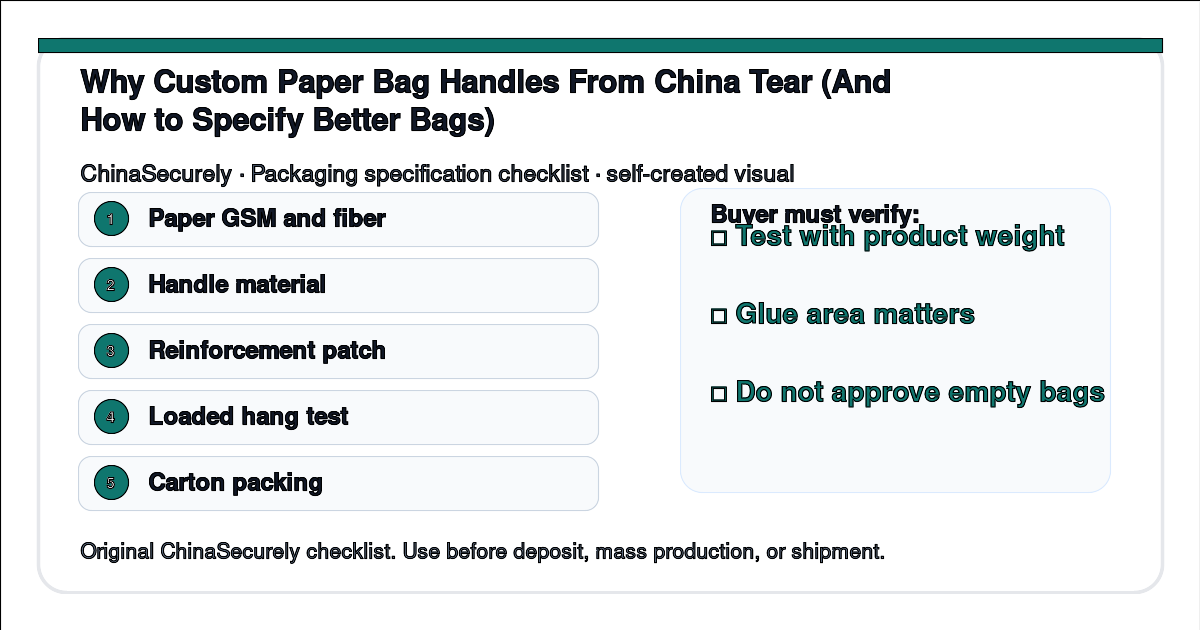
A real buyer question is: “Our custom paper bags from China looked beautiful, but handles started tearing when customers carried two boxed products inside. What should we have specified?”
For small importers, this is a painful defect because the bag is part of the customer experience. A torn handle makes a shop, gift set, or ecommerce package feel unreliable even if the product is fine.
Why this happens
Paper bags are often quoted by size, color, paper thickness, printing, finish, and handle type. Strength is discussed less clearly. A 250 gsm paper bag can still fail if the handle hole is too close to the top edge or if reinforcement is missing.
The load also matters. A bag that is fine for a light scarf may fail with glass jars, candles, books, or boxed cosmetics. If the supplier tests an empty bag or one light sample, the real defect stays hidden.
Another cause is finishing. Lamination, foil stamping, embossing, or heavy ink can change stiffness and crease behavior. A beautiful bag is not automatically a strong bag.
China-side explanation
Chinese packaging factories often quote fast because buyers compare unit price. The salesperson may choose a common paper grade and handle style unless you specify the actual loaded weight and carry test.
There may also be separate teams for printing, die-cutting, handle assembly, and packing. If the handle hole punching or glue patch is rushed, a bag can look correct from outside but fail under load.
For very small custom runs, suppliers may avoid special reinforcement because it slows production. That trade-off can be acceptable for a light promotional bag. It is not acceptable for a heavy retail bag.
Step-by-step solution
- Tell the supplier the real product weight per bag, including packaging and expected number of items.
- Ask for paper material, GSM, handle material, handle fixing method, and reinforcement patch details.
- Request a physical sample and test it with the real loaded weight for at least a few minutes, not only a quick lift.
- Check hole position and whether the paper tears around the punched area.
- Confirm carton packing so handles are not bent, crushed, or pulled during transit.
- Add a loaded carry test to the pre-shipment inspection checklist.
- Keep one approved sample and photos of the inside reinforcement for comparison.
What to ask the supplier
Please design the paper bag for a loaded weight of [X kg] with [product type] inside. Please confirm paper GSM, handle material, reinforcement patch size, glue area, and hole position. Before mass production, please send a sample and a loaded carry-test video using the real product weight.
A stronger follow-up is:
If you change paper grade, handle rope, glue, reinforcement, or carton packing after sample approval, please ask for written approval first.
Handle failure checklist
| Check point | What to verify | Warning sign |
|---|---|---|
| Paper body | GSM and material are written in the spec | Supplier only says “thick paper” |
| Handle fixing | Patch, knot, glue, or rivet method is clear | Handle attachment is hidden or vague |
| Hole position | Enough distance from top edge and side fold | Tear starts from punched hole |
| Loaded test | Test with the actual product weight | Only empty-bag photos are shown |
| Carton packing | Bags are packed flat without handle stress | Handles are bent sharply or compressed |
Practical checklist
□ Do not approve a custom paper bag from a flat photo only.
□ Test the bag with the actual product weight, not a guess.
□ Look inside the bag to see the handle reinforcement.
□ Specify whether the bag is for light promo use or real retail carrying.
□ Ask for carton packing photos before shipment.
□ Reject vague language such as “strong handle” unless the supplier shows how it is made.
Related questions
Is thicker paper always the answer? Not always. Handle construction, hole position, and reinforcement can matter more than a small GSM increase.
Can I add reinforcement after the bags arrive? Usually not in a clean, retail-ready way. Fix the structure before mass production.
Should I choose twisted paper handles or rope handles? Either can work. The right choice depends on load, appearance, cost, and how the handle is attached.
Sources and source status
The sources below are used for general paper strength and packaging material context. The final bag specification still needs supplier confirmation and loaded sample testing.
- ASTM D828/D828M paper tensile testing reference: https://www.astm.org/d828_d828m-16r22.html
- TAPPI paper and packaging industry technical context: https://www.tappi.org/
- Fibre Box Association packaging basics: https://www.fibrebox.org/page/boxbasics
A paper bag should be tested as a loaded package, not as a pretty printed object.