
Short answer
If desk fans from China rattle after shipping, do not approve the next order from a quiet sample alone. Ask the supplier to check motor mounting, blade balance, screw torque, grille fit, carton drop protection, and a pre-shipment run test on random units.
Buyer question: “The desk fan sample was quiet, but after shipping the bulk order, many units rattle on the first speed. What should I ask the Chinese supplier to test before I reorder?”
For a small importer, the practical goal is not to become a motor engineer. The goal is to turn “please make it quiet” into checks the supplier and inspector can actually perform.
Why this problem happens
A desk fan can pass a quick showroom test and still rattle after export shipping. The noise may come from a slightly loose motor mount, an off-center blade, a grille touching the blade path, screws backing out, thin plastic housing, or a stand that vibrates on a hard table.
Packing also matters. Parcel and freight packing guidance from carriers usually stresses protection from movement, compression, and normal handling. If a fan is packed with weak inner support, vibration and impact during transit can shift parts enough to create noise even when the unit worked before packing.
China-side explanation
Many small appliance suppliers in China assemble fans from purchased motors, blades, grilles, housings, switches, and cartons. The supplier may control final assembly but not every upstream part. If the buyer only approves the outer appearance and color box, the factory may treat noise and vibration as a loose, subjective requirement.
A better purchase file says how long to run the fan, which speed levels to test, what obvious rattles are not acceptable, and how the carton should hold the unit. For low-cost fans, suppliers may resist long tests on every unit, but sampled run tests and carton checks are realistic.
Step-by-step solution
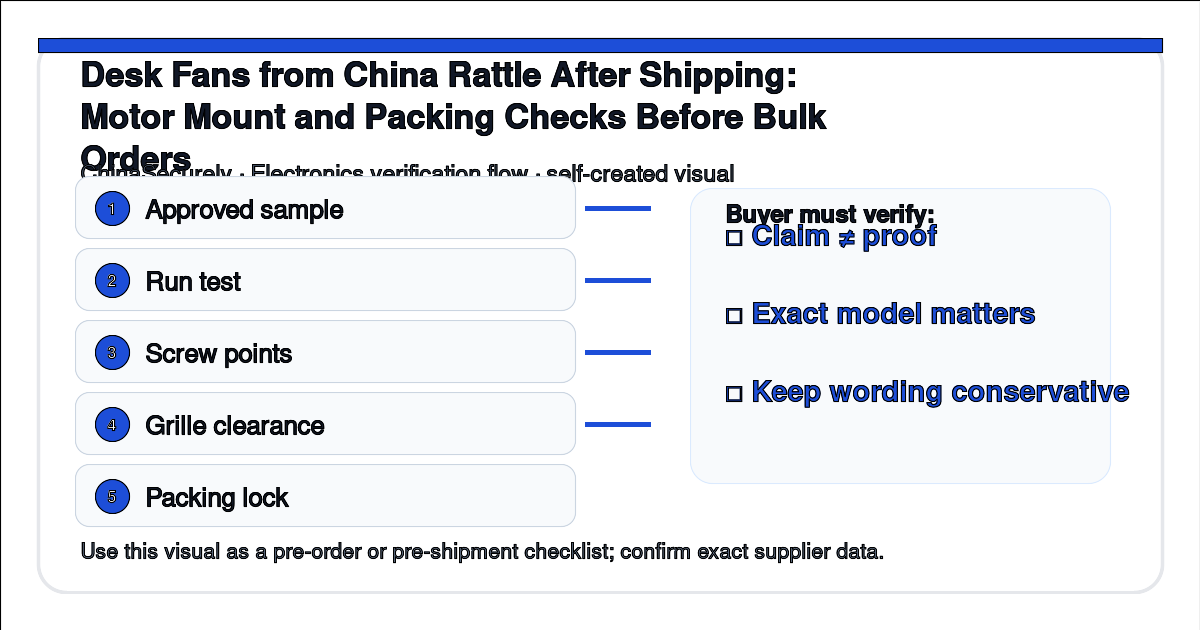
- Keep one approved sample as the noise and assembly reference.
- Ask the supplier to confirm motor model, blade material, grille type, screw points, and packing structure.
- Require a run test at each speed level on pre-shipment samples.
- Ask the inspector to listen for rattling, scraping, unstable base vibration, and intermittent noise.
- Check that screws are tight at the motor mount, grille, stand, and base.
- Confirm the blade does not touch the grille after the unit is moved or tilted gently.
- Review inner packaging: foam, pulp tray, cardboard lock, twist tie, and carton compression.
- If failures appear, separate mechanical noise from electrical or safety issues and pause shipment when risk is unclear.
What to ask the supplier
Copy and adapt this message:
Please confirm the desk fan motor model, blade material, screw points, grille clearance, and packing method. Before shipment, please run randomly selected units at all speed levels and check for rattling, scraping, abnormal vibration, loose screws, and grille contact. Please send photos of the inner packing and confirm how the fan is fixed inside the color box and export carton.
This is more useful than asking “is the quality good?” because each line points to a physical check.
Desk fan rattle checklist
| Check point | What to inspect | Why it matters |
|---|---|---|
| Motor mount | Loose screws or moving bracket | A small looseness can become a loud rattle |
| Blade balance | Wobble at low and high speed | Imbalance creates vibration and returns |
| Grille clearance | Blade does not touch grille | Shipping movement can shift the grille |
| Stand and base | Unit sits stable on a flat table | A light base can amplify noise |
| Inner packing | Fan cannot move inside the box | Poor packing creates mechanical stress |
Cost and trade-off notes
A quieter fan may need better assembly control, stronger housing, improved blade balance, more inspection time, or better packing. For a low-price promotional fan, some sound may be acceptable. For a retail fan sold on a marketplace, obvious rattling on first use is not acceptable.
Do not let the supplier solve a noise complaint only by tightening one sample. Ask whether the same screw, blade, motor, and packing method will be used for the whole lot.
Sources and source status
- FedEx packing guidance for protection from handling and movement: https://www.fedex.com/en-us/shipping/packing.html
- UPS packaging support page, used as a general packing reference; access may need manual review from some locations: https://www.ups.com/us/en/support/shipping-support/packaging-tips.page
Related questions
Is rattling always a product defect?
Not always. It may be assembly, packing, or transit damage. But if customers hear it on first use, the buyer still has a product problem to solve.
Should I ask for a video test?
Yes, for a reorder after complaints. A short video at each speed level is not perfect evidence, but it is better than photos only.
Can I rely on the golden sample?
Use the golden sample as a reference, then add shipment inspection checks. One good sample does not prove the bulk order is quiet.
Light CTA
If a desk fan is sold on quiet operation, treat noise as a measurable quality point, not as a vague preference.