
Short answer
A real buyer question sounds like this: “The LED strip sample from China was a warm 3000K color, but the bulk order has some reels that look yellow and some that look almost white. Did the factory change the LED chips?”
Maybe. But color difference in LED strip lights can also come from LED binning, mixed production batches, voltage drop, diffuser materials, power supply mismatch, or inspection under the wrong lighting conditions. The safe approach is to turn “same color” into measurable requirements before production.
This is a practical sourcing article, not electrical safety certification advice. For products connected to mains power or sold in regulated channels, ask qualified labs and your marketplace or importer-of-record for compliance requirements.
Why this problem happens
LEDs are sorted into bins after production. Even LEDs sold under the same nominal color temperature can have visible differences if the supplier mixes bins or changes chip source between sample and bulk order. For small importers, the problem is worse because low-MOQ orders may be produced from available stock instead of a dedicated component batch.
Color can also shift after assembly. Long LED strips may show voltage drop, especially when powered from one end. A weak or mismatched power supply can make the far end dimmer or warmer. If the strip sits behind a silicone cover, diffuser, aluminum channel, or plastic lens, the final appearance may differ from the bare strip sample.
The key lesson: supplier photos are not test evidence. A phone camera can hide color differences or exaggerate them.
China-side explanation
Chinese LED strip suppliers often buy LED beads, PCB, resistors, adhesive backing, silicone sleeves, and packaging from different upstream vendors. If your order is small, the factory may use stock LED reels that meet the basic specification but are not from exactly the same bin as your sample.
A careful supplier can control this, but only if the purchase order makes it important. If the PO simply says “warm white LED strip,” the factory may treat small color variation as normal. If your product line depends on consistent color, you need sample sealing, bin confirmation, and batch inspection.
A practical China-side check is to ask whether all production reels will use the same LED bin and whether the supplier can keep a sealed golden sample at the factory.
Step-by-step solution
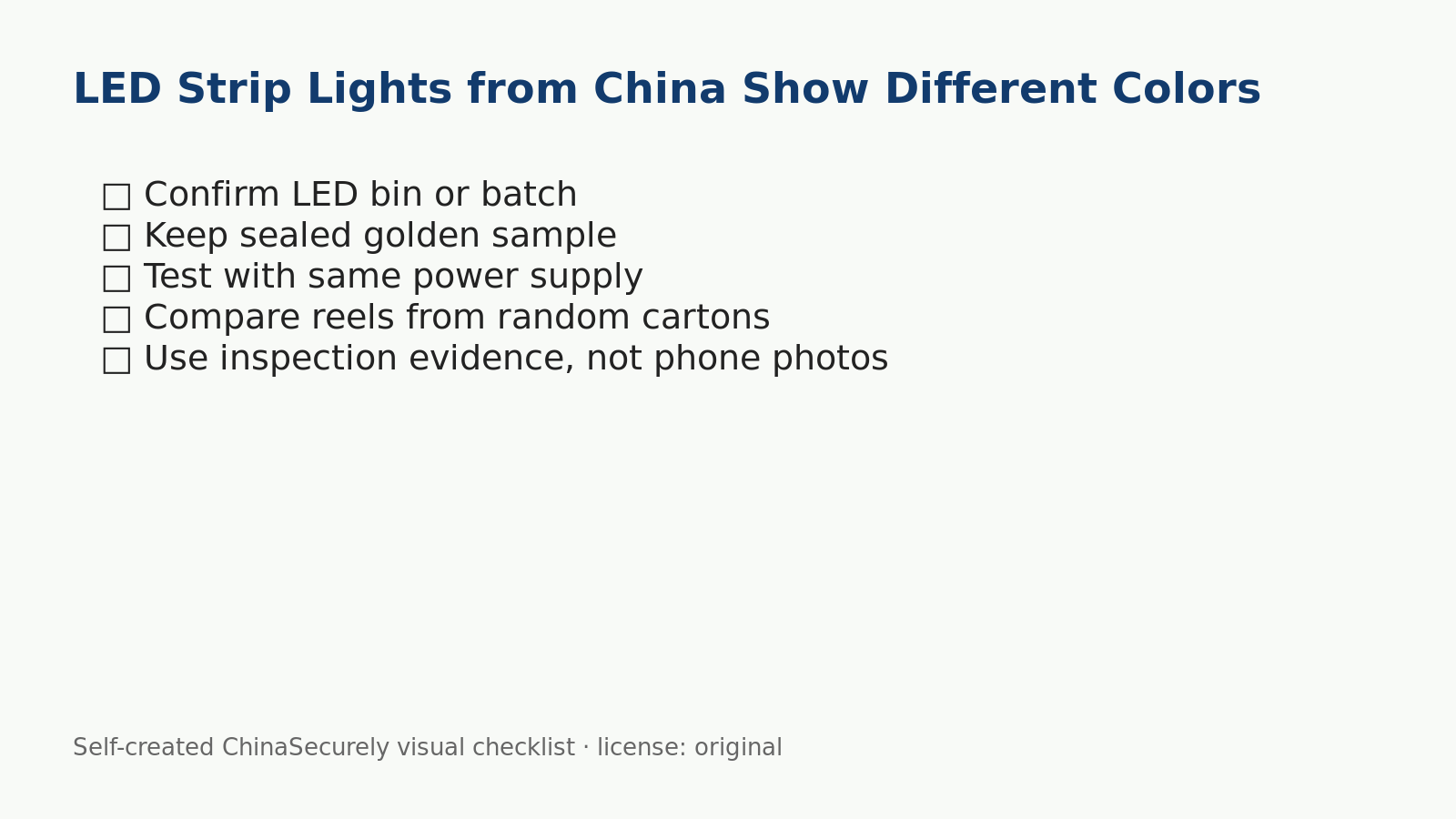
- Define the target color temperature and tolerance in writing, for example 3000K with an agreed tolerance range if the supplier can support it.
- Ask the supplier whether the sample LED bin will be used for the full order.
- Seal one approved sample. Keep one with you and ask the factory to keep one.
- Test the strip with the same power supply and connection method you plan to sell or recommend.
- During production, ask for a short video comparing random reels against the sealed sample under the same power and camera setting.
- For shipment inspection, check reels from different cartons, not only one carton.
- If color matching is critical, use a third-party inspection or lab measurement instead of relying only on supplier photos.
What to ask the supplier
Please confirm the LED bin used for the approved sample and whether the bulk order will use the same bin or an equivalent controlled bin. Please test random reels from different cartons beside the sealed sample using the same power supply. We need to check visible color difference before shipment, not only brightness.
A cautious supplier will answer with component and test details. A weak answer is “all warm white, no difference” without any batch evidence.
Practical checklist
| Risk | Buyer check | Evidence to request |
|---|---|---|
| Mixed LED bins | Confirm bin or batch control | Supplier written confirmation |
| Sample differs from bulk | Use sealed golden sample | Side-by-side test photo or video |
| Voltage drop | Test full length, not only short strip | Power method and end-to-end brightness check |
| Diffuser color shift | Test final assembled version | Strip inside channel or sleeve |
| Supplier photo bias | Use same setup and random cartons | Inspection report or controlled video |
Source notes
Source URLs used as background:
- ENERGY STAR LED lighting basics: https://www.energystar.gov/products/lighting_fans/light_bulbs/learn_about_led_bulbs
- U.S. Department of Energy LED lighting resources: https://www.energy.gov/eere/ssl/led-lighting
- IEC Electropedia entry point for electrotechnical terminology, used only for general terminology context: https://www.electropedia.org/
These sources support general LED lighting concepts. They do not prove a specific supplier’s batch quality. Supplier documents, sealed samples, and inspection evidence are still needed for each order.
Related questions
Can I fix color difference by changing the power supply? Sometimes, if the issue is voltage drop or underpowering. It will not fix mixed LED bins.
Should I reject the whole order for small differences? That depends on your agreed tolerance and sales channel. For accent lighting, small differences may be acceptable. For matched installations, they are a serious problem.
Light CTA
If LED color is part of your product promise, do not approve production with only a pretty sample photo. Approve the bin control, the power setup, and the batch inspection method.