
Short answer
If metal storage racks from China rust in garages, the issue may be coating coverage, weld treatment, scratches, thin plating, poor packing, or a use environment that is harsher than the original specification. Small importers should check finish type, edge coverage, weld areas, salt or humidity exposure claims, and carton protection before reordering.
Buyer question: “Our powder-coated metal storage racks looked clean on arrival, but customers using them in garages reported rust near welds and shelf edges. What should I check before reordering from China?”
For home goods, the practical question is not “can metal rust?” Everyone knows it can. The question is whether the product specification and packaging match the customer’s real use.
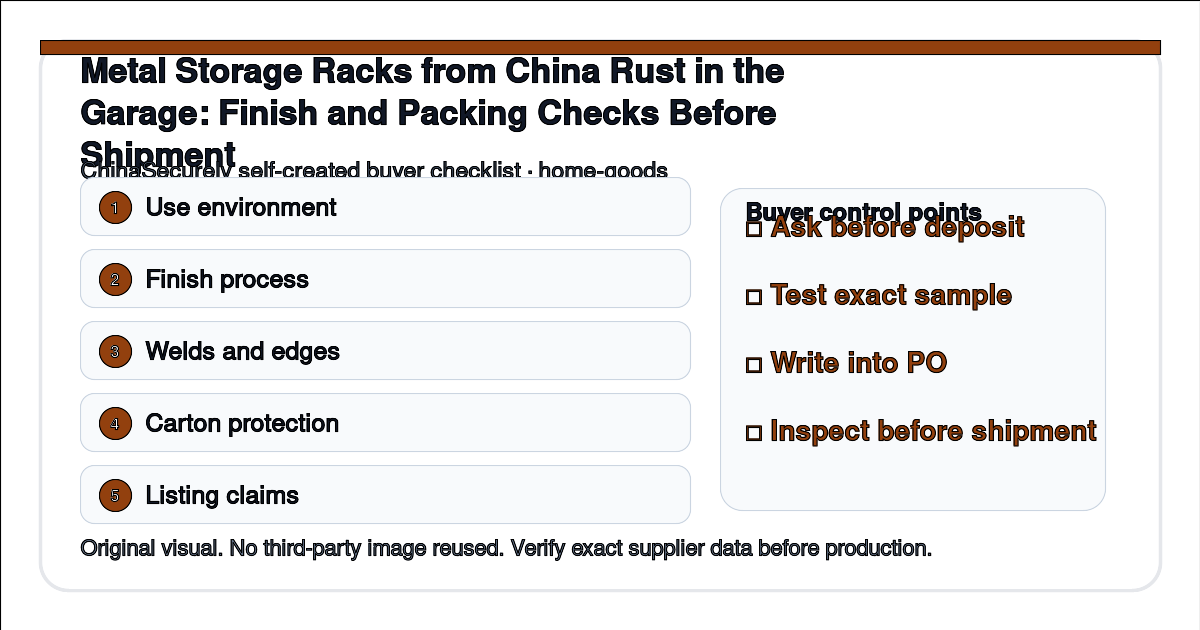
Why this problem happens
Rust often starts where coating is weakest: welds, drilled holes, cut edges, corners, screw contact points, and scratched surfaces. A rack can look good in supplier photos because the flat surfaces are clean while the hidden stress points are poorly covered.
Garages and storage rooms can be humid. Products may also sit in containers, warehouses, or damp cartons before the customer assembles them. If parts rub inside the carton, scratches can expose metal before use.
China-side explanation
Chinese suppliers may quote several finish options: basic paint, powder coating, electroplating, galvanized parts, or mixed treatments for different components. The sample may be made carefully, while bulk production depends on pretreatment, coating thickness, curing, handling, and packing.
A small importer may not need the most expensive outdoor-grade finish for an indoor rack. But if marketing photos show garage, laundry room, or utility-room use, the product should be checked against a more humid environment than a dry showroom.
Step-by-step solution
- Define the expected use: dry closet, kitchen, laundry room, garage, or covered outdoor area.
- Ask the supplier for finish type and which parts receive the finish.
- Inspect welds, holes, edges, and screw areas on the sample.
- Rub assembly contact points to see whether coating scratches easily.
- Ask how parts are separated inside the carton to prevent metal-on-metal rubbing.
- Check whether desiccant, bags, or separators are used when needed.
- Add a pre-shipment inspection point for rust, scratches, exposed metal, and carton moisture.
- Be conservative in listing copy; do not imply outdoor or damp-area use unless tested.
- Keep one sample in a realistic storage environment before placing repeat orders.
What to ask the supplier
Copy and adapt this message:
Please confirm the metal finish process for each part of the storage rack, including shelves, posts, screws, weld areas, and cut edges. Please send close-up photos of welds, holes, and corners after coating. Please also confirm how parts are protected inside the export carton to avoid scratches and moisture during shipping.
This gives the supplier a clear checklist rather than a vague “anti-rust quality” request.
Rust-risk inspection checklist
| Area to check | What to look for | Why it matters |
|---|---|---|
| Welds | Gaps, bubbles, thin coating | Rust often starts around welds |
| Cut edges | Exposed metal or sharp edges | Coating may be weaker on edges |
| Screws and holes | Scratches during assembly | Contact points can expose metal |
| Carton packing | Rubbing, moisture, weak separators | Shipping can damage coating |
| Use claim | Indoor, garage, or damp area | Marketing must match real durability |
Cost and trade-off notes
A better finish, stronger packing, or additional separators can raise cost. But customer complaints about rust are difficult to fix after delivery because the buyer cannot easily prove where the corrosion started.
For a dry indoor shelf, a basic finish may be enough. For a garage storage rack, the buyer should be more careful with coating and packaging. Do not let listing photos promise a harsher use case than the product can handle.
Sources and source status
These sources support the packing-protection and corrosion-risk logic; they are not used as product-specific test certifications.
- FedEx packing guidance for protection during transit: https://www.fedex.com/en-us/shipping/packing.html
- AMPP corrosion basics for explaining why exposed or weakly protected metal corrodes: https://www.ampp.org/technical-research/what-is-corrosion
Related questions
Is powder coating always rust-proof?
No. It can help, but scratches, weak edge coverage, welds, and moisture can still create rust points.
Should I request outdoor-grade material?
Only if your product will be sold for outdoor or damp use. Otherwise, ask for a realistic finish and avoid overclaiming.
Can packing really cause rust complaints?
Yes. Scratched parts or damp cartons can expose weak points before the customer assembles the rack.
Light CTA
For metal home goods, inspect the ugly places first: welds, holes, edges, screws, and carton rub marks.