
Short answer
A Bluetooth speaker sample that sounds fine at medium volume is not enough evidence for a bulk order. Small importers should test several samples at different volumes, tracks, battery levels, charging states, and surfaces before approving production.
Buyer question: “The Bluetooth speaker sample sounded fine at half volume, but customers hear buzzing at high volume. What should I test before ordering 3,000 pieces from China?”
The buyer’s job is to separate three things: normal product limits, supplier claims, and evidence from the exact model.
Why this problem happens
Small speakers are built from many parts that interact: driver, enclosure, passive radiator if used, amplifier, battery, Bluetooth module, screws, glue, grille, rubber feet, and firmware settings. Buzzing can come from a loose part, weak enclosure, overdriven amplifier, poor driver matching, rattling grille, or distortion when the speaker is pushed beyond a realistic limit.
The sample may also be hand-selected. That does not prove mass production will sound the same. If the purchase order only says “good sound quality,” the factory has no measurable acceptance point.
China-side explanation
Many electronics suppliers in China assemble final products from upstream components. The Bluetooth module, battery, speaker driver, charging board, and plastic enclosure may come from different vendors. A small change in driver source or enclosure fit can affect sound.
Bluetooth-related claims also require caution. Bluetooth SIG provides qualification and specification resources, but the importer should verify what applies to the exact model and how the product is marketed. A supplier’s casual “Bluetooth certified” message is not the same as checking model-specific evidence.
Step-by-step solution
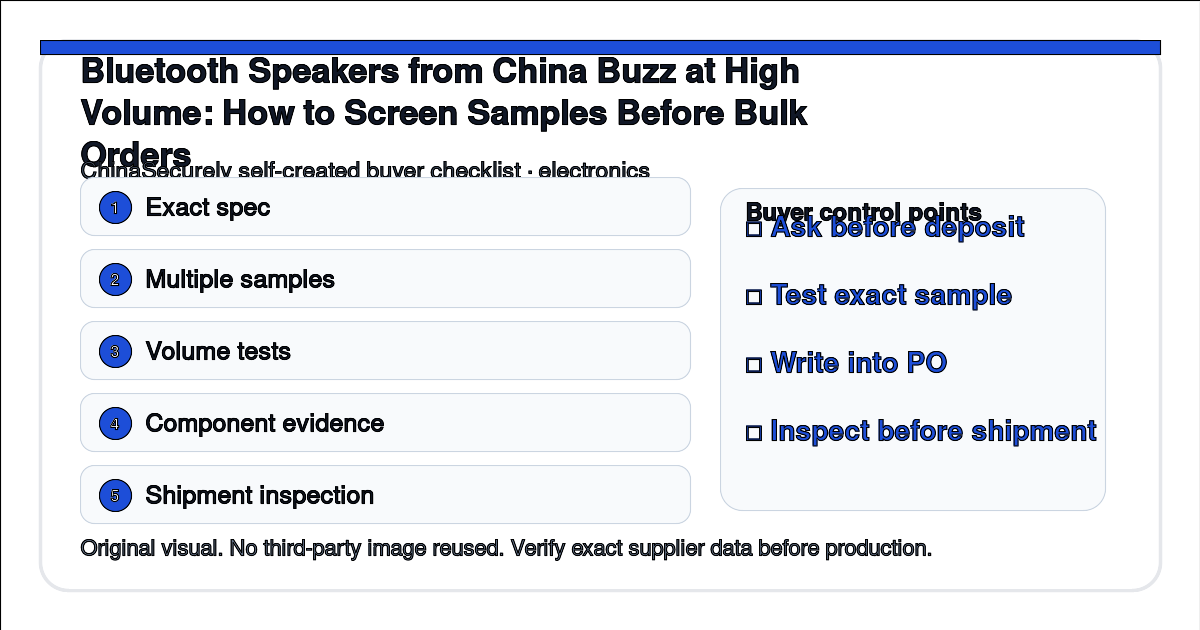
- Define the model specification: size, battery, output claim, driver, Bluetooth version claim, charging port, and packaging.
- Request three to five samples from the intended production setup, not one polished sample.
- Test at low, medium, and high volume with speech, bass-heavy music, and simple tones.
- Test while battery is full, low, and charging if the product allows use while charging.
- Place the speaker on wood, glass, and fabric surfaces to catch vibration problems.
- Shake gently and inspect for loose grille, screws, or rattling parts.
- Ask the supplier what factory audio checks are done on every unit and what is sampled.
- Confirm whether component sources can change during production.
- Add a pre-shipment inspection check for buzzing, rattling, charging, pairing, and buttons.
What to ask the supplier
Copy and adapt this message:
Please confirm the speaker driver, amplifier board, battery, Bluetooth module, enclosure material, and factory audio test process for this exact model. Please explain which sound checks are performed on every unit and which are sampled. Before mass production, please send several samples from the intended component sources. We will test buzzing or rattling at different volumes and battery levels.
This is more useful than asking “is the sound good?” It tells the supplier what failure you are trying to prevent.
Sample test matrix
| Risk | Simple buyer test | Evidence to request |
|---|---|---|
| High-volume buzz | Play the same track at several volumes | Factory audio check method |
| Loose parts | Shake gently and listen for rattle | Assembly and screw/glue check |
| Battery-related noise | Test full, low, and charging states | Battery and board specification |
| Bulk differs from sample | Test multiple samples | Component source confirmation |
| Unsupported Bluetooth claim | Check exact model evidence | Bluetooth qualification or listing evidence where applicable |
Cost and trade-off notes
A louder speaker is not automatically a better product. For a small, low-cost speaker, pushing maximum volume may create distortion. Safer marketing may describe normal use rather than promising unrealistic bass or power.
If the supplier offers a cheaper version, ask what changes: driver, battery, amplifier board, plastic shell, waterproof structure, or QC time. The answer matters more than the discount.
Sources and source status
- Bluetooth SIG qualification and listing resources: https://www.bluetooth.com/develop-with-bluetooth/qualification-listing/
- Bluetooth specifications page: https://www.bluetooth.com/specifications/specs/
Related questions
Is buzzing always a defect?
Not always. Some distortion at unrealistic maximum volume may be a product limit. But rattling, loose parts, or buzzing during normal listening should be treated as a quality issue.
Can I rely on one sample?
No. Test several samples because audio defects can vary unit by unit.
Should I ask for Bluetooth documents?
If the product makes Bluetooth claims or uses logos, verify the exact model evidence and requirements before printing packaging.
Light CTA
Before you approve a speaker, listen for the ugly sounds, not just the first ten seconds of music.