
Short answer
If sticker labels from China peel on curved bottles, the label may not be wrong by itself. The adhesive, face stock, bottle material, surface curve, storage environment, and application method must match.
Buyer question: “The labels looked perfect on the roll, but after we applied them to curved plastic bottles, the corners lifted. How do I prevent this with a Chinese label supplier?”
For small importers, the safer process is to test the label on the exact bottle before bulk printing, especially if the bottle is small, soft, textured, oily, cold-filled, or highly curved.
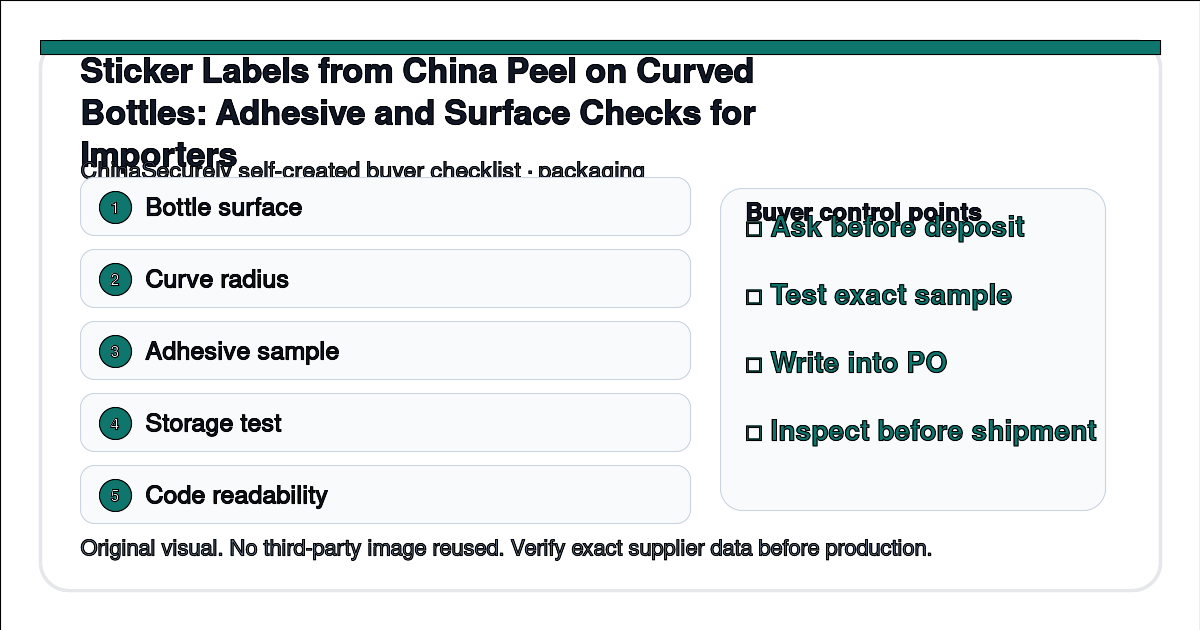
Why this problem happens
A label that sticks well to a flat test card may fail on a curved bottle because the label wants to return to a flat shape. This creates lift at the corners and edges. The tighter the curve, the more stress the adhesive must hold.
The bottle surface also matters. Some plastics are harder for common adhesives. Mold release residue, dust, oil, condensation, and low application pressure can all reduce adhesion. If the label includes a barcode, QR code, ingredients panel, or batch code, peeling becomes more than a cosmetic problem because customers may not be able to scan or read the information.
China-side explanation
Chinese label suppliers often ask for label size, material, printing color, finish, roll direction, and quantity. But they may not know the real bottle radius, storage temperature, filling process, or whether the buyer applies labels by hand or machine.
A supplier can quote a standard adhesive unless the buyer explains the surface and use condition. That does not always mean the supplier is dishonest. It may mean the original inquiry was too vague for the real application.
Step-by-step solution
- Send the supplier the bottle material, diameter, surface finish, and label size.
- Ask whether the adhesive is suitable for a curved plastic surface.
- Request a small printed or blank label sample using the intended adhesive.
- Apply the label to the exact bottle with normal pressure and dwell time.
- Test after 24 hours and again after several days.
- Store a few samples in realistic conditions, such as a warehouse, bathroom, or refrigerator if relevant.
- Check corners, seams, barcode or QR readability, and any lifting near embossed areas.
- Confirm roll direction if labels will be machine-applied.
- Put the approved adhesive and label material into the purchase order.
What to ask the supplier
Copy and adapt this message:
Please recommend a label material and adhesive for our exact bottle: material ___, diameter ___, surface finish ___, label size ___. The label will be applied by hand/machine and stored in ___. Please send samples using the proposed adhesive so we can test corner lifting after 24 hours and several days. Please also confirm the roll direction and whether the barcode or QR code remains scannable after application.
This message gives the supplier enough context to choose something better than a generic label.
Label adhesion checklist
| Check point | What to verify | Why it matters |
|---|---|---|
| Bottle surface | Plastic type, coating, texture | Adhesive choice depends on surface |
| Curve radius | Bottle diameter and label width | Tight curves increase edge lift |
| Application | Hand or machine, pressure, dwell time | Weak application causes early peeling |
| Environment | Heat, cold, humidity, liquid exposure | Storage can change adhesion |
| Code readability | Barcode or QR after application | Peeling can break scanning and trust |
Cost and trade-off notes
A stronger adhesive can cost more and may be harder to remove cleanly. A thinner label may wrap better around a curve, but it may feel less premium. A laminated label can look better but may add stiffness.
Ask for two options: a standard adhesive and a curved-surface option. Then test both on the real bottle instead of choosing only by unit price.
Sources and source status
- Avery label adhesive guide, used for general adhesive-type and surface-fit background: https://www.avery.com/blog/label-adhesives/
- FedEx packing guidance, used for general handling and protection concepts during storage and shipment: https://www.fedex.com/en-us/shipping/packing.html
- GS1 barcode standards page was checked as a reference for barcode importance; this server received access restrictions, so source status is blocked/manual review needed: https://www.gs1.org/standards/barcodes
Related questions
Can I fix peeling labels with stronger glue?
Sometimes, but not always. The label face material, curve, and application pressure may also need to change.
Should the label supplier test on my bottle?
Yes, if possible. Send bottles or at least exact bottle specifications before final approval.
Is peeling only cosmetic?
No. If the label includes a barcode, QR code, ingredients, or warnings, peeling can create operational and customer trust problems.
Light CTA
Do not approve bottle labels only on a flat sheet. A curved bottle is the real test surface.