
Short answer
When storage bins from China arrive warped, the cause may be material, molding, cooling, nesting, carton compression, or heat during transport. Small importers should not approve the next order from photos alone. Measure real samples, test lid fit, check wall thickness, and control packing before shipment.
Buyer question: “The plastic storage bins looked straight in supplier photos, but many arrived warped and the lids did not fit. What should I check before I reorder?”
For home goods, the customer does not care whether the issue happened at the mold, warehouse, or container stage. They only see a bin that does not stack, close, or sit flat.
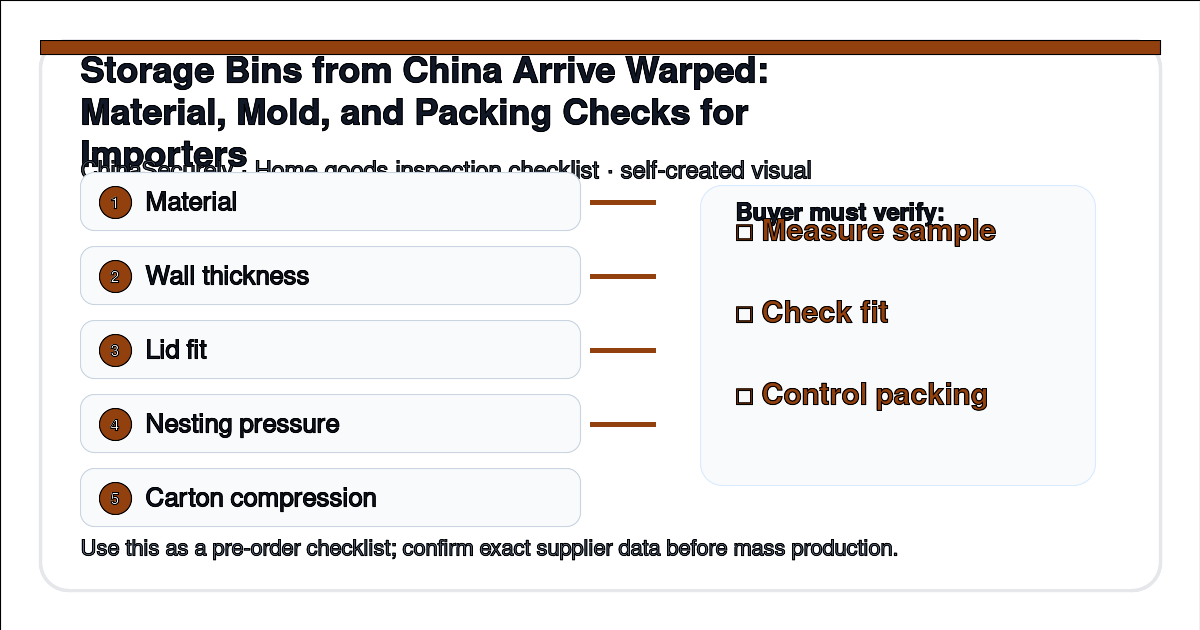
Why this problem happens
Plastic storage bins are often nested tightly to save carton and freight space. That saves money, but it can put pressure on side walls and rims. If the product is still slightly stressed from molding, or if the wall thickness is light, it may deform during storage and transport.
Warping can also come from uneven cooling after molding, recycled material with inconsistent properties, thin walls, poor rib design, tight lids, or export cartons that do not resist compression. In warm environments, plastic parts can become more vulnerable to deformation under load.
China-side explanation
A Chinese supplier may quote several versions of the same storage bin: different plastic material, different wall thickness, with or without reinforced ribs, different lid fit, and different carton packing. The photo may look the same across versions.
Factories also try to reduce shipping volume because home goods can be bulky. Tight nesting and high carton counts are normal cost-control methods. The buyer’s job is not to reject cost savings automatically; it is to decide how much nesting pressure the product can tolerate and how much deformation is acceptable.
Step-by-step solution
- Ask for material type and whether recycled material is used.
- Request wall thickness at key points: rim, side wall, base, and lid edge.
- Approve a physical sample set, not only one perfect unit.
- Measure length, width, height, rim straightness, and lid fit.
- Stack and nest the sample bins for several days with realistic pressure.
- Ask how many pieces are packed per carton and whether lids are packed separately.
- Confirm carton strength and whether cartons are palletized or floor-loaded.
- Add a pre-shipment inspection point for warping, rocking on a flat surface, and lid fit.
- Photograph defects with a ruler so the supplier can see whether the issue is cosmetic or functional.
What to ask the supplier
Copy and adapt this message:
Please confirm the storage bin material, wall thickness at the rim and side wall, lid fit tolerance, and packing method. Please send photos of nested units inside the export carton and confirm how many pieces are packed per carton. For inspection, please check whether each sampled bin sits flat, whether the lid closes without force, and whether the rim is visibly warped.
This is plain language, but it gives the supplier and inspector something measurable to check.
Pre-shipment inspection checklist
| Item to check | Pass condition | Why it matters |
|---|---|---|
| Rim straightness | No visible twist on flat surface | Lid fit depends on rim shape |
| Lid fit | Closes without force | Prevents customer returns |
| Wall thickness | Matches approved sample | Thin walls deform more easily |
| Nesting pressure | No deep side-wall stress marks | Tight packing can bend bins |
| Export carton | No crushing or overpacking | Carton compression can deform product |
Cost and trade-off notes
A thicker bin, stronger rib design, or looser packing can raise unit cost or freight cost. That does not mean the cheapest option is always wrong. For a lightweight closet organizer, small cosmetic variation may be acceptable. For stackable bins, food storage, or marketplace products with close-up listing photos, warping is harder to tolerate.
Ask for a cheaper option and a safer option. Compare what changes: material, thickness, nesting count, carton size, or lid packing.
Sources and source status
- USDA Forest Products Laboratory packaging/transport reference PDF used as a general packaging stress reference: https://www.fpl.fs.usda.gov/documnts/fplgtr/fpl_gtr190.pdf
- FedEx packing guidance for transit handling and protection concepts: https://www.fedex.com/en-us/shipping/packing.html
Related questions
Is warped plastic always a factory defect?
Not always. It can happen during molding, storage, packing, or shipping. That is why inspection should include both product dimensions and carton condition.
Should I ask for thicker plastic?
Maybe, but first ask where the deformation appears. Sometimes better rib design or looser packing solves more than simply adding material.
Can photos prove the bins are good?
Photos help, but they do not prove lid fit or flatness. Ask for measurements and inspection checks.
Light CTA
If your storage bins are bulky and cheap to ship only when tightly nested, treat packing as part of the product specification, not an afterthought.