
Short answer
A USB-C cable sample that charges one phone is not enough evidence for a bulk order. Before buying thousands of units from China, small importers should check the cable specification, request supplier test evidence, test multiple samples, and avoid making compliance claims they cannot prove.
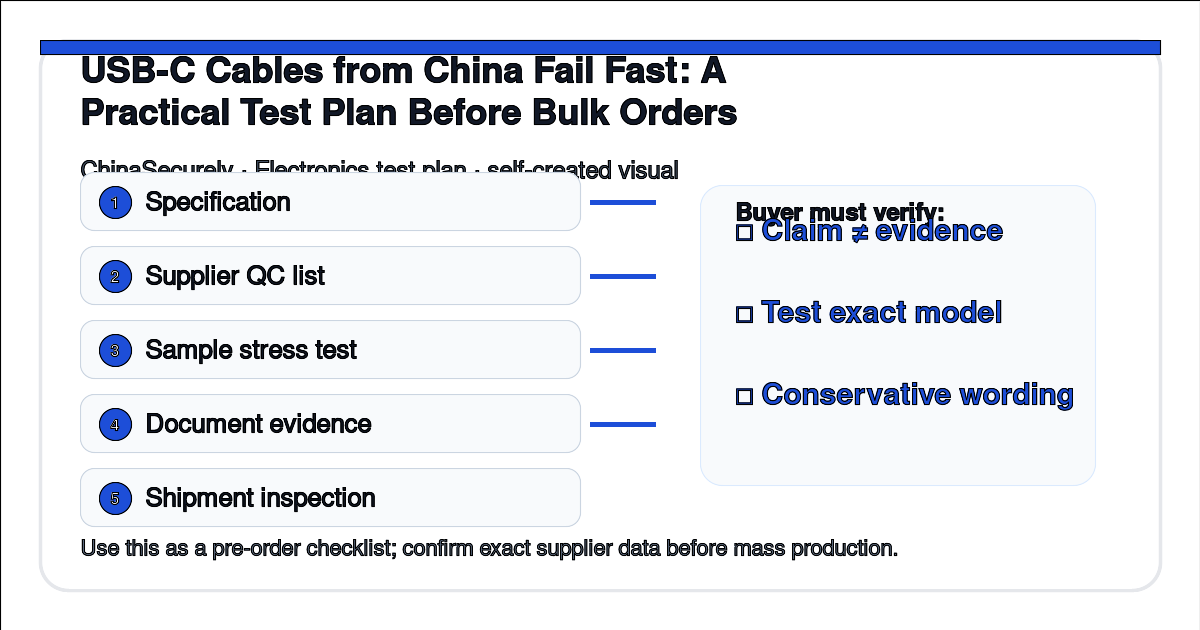
Buyer question: “The sample USB-C cable charged my phone, but customer returns started after a few weeks. How can I test cables before ordering 5,000 pieces from China?”
The practical goal is simple: separate supplier claims from documents, sample behavior, and repeatable tests.
Why this problem happens
USB-C cables can look almost identical from the outside while using different wire gauges, connectors, shielding, strain relief, chips, and assembly quality. A low-cost sample may pass a quick charge test but still fail after bending, repeated plugging, or use with higher-power devices.
There is another issue: buyers often use vague purchase descriptions such as “USB-C fast charging cable.” That phrase can mean different things to different suppliers. If the quote does not state current rating, data function, connector shell, e-marker requirements where applicable, cable length, wire gauge, test method, and packaging, the factory has room to choose a cheaper build.
China-side explanation
Many electronics suppliers in China source cable components from several upstream vendors. The final assembler may not make the connector, wire, chip, or packaging in-house. If the buyer only approves appearance, the supplier may focus on matching color, length, and logo while treating internal construction as flexible.
A cautious supplier can provide internal QC records, but those records are not the same as independent certification. USB-IF publishes compliance and document resources, but whether your exact cable design needs a specific approval or logo program depends on how it is marketed and sold. Do not put a compliance logo or claim on packaging unless you can support it.
Step-by-step solution
- Define the cable in writing: connector type, length, charging current, data support, outer jacket material, color, logo, and packaging.
- Ask whether the cable is charge-only or charge-and-data. Do not assume.
- Request the supplier’s test items: continuity, current, voltage drop, insertion and removal, bend test, appearance, and packaging check.
- Buy a small pre-production sample set from the intended mass-production materials.
- Test more than one sample and use more than one device or charger.
- Bend the cable near both connectors repeatedly during a basic in-house screening test.
- Check whether the supplier can keep the same wire, connector, and chip source for mass production.
- If using USB logos or compliance claims, verify requirements with authoritative USB-IF resources or a qualified test lab.
- Before shipment, request an AQL-style inspection with functional tests on randomly selected units.
What to ask the supplier
Copy and adapt this message:
Please confirm the full USB-C cable specification for our order: cable length, wire gauge or internal construction, charge current rating, data function, connector material, strain relief design, and packaging. Please send your standard QC test list and explain which tests are done on every unit and which are sampled. If you claim USB-IF compliance or allow a USB logo, please provide the exact supporting documents for this model, not only for a similar cable.
The last sentence matters. A certificate for another model is not proof for your cable.
Practical test matrix
| Risk | Simple buyer check | Evidence to request |
|---|---|---|
| Charges slowly | Test with the intended charger and device | Current or voltage-drop test record |
| Breaks near connector | Bend near both ends repeatedly | Strain relief design and bend test method |
| Data does not work | Transfer data, not only charge | Clear charge-only vs data specification |
| Wrong compliance claim | Check exact model documents | USB-IF or qualified lab evidence where applicable |
| Bulk differs from sample | Inspect random units before shipment | Component source confirmation and QC report |
Cost and trade-off notes
A cheaper cable may be fine for a low-risk giveaway if the packaging does not overclaim performance. It is not fine if you sell it as fast charging, data-capable, or compliant without evidence.
For small importers, the safest compromise is to reduce marketing claims until testing catches up. Selling a plain cable with conservative wording is usually less risky than promising high performance based only on a supplier message.
Sources and source status
- USB-IF Compliance Program: https://www.usb.org/compliance
- USB-IF Documents Library: https://www.usb.org/documents
Related questions
Can I rely on the supplier’s certificate?
Only after checking that it applies to the exact model, construction, and claim. A document for a similar product is not enough.
Is a phone charging test useful?
Yes, but only as a first screen. It does not prove durability, data function, current rating, or compliance.
Should I hire a third-party lab?
For higher-risk claims, marketplace requirements, or large orders, a qualified lab is safer than relying on internal supplier testing.
Light CTA
Before you reorder a cable that “worked in the sample,” ask what changed inside the cable and what evidence proves it. The outside appearance is the easiest part to copy.