
Short answer: if your label looked fine in the supplier’s sample video but starts lifting after sea freight or warehouse storage, the problem is usually not one single bad label. It is more often a mismatch between the bottle surface, adhesive, lamination, curing time, and carton environment.
A common buyer question is: “My Chinese supplier says the sticker passed their test, but after the bottles arrived, the label corners are peeling. Is this a printing problem or a packaging problem?”
For a small importer, the safest answer is to treat it as a specification problem first. Ask the supplier to prove the label material, adhesive type, bottle surface treatment, application method, and storage condition before you approve the next production run.
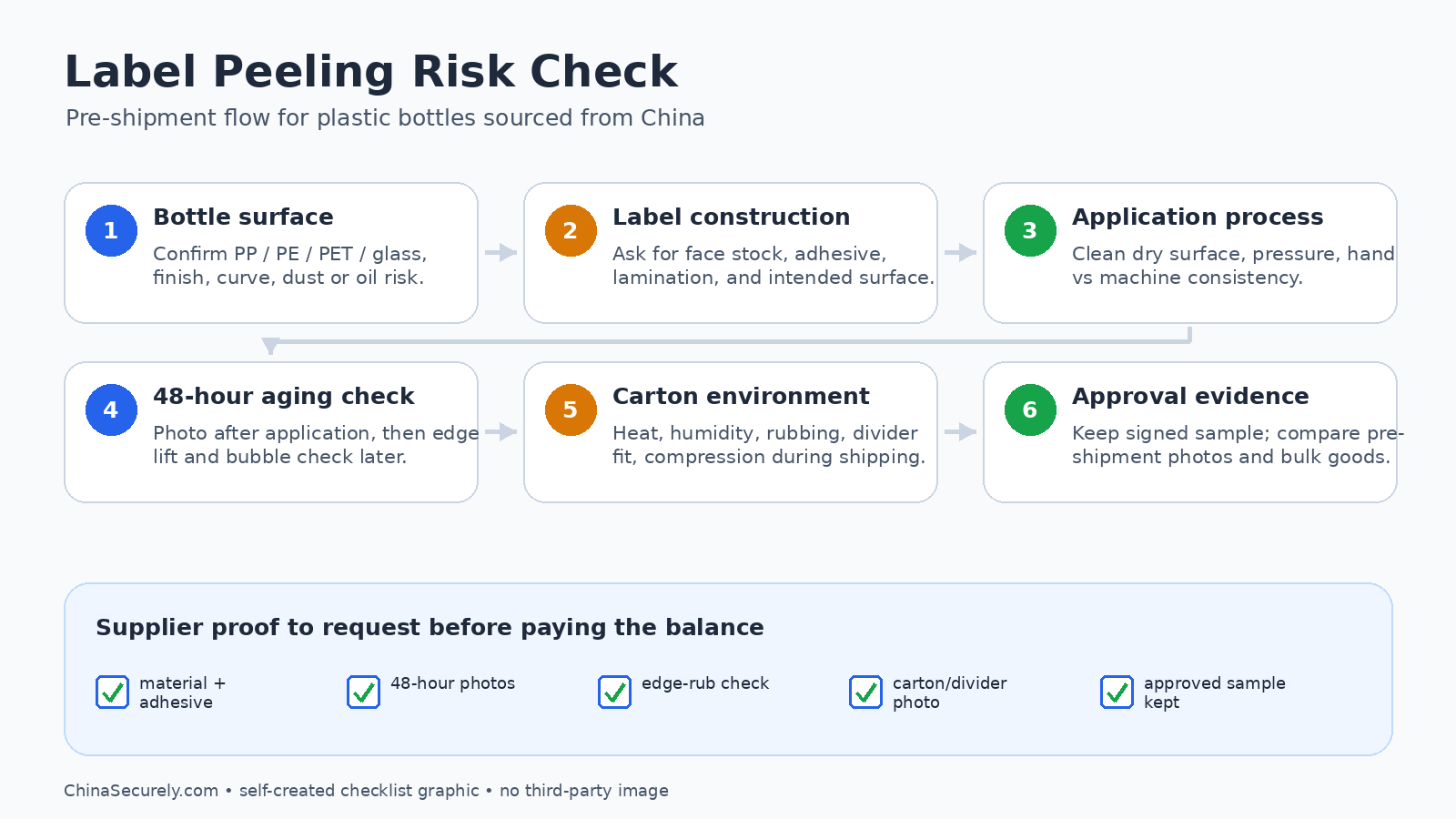
Why this happens
Labels peel when the adhesive cannot keep enough contact with the bottle surface. That sounds simple, but in a China sourcing order it can happen for several practical reasons.
The bottle may be made from PP, PE, PET, glass, aluminum, or coated paper. Some plastics have lower surface energy, so ordinary paper label adhesive may not bond well unless the surface is treated or the adhesive is selected for that material.
The label may also be applied too soon after bottle molding, cleaning, filling, or printing. If the surface still has dust, silicone release agent, oil, moisture, or static, a label can look flat during packing and still fail later.
Shipping makes the weakness more visible. A carton may sit in heat, humidity, compression, or repeated vibration. A small corner lift becomes a visible peeled edge after the cartons move through warehouse handling.
China-side explanation
On the China side, label and bottle production are often split between several parties: the bottle factory, label printer, filling or assembly workshop, and export carton supplier. Each party may test only its own part.
A label printer may say, “Our adhesive is standard and good.” The bottle factory may say, “The bottle surface is normal.” The packing workshop may say, “It was fine when we packed it.” None of those statements proves that the final label-on-bottle combination can survive your shipping and storage environment.
For small custom orders, suppliers may use whatever label stock is already available because it keeps MOQ and setup cost lower. That can be acceptable for simple paper boxes, but it is risky for curved plastic bottles, squeeze tubes, cosmetic containers, bathroom products, or any product that may face moisture.
Step-by-step solution
Start by separating three questions: surface, adhesive, and environment.
- Identify the bottle material and shape. Ask whether the label is going on PET, PP, PE, glass, aluminum, or coated paper. Curved surfaces and textured surfaces need more attention.
- Ask the label printer for the label construction: face stock, adhesive type, lamination or coating, and intended surface.
- Check the application process. Labels should be applied to a clean, dry, stable surface with enough pressure. Hand application can be inconsistent on small runs.
- Request a small aging check before shipment. The supplier can keep labeled samples for several days, then check corners, bubbles, and edge lift.
- Add carton-level protection. Avoid labels rubbing directly against dividers, poly bags, or neighboring bottles if the surface is still easy to scratch.
- For important orders, keep approved labeled samples in your own office and compare them with pre-shipment photos.
Do not only ask, “Will the sticker peel?” That question is too easy to answer with a yes or no. Ask for the details that make the answer useful.
What to ask the supplier
You can copy this message:
“Before we approve bulk production, please confirm the bottle material and the exact label material. Is the adhesive suitable for this bottle surface? Please send photos of the label after application, after 48 hours, and after light rubbing on the edge. Also confirm whether the bottle surface is cleaned before labeling and whether labels are applied by hand or machine. If there is a better adhesive option for humid storage, please quote it separately.”
If the supplier cannot answer clearly, slow down before paying the balance. It may simply mean the sales contact has to ask the label printer or production manager. That is normal. What matters is whether they can bring back a specific answer.
Label peeling risk table
| Risk point | What to check | Safer buyer action |
|---|---|---|
| Plastic surface | PP/PE/PET/glass and surface texture | Match adhesive to the bottle material |
| Label stock | Paper, PP, PET, clear film, coating | Ask for label construction, not only photos |
| Application | Hand applied or machine applied | Request close-up edge photos and 48-hour check |
| Shipping environment | Heat, humidity, rubbing, compression | Add divider, bag, or carton fit check |
| Approval sample | One perfect sample only | Keep a signed sample and compare bulk goods |
Practical checklist before bulk production
□ Confirm bottle material and surface finish.
□ Confirm label face stock and adhesive type.
□ Ask whether the label is intended for moisture, oil, or bathroom storage if relevant.
□ Check that bottles are clean and dry before labeling.
□ Request photos immediately after labeling and after 48 hours.
□ Ask for a simple edge-rub check on at least several samples.
□ Confirm carton packing does not press or scrape label edges.
□ Keep one approved labeled sample outside China for comparison.
Cost and trade-off notes
A stronger adhesive or film label can raise unit cost, and the supplier may also need a higher MOQ from the label printer. For a low-value trial order, you may accept a basic label if the product is dry and the label is not part of the customer-facing finish.
For cosmetics, cleaning products, bathroom items, or branded gift packaging, weak labels can create returns and bad reviews. In those cases, it is usually cheaper to specify the label correctly than to argue after arrival.
Source status
The buyer question is based on repeated importer problems seen in sourcing discussions and small-order packaging complaints, used here as an anonymized demand signal rather than copied text. Technical guidance is cross-checked against public packing and package testing references from FedEx and ISTA, plus general adhesive surface-energy guidance from industrial adhesive suppliers. Exact supplier label data must still be confirmed for each order.
Source URLs:
- https://www.fedex.com/en-us/shipping/packing.html
- https://www.ista.org/test_procedures.php
- https://www.ista.org/
- https://support.google.com/manufacturers/answer/6124116?hl=en
Related questions
- Should I use paper labels or film labels for cosmetic packaging from China?
- How do I approve a printed bottle sample before mass production?
- What packaging photos should I request before a Chinese supplier ships my order?
Light CTA
If a label problem appears only after shipping, do not start by blaming the printer. Rebuild the specification: surface, adhesive, application, storage, and carton protection. That gives your supplier something concrete to fix before the next run.