
Buyer question: “My Chinese packaging supplier sent a box sample that matched our brand color, but the bulk order is a little duller and darker. Is this normal, and how do I prevent it next time?”
Short answer: A small color difference can be normal; a surprise brand mismatch is not something to accept silently. The key is to separate artwork approval, material approval, print proof approval, and mass-production tolerance. If you only approve a photo of one sample under unknown lighting, you have very little protection.
Why this problem happens
- Paperboard shade, coating, lamination, and ink absorption can shift the final color even when artwork is unchanged.
- Digital proofs, hand samples, and offset production runs do not always use the same machine or ink setup.
- Photos taken under factory lighting can hide differences that become obvious beside your retail product.
China-side explanation
Many packaging suppliers in China quote quickly and move fast once the deposit is paid. If the purchase order does not define Pantone/CMYK values, material, finish, proof type, and acceptable tolerance, the factory may treat “close enough” as acceptable production.
Where the color shift usually enters the order
For small custom box orders, the problem often starts before printing. A supplier may quote on one paperboard, make a quick sample on another available board, and then run mass production on the material that fits the confirmed price. Even a slight change in board whiteness, coating, or lamination can make the same artwork look warmer, duller, or darker.
The second weak point is proof approval. A photo proof is convenient, but it is not a color standard. Phone cameras, factory lighting, screen brightness, and image compression can all hide a color shift. If the box will sit next to an existing retail product, skincare line, candle label, or Amazon listing image, approve a physical proof or at least define the exact color reference and viewing condition in writing.
The third weak point is the first production run. A pre-production sample can be close, but the operator still needs to match it when the full batch starts. Ask for first-article photos beside the signed sample, but do not rely on photos alone for a high-value brand color. For sensitive jobs, arrange an inspector or your China-side agent to compare the first pieces before the factory finishes the whole order.
Step-by-step solution
- Send artwork files plus written color references, not screenshots.
- Confirm board material, surface coating, lamination, and whether the proof uses the same process as mass production.
- Approve a physical color proof under your own lighting before bulk production when brand color matters.
- Write an acceptable color tolerance or rejection rule into the PI or purchase order.
- Ask the supplier to keep one signed approved sample and compare random mass-production boxes against it.
What to ask the supplier
Before mass production, please confirm whether the sample and bulk order use the same paperboard, coating, lamination, ink system, and printing process. Please keep one signed approved sample at the factory and compare the first production pieces against it. If the first production pieces are visibly different from the signed sample, please stop and send photos plus your proposed correction before continuing.
Acceptance language to add before deposit
A simple purchase order sentence is better than a long argument after delivery: “Bulk cartons must match the signed approved physical sample for board, finish, and overall color appearance. Any visible deviation must be approved by the buyer before mass production continues.” This does not replace professional color measurement, but it gives the supplier a clear stop point.
Be realistic about tiny variation. Paper and ink are not metal parts; there can be a small difference between runs. The issue is whether the box still represents your brand correctly. If the color shift is visible to a normal buyer under normal lighting, treat it as a production control problem, not just a photography problem.
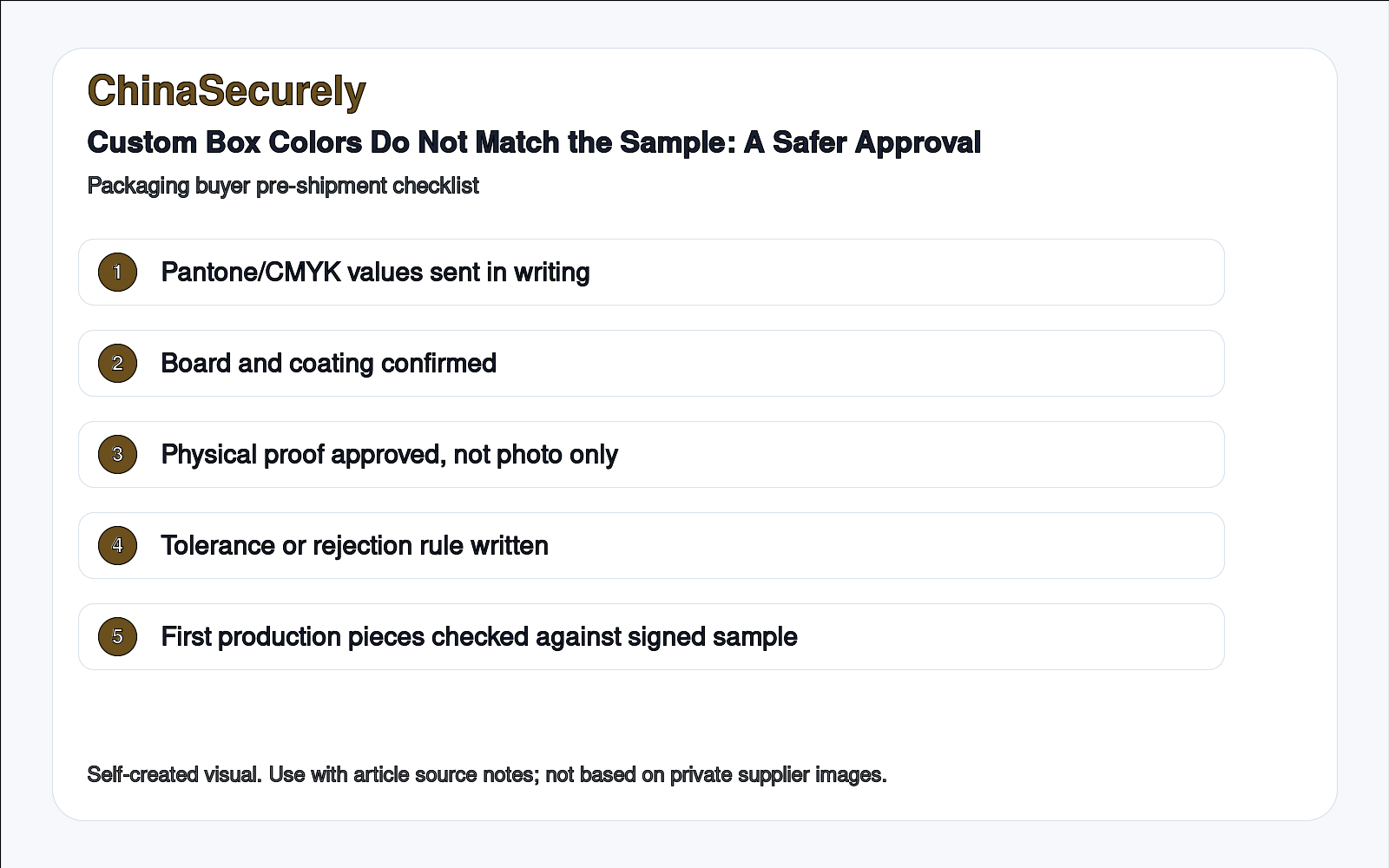
Practical checklist
- Pantone/CMYK values sent in writing
- Board and coating confirmed
- Physical proof approved, not photo only
- Tolerance or rejection rule written
- First production pieces checked against signed sample
| # | Check | Evidence to request |
|---|---|---|
| 1 | Pantone/CMYK values sent in writing | Ask supplier for written evidence or sample photo. |
| 2 | Board and coating confirmed | Ask supplier for written evidence or sample photo. |
| 3 | Physical proof approved, not photo only | Ask supplier for written evidence or sample photo. |
| 4 | Tolerance or rejection rule written | Ask supplier for written evidence or sample photo. |
Source notes
Buyer-demand status: public Reddit access was blocked by HTTP 403 during this run, so the buyer question is treated as a common demand scenario rather than a quoted source. The operational advice below is supported by public packaging and color-management references where relevant.
- Pantone: Understanding different color spaces
- https://www.fedex.com/content/dam/fedex/us-united-states/services/GrlPkgGuidelines_fxcom.pdf
Related questions
- Can the supplier show the same check on finished bulk goods?
- Is the sample made with the same material and process as mass production?
- What should be written into the purchase order before deposit?
If you are comparing Chinese suppliers for this product, slow down before paying the deposit and ask for the small pieces of evidence above. It is cheaper to reject a weak sample than to argue after a container arrives.