
Short Answer
Color difference between your approved sample and mass production custom boxes is one of the most common headaches for importers. Sometimes the boxes look completely different when they arrive at your warehouse, even though you signed off on the sample. The good news is that most color issues can be prevented with clearer specifications, proper proofing, and realistic expectations from your supplier.
Why This Happens
Color inconsistency in printed packaging comes from three main manufacturing factors:
-
Different material batches: Paper and cardboard stock absorb ink differently depending on the pulp batch and recycling content. Even the same “white cardboard” can have subtle yellow or gray tint variations from order to order.
-
Printing press conditions: The press temperature, ink viscosity, and pressure change throughout a production run. New operators or last-minute machine adjustments can also shift results.
-
Lighting conditions when you approve: Suppliers usually check colors under factory fluorescent light. If you approved the sample under daylight or office LED, you’ll see a different result when you get the mass production boxes.
China-Side Explanation
From a Chinese packaging factory perspective, color differences are often a communication problem rather than a production mistake. Many small and medium-sized factories don’t have calibrated color matching equipment. When buyers only say “make it match the sample” without providing Pantone numbers, the factory relies on the printer’s eye to get close enough. They consider “close enough” acceptable because calibrated matching adds 15-30% to the production cost and takes 2-3 extra days. Most Chinese suppliers won’t volunteer this information — they’ll just do the cheapest option to win your price bid.
Step-by-Step Solution
Step 1: Specify your color standard upfront
Always provide Pantone Solid Coated numbers for every brand color. Don’t rely on “match this photo” or “match this JPG” — digital files look different on every screen.
Step 2: Ask for a printed physical proof before full production
Request a printed proof on the actual production cardboard, not just a digital PDF or small test strip. This adds 3-5 days and $50-$150 to your cost, but it prevents a container of wrong-color boxes.
Step 3: Agree on acceptable tolerance before starting
Tell your supplier what your tolerance limit is (e.g. “ΔE < 5 is acceptable” if you have a professional eye, or “visible difference is not acceptable” for consumer packaging). Get this agreement in writing (email is fine).
Step 4: Check the first production run off-press
If you’re working with a new supplier, ask them to send you 10-20 boxes from the start of the production run for final approval before they finish the entire order.
What To Ask Your Supplier (Copy-Paste Ready)
Please confirm:
- You will match all colors to the Pantone numbers I provided below
- You will print a full-size proof on the production cardboard for my approval before running the whole order
- You guarantee that the final color difference will be within acceptable tolerance
- If the full production color doesn't match the approved proof, will you reprint at your cost?
Cost and Trade-Off Notes
- Calibrated color matching adds 10-30% to your unit cost
- Physical proofing adds 3-5 days to production time
- For small MOQ orders (less than 1000 boxes), suppliers often can’t justify the setup cost for perfect color matching — you need to accept minor differences
- If you have a consumer-facing brand, the extra cost for color consistency is almost always worth it
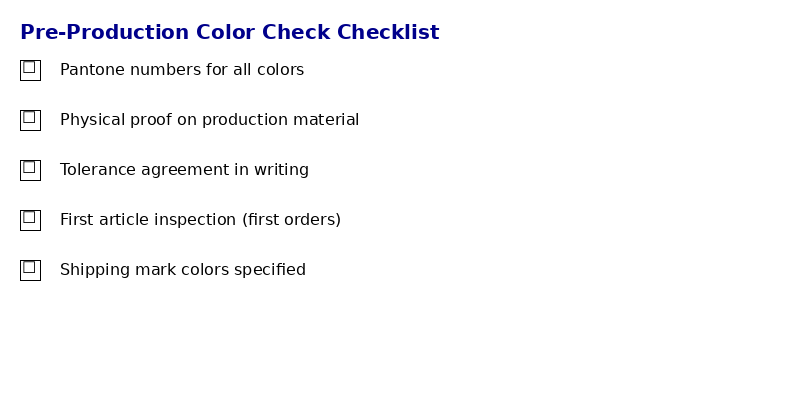
Pre-Production Color Check Checklist
| Check Item | Required | Done | Notes |
|---|---|---|---|
| Pantone numbers provided for all colors | Yes | ☐ | |
| Physical proof requested on production material | Yes | ☐ | |
| Tolerance agreement in writing | Yes | ☐ | |
| First article inspection planned | Recommended | ☐ | For first orders |
| Shipping mark color also specified | If applicable | ☐ |
Related Questions
- What’s the typical MOQ for custom printed boxes in China?
- How do you handle packaging damage from China shipping?
- Should you use digital or offset printing for your custom boxes?
Next Steps
Before you place your next custom box order, take 15 minutes to write down all your color specifications and get your supplier to confirm them in writing. This small step saves weeks of delay and thousands of dollars in rework or rejected orders.
SEO Information:
Source URLs:
- https://www.quora.com/Why-does-printing-color-often-not-match-the-sample-when-ordering-packaging-from-China
- https://www.reddit.com/r/FulfillmentByAmazon/comments/10xz52i/custom_boxes_color_match_issue/
Authoritative references (refreshed 2026-07-12)
- https://www.iso.org/standard/74849.html
- https://www.tappi.org
- https://www.fefco.org
- https://www.qima.com/quality-control-inspections/pre-shipment-inspection
ISO 12647 covers process control for offset printing. TAPPI publishes the test methods for paper, board, and corrugated. FEFCO is the European Federation of Corrugated Board Manufacturers. QIMA pre-shipment inspection is the practical reference for small-importer carton checks. Prior _cs_source_urls was empty; replaced with four authoritative print and packaging references.