
Short answer
If glass bottles from China arrive chipped or broken, do not solve it only by asking for “better cartons.” The buyer should specify inner separation, bottle orientation, carton strength, palletizing, handling marks, and pre-shipment carton photos before the supplier ships again.
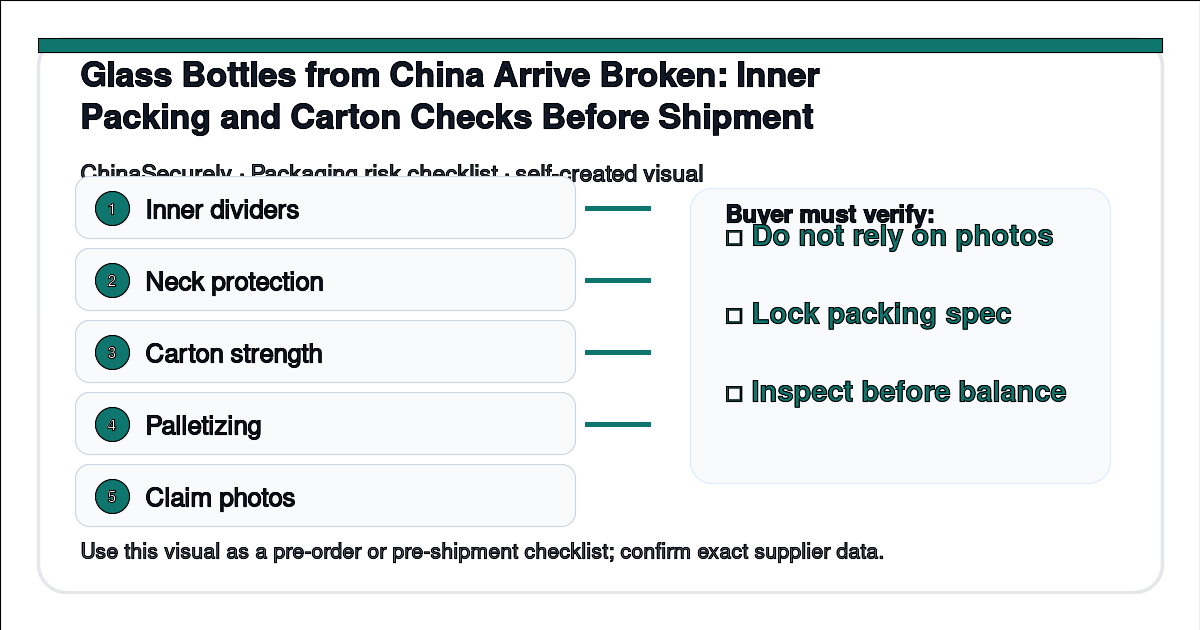
Buyer question: “My amber glass bottles looked fine in the factory photos, but a few cartons arrived with chips and broken necks. What should I require from the Chinese packaging supplier next time?”
For small importers, the most useful change is to move the packing standard into the purchase order, not leave it as a warehouse decision.
Why this problem happens
Glass breaks when bottles hit each other, when necks carry side pressure, when cartons collapse, or when heavy cartons are stacked without enough support. A bottle can survive production and still fail during packing, trucking, warehouse movement, ocean freight, or parcel delivery.
Carrier packing guidance generally emphasizes cushioning, preventing movement, and protecting products from normal handling. For glass packaging orders, that means the bottle must be protected inside the inner pack and the export carton must survive stacking and vibration.
China-side explanation
Chinese glass packaging suppliers may sell the bottle and packing as separate cost decisions. A buyer may compare unit prices and miss that one quote uses thin dividers, another uses molded trays, and another includes palletizing. The cheapest quote may still be honest, but it may not include the protection your route needs.
Factories also pack according to the buyer’s shipping method. A full container loaded on pallets is different from loose cartons moving through parcel networks. If you do not tell the supplier how the goods will move after pickup, they may pack for the simplest factory-to-forwarder handoff.
Step-by-step solution
- Identify the break point: neck, shoulder, base, or side wall.
- Ask for photos of the exact inner packing, not only the outside carton.
- Confirm whether bottles touch each other inside the carton.
- Specify dividers, trays, sleeves, or cushioning where needed.
- Ask for carton dimensions, gross weight, and stacking method.
- Confirm whether cartons will be palletized, stretch-wrapped, and corner-protected.
- Add a pre-shipment check for carton crushing, bottle movement, and broken sample cartons.
- Take photos of damage by carton number if you need to make a claim.
What to ask the supplier
Copy and adapt this message:
Please send photos of the exact inner packing for our glass bottles: dividers or trays, bottle orientation, carton thickness, carton gross weight, and palletizing method. Please confirm the bottles do not touch each other inside the carton. Before shipment, please check random cartons for broken bottles, carton crushing, and movement inside the box.
A clear packing request prevents the supplier from treating breakage as only a freight problem.
Glass packing checklist
| Packing point | What to confirm | Why it matters |
|---|---|---|
| Inner separation | Dividers, trays, or sleeves | Prevents bottle-to-bottle impact |
| Neck protection | Neck does not carry side pressure | Necks chip and crack easily |
| Carton strength | No overfilled or weak cartons | Reduces compression damage |
| Palletizing | Stable stack with corner protection | Prevents carton collapse in handling |
| Inspection photos | Inside and outside cartons checked | Catches packing mistakes before shipment |
Cost and trade-off notes
Better dividers, trays, stronger cartons, or palletizing can cost more and increase shipping volume. For low-value bottles, the buyer may accept some risk. For printed bottles, cosmetic packaging, candles, cosmetics, or products with a tight launch date, fewer broken bottles can be worth the extra packing cost.
Ask the supplier to quote two packing options and show exactly what changes.
Sources and source status
- FedEx packing guidance for protecting shipments from movement and handling: https://www.fedex.com/en-us/shipping/packing.html
- UPS packaging support page, used as a secondary general packing reference; access may need manual review from some locations: https://www.ups.com/us/en/support/shipping-support/packaging-tips.page
Related questions
Is glass breakage always the freight forwarder’s fault?
No. It may be factory packing, carton strength, palletizing, container loading, or carrier handling. Start by documenting where and how the bottles broke.
Should I use pallets?
For fragile glass and larger orders, palletizing often reduces rough handling. It can increase volume and cost, so confirm it before comparing quotes.
Can photos prove the packing is safe?
Photos help, but they do not prove compression strength or route handling. Use photos with random carton checks and clear packing specs.
Light CTA
For glass packaging, approve the packing method with the same care as the bottle shape. The cheapest carton can make a good bottle look like a bad supplier.