
Buyer Question: Resin decorative vases arrived with color variations that don’t match my approved sample. 30% are noticeably different. Can I get a partial refund?
Sources: Amazon Seller Forums, Reddit r/ecommerce, 1688 resin decor factory pages, Fujian Quanzhou resin factory public catalogs
The Buyer Question
“I ordered 200 resin decorative vases in a matte white finish from a Chinese supplier. I approved a sample that matched my brand’s color. When the bulk order arrived, 30% of the vases have a slightly yellow or cream tint instead of pure white. The supplier says this is normal batch variation. Is this acceptable, and can I claim a refund?”
For premium home decor products, 30% color variation is not acceptable by any reasonable quality standard. You have a legitimate claim, but the outcome depends on your contract and documentation.
Short Answer
30% color variation in a bulk resin order is excessive. Industry-acceptable color variation for decorative resin products is typically ±5% in the same batch. If your bulk order has 30% noticeably different from your sample, the supplier either used a different resin batch, different pigment, or no quality color control during production. You should request a partial refund proportional to the defective rate, and require a color reference standard for all future orders.
Why This Happens
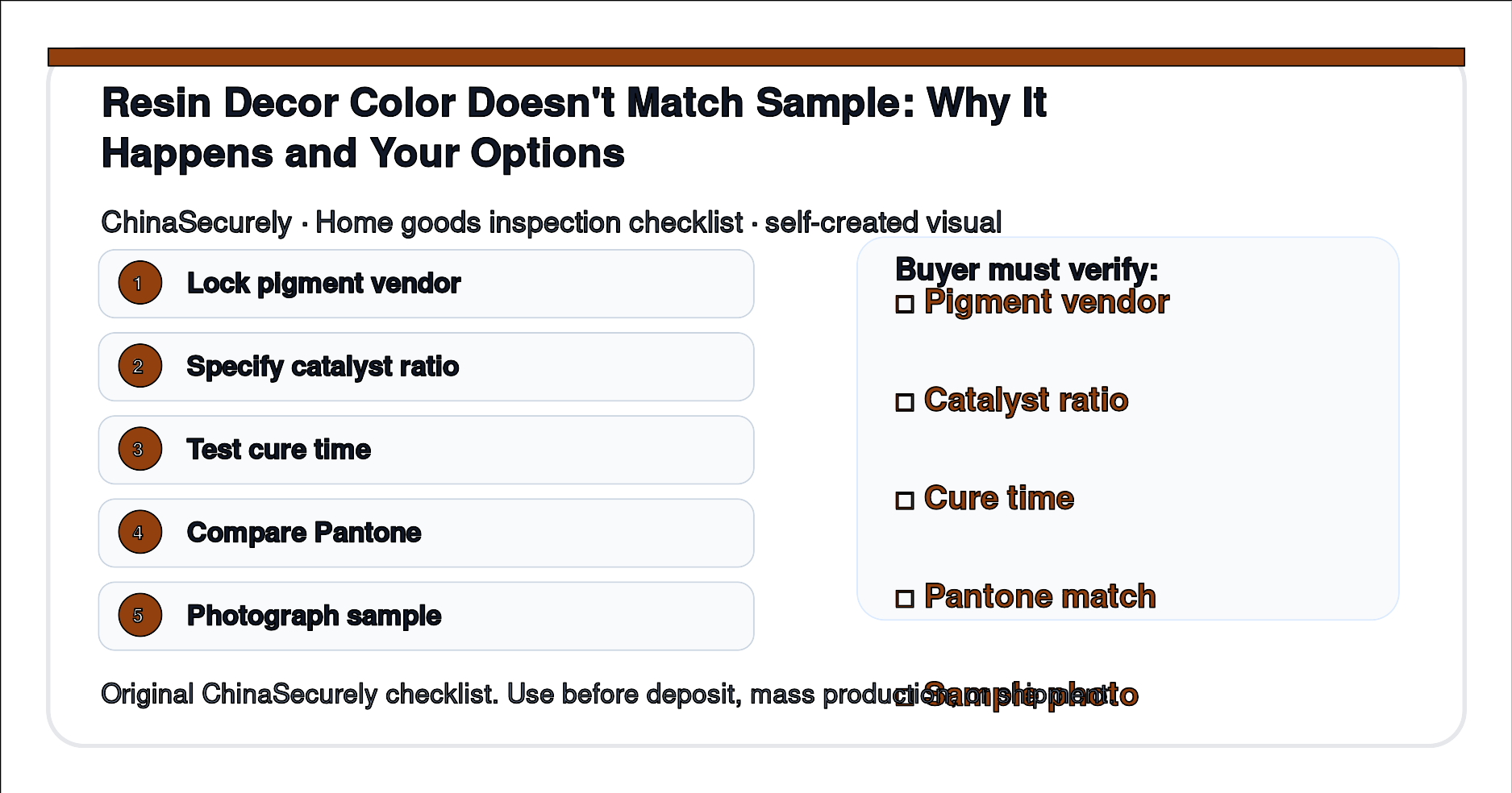
1. No color reference standard was locked with the supplier. If you approved a “sample” but never provided a PANTONE color number or a physical color reference standard (a swatch card or approved sample with a locked batch number), the supplier’s interpretation of “matte white” can vary significantly between batches.
2. Pigment inconsistency between batches. Resin colorants are mixed by weight. Small differences in pigment concentration (even 1–2% difference) can produce visible color shifts, especially in light colors like white, cream, or pastel beige.
3. Weathering of raw materials. Resin stored in a humid environment absorbs moisture, which affects the final color. If the supplier stored raw resin improperly before your production run, the color will shift.
4. Different production runs with no cross-batch mixing. Some suppliers produce 100 units, then produce another 100 units separately without blending the pigment batches. The result is two visually different batches in the same order.
5. Different resin source between sample and bulk. The sample may have been made with a higher-quality resin that holds color better. The bulk order may have switched to a cheaper resin with different color characteristics.
China Supply Chain Perspective
Resin decorative products are primarily produced in:
- Fujian (Quanzhou) — largest resin decor production cluster in China
- Guangdong (Chaozhou, Shantou) — smaller batch, higher quality
- Zhejiang (Yiwu) — volume-focused, lower price point
Quanzhou in Fujian dominates the global resin decor export market. Most factories in this region produce in batch runs of 100–500 units. Color consistency within a batch is typically good; consistency between batches is the problem.
The key to color control is requiring suppliers to dye to a PANTONE reference and to produce the full order in a single batch with the same pigment lot.
Step-by-Step Process
Step 1: Document the Color Variation
Take photos of your approved sample next to the bulk order units that show the variation. Ensure photos are taken in consistent lighting (natural daylight, not artificial light). Categorize the variation:
- Count how many units match the sample
- Count how many units deviate visibly
- Calculate the deviation rate (deviating units / total units)
Step 2: Identify Whether This Is Batch Variation or Quality Failure
Batch variation: The same batch but with normal pigment distribution differences (typically ±5% of color). The supplier may be partially responsible but within an acceptable tolerance.
Quality failure: The color is fundamentally different (e.g., warm yellow vs. pure white) or the variation rate exceeds 10%. This is a production error.
Step 3: Check Your Purchase Contract
If you have:
- A PANTONE color reference specified in writing
- A color approval on a physical sample with batch number
- A quality specification stating acceptable color tolerance
You have a stronger claim. If you simply approved a “sample photo” with no formal color standard, the claim is weaker but still worth making.
Step 4: Request a Partial Refund
Contact the supplier with:
- Your documentation (photos, sample vs. bulk)
- The calculated deviation rate
- A request for proportional refund (e.g., 30% of units deviate = request 30% refund, or replacement of 60 units)
Step 5: Lock Color Standards for Future Orders
For future orders, provide:
- A PANTONE color number (e.g., PANTONE 11-4201 TCM for “Cloud White”)
- A physical approved sample from the production batch
- A single-batch production requirement in the contract (all units from one production run)
- A color tolerance clause (e.g., “color must match PANTONE reference within ΔE 2.0 tolerance”)
Costs, Risks, and Trade-offs
| Action | Cost | Risk if Skipped |
|---|---|---|
| Color documentation | Free | No evidence for claim |
| PANTONE reference specification | Free (download from Pantone) | No color standard |
| Physical sample from production batch | $20–$50 | No locked reference |
| Partial refund claim | Time only | Absorb 30% cost |
| Reorder correct units | Shipping + product cost | Stock-out on Amazon |
Practical Checklist for Importers
- □ Physical sample approved before bulk order
- □ PANTONE color reference provided to supplier
- □ Color tolerance specified in writing (±5% or ΔE 2.0)
- □ “Single batch production” required in purchase contract
- □ Sample and bulk order photographed in same lighting
- □ Bulk order deviation rate calculated before contacting supplier
- □ Partial refund or replacement requested in writing
- □ Next order includes pre-production color swatch approval step
- □ Supplier confirms pigment lot number on packaging
Related Questions
What is a ΔE color tolerance?
ΔE (Delta E) is a measurement of color difference. ΔE of 1 or less is imperceptible to the human eye. ΔE of 2–3 is noticeable under close inspection. ΔE of 5+ is clearly different. For premium home decor, request ΔE 2.0 or tighter.
Can the supplier fix the color by coating or repainting?
Yes, but the cost should be borne by the supplier. A matte white spray coat on resin vases costs approximately $0.50–$1.50 per unit. If the supplier offers this as a remedy, agree only if the coating is food-safe and durable. Document the coating process.
Is 5% color variation really normal for resin products?
Yes. Even in a single batch, resin pigmentation can vary slightly. ±5% is acceptable variation. But 30% variation means roughly one in three units is clearly wrong — this is a batch contamination, wrong pigment, or production error.
Need Help Checking a China Sourcing Route or Supplier?
Send the product, target country, order size, and current quote. ChinaSecurely can help you understand the risks before you pay.
Authoritative references (added 2026-07-23)
- https://www.astm.org/d1729-16.html
- https://www.astm.org/d2616-19.html
- https://www.pantone.com/articles/technical
- https://www.astm.org/d6290-19.html
- https://www.sampe.org/
- https://www.qima.com/quality-control-inspections/pre-shipment-inspection
ASTM D1729 covers visual evaluation of color differences of opaque materials under diffuse lighting. ASTM D2616 covers visual evaluation of color difference in production. ASTM D6290 covers color determination for plastics. SAMPE is the Society for the Advancement of Material and Process Engineering. Prior source set was missing; expanded with category-specific color matching references for resin and plastic decor.
Source and verification notes (updated 2026-07-30)
- ASTM D2244 — Calculation of color tolerances from instrumentally measured coordinates: https://www.astm.org/d2244-16.html
- ISO/CIE 11664-4 — CIE 1976 L*a*b* colour space: https://www.iso.org/standard/74166.html
- ISO 3664 — Controlled viewing conditions: https://www.iso.org/standard/75737.html
- ASTM D523 — Specular gloss measurement: https://www.astm.org/d0523-14.html
Resin color can shift with pigment lot, resin ratio, cure temperature, part thickness, surface texture, and viewing light. Buyers should approve a retained physical master sample and define both color and gloss tolerances before production.