
Buyer Question: Amazon rejected my listing for acrylic cosmetic organizers because actual dimensions don’t match my listing. I measured wrong. Can I relist and what should I do differently next time?
Sources: Amazon Seller Forums, Reddit r/FulfillmentByAmazon, 1688 acrylic organizer product pages, Yiwu acrylic factory public catalogs
The Buyer Question
“I imported 150 acrylic cosmetic organizer trays from China. I listed them on Amazon based on the supplier’s photos and description. Amazon rejected the listing because the actual dimensions I provided don’t match what I claimed. I measured the wrong dimension. Can I relist, and how do I prevent this with future orders?”
This is a common mistake that is easy to avoid once you understand how Chinese suppliers measure products — which is often differently from how Western buyers expect it.
Short Answer
Yes, you can relist once you correct the dimensions. Amazon requires accurate dimensions, and they will accept corrected listings. The key lesson is to measure the sample yourself in three dimensions using the correct method, and to specify the measurement method in your purchase contract (e.g., “dimensions listed are external measurements at the longest/widest/highest points”). Do not rely on the supplier’s stated dimensions for your Amazon listing.
Why Dimension Mismatches Happen
1. Internal vs. external measurement. Chinese suppliers often list internal dimensions (the usable space inside the organizer) while buyers assume the dimensions are external (the total footprint). This can create a 5–15mm difference per side, which compounds when calculating volume.
2. Product photos show the wrong orientation. Many acrylic organizer photos are taken at an angle that makes it hard to tell which dimension is length, width, or height. The item may be photographed horizontally when it is designed to be used vertically.
3. “Standard sizes” vary by market. What a Chinese supplier calls “medium” may be sized for the Chinese domestic market, which has different vanity and drawer sizes than the US or EU market.
4. Assembly adds dimension changes. Some acrylic organizers are shipped flat and require assembly. The assembled dimension may differ from the listed flat-pack dimension.
5. Tolerances are not stated. Chinese factories operate on manufacturing tolerances of ±2–5mm. The supplier lists the target dimension but does not state the acceptable tolerance range. Your Amazon listing shows the “perfect” dimension.
China Supply Chain Perspective
Most acrylic home organizers on global platforms come from two Chinese production clusters:
- Zhejiang (Yiwu) — largest producer of acrylic cosmetic organizers and home storage, mass-market focus
- Guangdong (Shenzhen, Dongguan) — higher-clarity acrylic, more precise manufacturing
Yiwu products dominate on price. They typically use extruded acrylic (less clear, less expensive) rather than cast acrylic (optically clear, more expensive). The manufacturing tolerance in Yiwu factories is typically ±2–3mm on smaller items.
The dimension naming convention often used by Chinese suppliers: “L x W x H” may be the internal usable space, not the external box. Always clarify.
Step-by-Step Process to Fix and Prevent
Step 1: Measure the Sample Correctly
Use a digital caliper (not a tape measure) and measure your sample in three orientations:
- External dimensions: Measure the full outer footprint (length x width x height) — measure to the farthest points including any lip or rim.
- Internal dimensions: Measure the inner cavity if applicable.
- Measure in multiple places: Measure the top, middle, and bottom. Acrylic can have slight taper from the molding process.
Record all three measurements and use the external maximum measurement for your listing.
Step 2: Photograph the Measurement Process
Take photos of each dimension being measured with the caliper visible and reading clearly. Save these for your Amazon listing documentation and for future supplier communication.
Step 3: Relist with Correct Dimensions
Submit a corrected listing with:
- Correct external dimensions (length x width x height)
- Photos showing your actual measurement
- A clear dimension description (e.g., “external dimensions: 9.5in L x 4.2in W x 3.0in H”)
Amazon may require additional documentation if you have been flagged for dimension accuracy before.
Step 4: Specify Dimensions in Your Next Purchase Contract
For future orders, add a dimension clause to your purchase order:
“Product dimensions must be external measurements. Supplier must confirm dimensions on a sample before mass production. Any dimension deviation exceeding ±3mm from approved sample requires buyer approval before shipping.”
Step 5: Request Dimension Verification from Supplier
Ask the supplier to provide a dimension sheet with their product specification. Then cross-check with your own measurements before approving mass production.
Costs, Risks, and Trade-offs
| Action | Cost | Risk if Skipped |
|---|---|---|
| Digital caliper | $15–$30 | Cannot verify dimensions accurately |
| Photo documentation | Free | No evidence of correct measurement |
| Dimension clause in contract | Free | Supplier ships wrong dimensions |
| Pre-ship dimension inspection | $30–$60 | Wrong dimensions shipped |
| Return/replacement shipping | $50–$200 | Absorb cost of dimension errors |
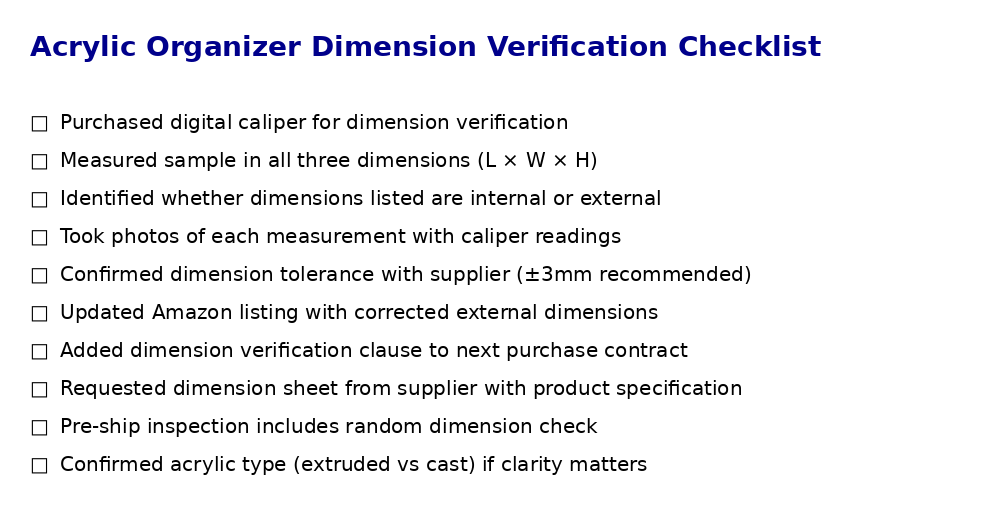
Practical Checklist for Importers
- □ Purchased digital caliper for dimension verification
- □ Measured sample in all three dimensions (L x W x H)
- □ Identified whether dimensions listed are internal or external
- □ Took photos of each measurement
- □ Confirmed dimension tolerance with supplier (±3mm recommended)
- □ Updated Amazon listing with corrected dimensions
- □ Added dimension verification clause to next purchase contract
- □ Requested dimension sheet from supplier with product specification
- □ Pre-ship inspection includes random dimension check
- □ Confirmed acrylic type (extruded vs. cast) if optical clarity matters
Related Questions
How do I measure acrylic compartments accurately?
Use a flexible measuring tape or digital caliper. For compartment interior dimensions, measure at the opening (top) and at the base. If these differ (common in tapered molds), record both and use the smaller measurement for your listing to avoid customer complaints.
The supplier says “standard size.” What does that mean?
“Standard size” in Chinese manufacturing usually means “our regular production size” — it is not a guarantee of a specific measurement. Always ask for exact dimensions in centimeters or inches.
Can I ask Amazon to reinstate my listing after correction?
Yes. Once dimensions are corrected, you can resubmit the listing. Amazon’s algorithm may temporarily limit your listing’s visibility if there was a prior rejection, but correcting the data and providing accurate photos typically resolves this.
Need Help Checking a China Sourcing Route or Supplier?
Send the product, target country, order size, and current quote. ChinaSecurely can help you understand the risks before you pay.